Executive Overview
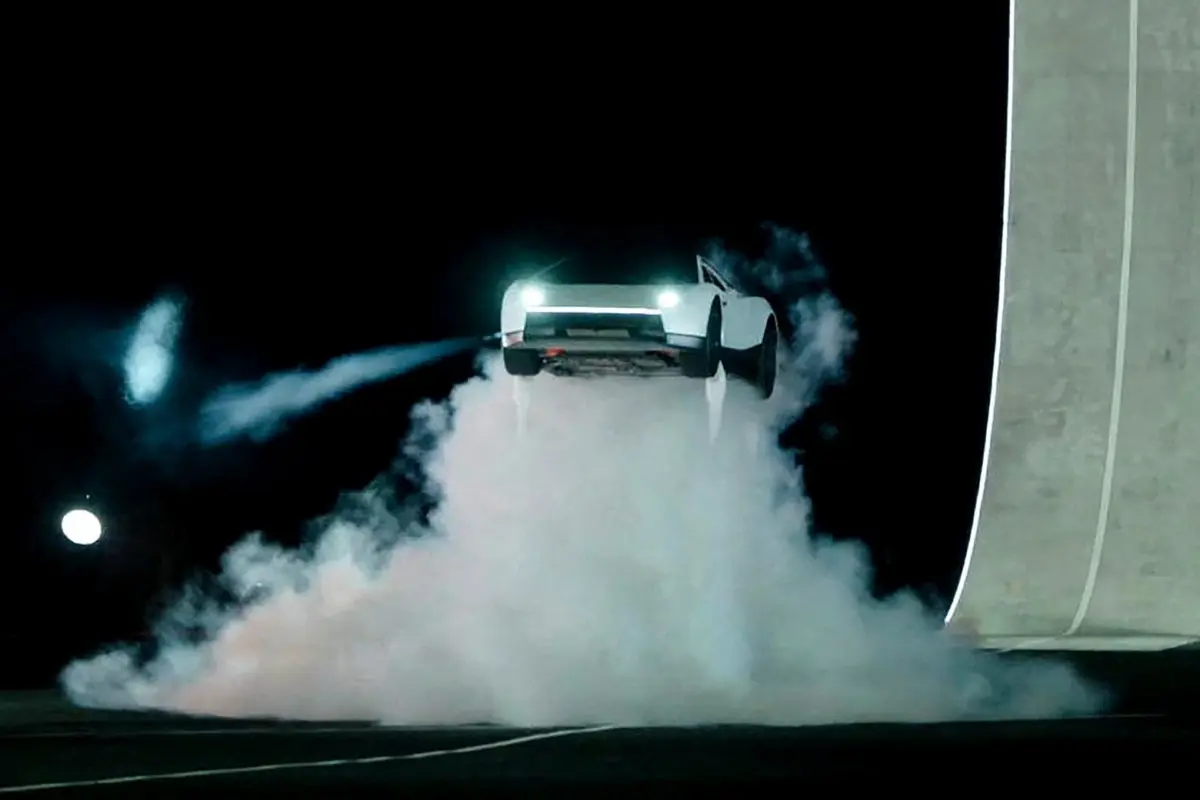
When Elon Musk took the stage in Texas under the glow of stadium lights, he offered a classic piece of tech-industry showmanship: "What you see with your eyes, you will not believe!" Behind him sat the long-delayed, much-anticipated new Tesla Roadster—a vehicle styled like a hybrid of a 1970s Lotus Esprit and an SR-71 Blackbird spy plane. Musk promised an electric drivetrain capable of launching from 0 to 60 mph in a blistering 0.8 seconds. But the true hook, and the centerpiece of the evening, was the addition of SpaceX-designed gas thrusters intended to give the car brief, gravity-defying bursts of flight.
Yet, automotive and financial analysts are looking past the pyrotechnics. While the spectacle dominated headlines, the vehicle itself—capable of only brief, controlled hops rather than actual sustained flight—served a far more strategic purpose.
The Texas showcase was not merely the delayed unveiling of a halo car; it was a carefully choreographed signal marking the sunset of Tesla as a traditional automotive company. Beneath the veneer of a product launch, Musk is clearing the runway for what could be the mother of all corporate mergers: the absorption of Tesla into SpaceX. Facing shrinking profit margins, fierce international competition, and a shifting regulatory landscape, Musk appears ready to fold the world’s most famous electric vehicle manufacturer into his private aerospace juggernaut. The ultimate goal? To construct a $3.5 trillion galactic enterprise funded by public markets, fueled by artificial intelligence, and dedicated to autonomy, robotics, and interplanetary expansion.
Detailed Chronology: From Electric Pioners to Autonomous Ambitions
To understand where Tesla is heading, one must trace the trajectory of its product pipeline and manufacturing philosophy over the past decade.
The Roadster’s Tortured Timeline
The original Roadster concept was announced back in 2017, prompting true believers and early adopters to plunk down $50,000 reservation fees—and up to $250,000 for the exclusive "Founder Series" model. Year after year, production dates slipped as Tesla prioritized the mass-market Model 3 and Model Y, alongside the development of the polarizing Cybertruck.
At the recent Texas event, Tesla resurrected the Roadster nameplate with an updated pricing structure: $50,000 for the "Performance" trim, $250,000 for the "Thrust" version, and an invite-only, undisclosed sum for the "Rocket" trim—the variant equipped with SpaceX cold-gas thrusters. However, with deliveries tentatively pencilled in for 2028, skepticism remains the default posture for industry observers operating under the guiding principle of caveat emptor.
The Final Manual Drive
More revealing than the car’s speculative specs was Musk’s declaration that the new Roadster will be the last manually drivable vehicle Tesla ever designs and builds.
This statement crystallizes a massive corporate pivot. Tesla’s future no longer relies on steering wheels and driver engagement. Instead, the company’s roadmap is dominated by two primary pillars:
- The Cybercab: A purpose-built, autonomous robotaxi featuring neither steering wheels nor pedals, designed to operate in dense urban fleets for on-demand transport.
- Optimus Humanoid Robots: General-purpose bipedal androids slated to perform repetitive or hazardous labor, from factory assembly lines to domestic lawn care and elder support.
Musk has boldly claimed that Optimus alone will eventually push Tesla’s market capitalization from its current $1.4 trillion plateau to an astronomical $25 trillion, selling at a targeted price point of $30,000 per unit.
Supporting Context & Metrics: The Pressures on Tesla’s Balance Sheet
Why would Tesla abandon or drastically pivot away from a core automotive business that took decades to build? The answer lies in hard financial metrics and a rapidly deteriorating macroeconomic environment for traditional electric vehicle (EV) manufacturers.
Production and Revenue Realities
For the record, Tesla remains a heavy hitter in absolute volume. In 2025, the company delivered over 1.6 million manually drivable vehicles, generating approximately $95 billion in revenue—the vast majority stemming from its automotive segment, alongside growing solar and energy storage initiatives.
However, beneath those top-line figures, profitability is under severe strain:
- Stagnant Lineup: Tesla has not introduced a conventional, non-flying passenger vehicle since the Cybertruck launched in 2019. Furthermore, the company has quietly sunset production of its higher-priced luxury mainstays—the Model S sedan and Model X SUV—leaving the Model 3 and Model Y to shoulder the entire burden of automotive sales.
- Margin Compression: The global EV market has matured rapidly, bringing intense margin pressure. Aggressive competition from Chinese automakers—particularly in European markets, where sales have also faced headwinds due to political polarization—has chipped away at Tesla’s once-untouchable market share.
- Regulatory and Tax Headwinds: For years, Tesla padded its bottom line by selling regulatory zero-emission credits to legacy automakers. As traditional manufacturers ramp up their own compliant fleets, those billions in high-margin credits have largely dried up. Simultaneously, the reduction or elimination of federal consumer tax credits in the United States has cooled overall domestic EV adoption rates.
The A.I. and Capital Expenditure Burden
Compounding these pressures, Tesla is spending heavily on artificial intelligence, supercomputing infrastructure, and neural network training. To keep pace with competitors like OpenAI and Anthropic in building massive data centers, Tesla’s capital expenditures have soared. The automaker increasingly resembles a heavily capitalized A.I. and robotics firm rather than the simple EV juggernaut of the late 2010s.
Official Statements and Industry Analysis
The theatrical integration of SpaceX technology into a Tesla product showcase was not a random coincidence; it was a deliberate preview of corporate restructuring.
Financial analysts have increasingly warmed to the inevitability of a combined entity. Barclays analyst Dan Levy recently noted that a merger between Tesla and SpaceX is "almost a done deal" in the minds of market strategists, with speculation mounting that a transaction could materialize.
Under a likely merger structure, SpaceX—backed by its unique private-market valuation and capital-raising prowess—would absorb Tesla, allowing public investors to swap shares for equity in the combined aerospace, automotive, and robotics titan. The resulting mega-corporation would command a combined valuation estimated near $3.5 trillion.
"Why else make SpaceX technology the star of what was meant to be a long-awaited Tesla showcase?" industry observers ask.
By tying Tesla’s fate to SpaceX, Musk gains access to a private fundraising engine capable of weathering the immense capital expenditures required to retool factories for Cybercabs and mass-produce Optimus robots. More audaciously, it aligns with Musk’s grander, science-fiction-adjacent visions: deploying orbital data centers powered by unfiltered solar energy and accelerating the colonization of the Moon and Mars.
Future Outlook: The Rise of the Galactic Mega-Entity
Looking forward, the era of Tesla as a standalone car company has effectively drawn to a close.
Musk’s strategy reveals a cold calculation: selling millions of moderately priced consumer EVs on thin margins is a grueling, low-return business compared to the high-margin promise of autonomous software networks, humanoid labor, and space infrastructure. The traditional vehicles were merely a transitional bootstrap—a means to develop global manufacturing expertise, supply chains, and brand equity before pivoting to a platform economy.
For customers and investors who bankrolled the company’s early decades, the journey has been nothing if not historic. The recent Roadster spectacle functioned as a nostalgic, guilty-pleasure throwback to Musk’s classic carnival-barker mode—reminiscent of the early days when SpaceX first mastered landing and catching orbital booster rockets.
Yet, as Tesla dissolves into the broader ambitions of SpaceX and its founder’s galactic roadmap, the standalone automaker of the past twenty years will cease to exist. In its place rises a vertically integrated mega-entity whose ambitions stretch far beyond terrestrial highways—one that makes corporate giants of dystopian fiction look modest by comparison.