Executive Overview
The seismic waves of the #MeToo movement have fundamentally transformed conversations surrounding workplace safety, accountability, and power dynamics. While much of the initial public reckoning targeted white-collar industries—toppling powerful executives, prominent politicians, and elite media personalities—a darker reality has persisted in blue-collar and corporate operational spaces. Frontline workers, particularly women of color employed in telecommunications hubs and call centers, have long navigated an environment where reporting misconduct routinely invites severe professional and personal retaliation.
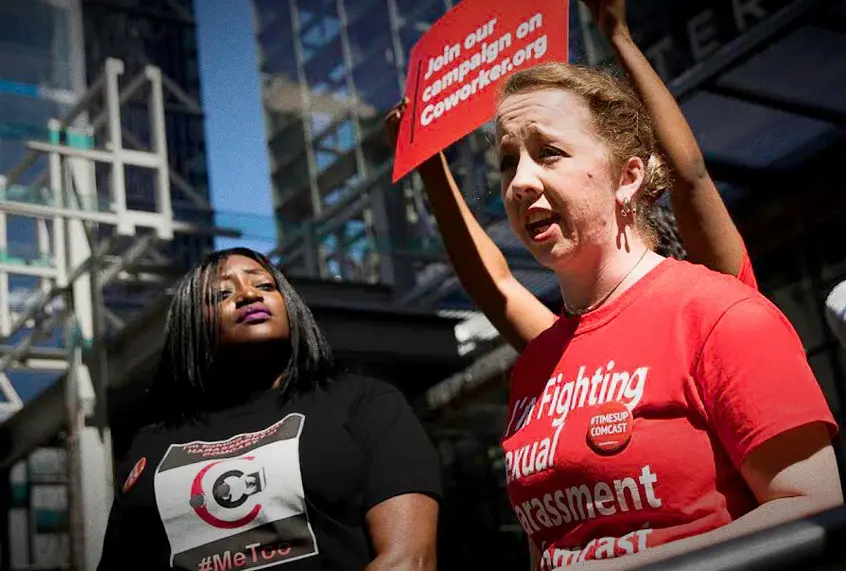
In May 2018, this systemic failure took center stage as former Comcast employees Laterrica Perry and Rylinda Rhodes spearheaded a high-profile campaign demanding sweeping institutional reform. Delivering a petition signed by more than 4,000 individuals to Comcast’s corporate headquarters in Philadelphia, these women challenged a corporate culture they argue systematically shields harassers while punishing victims.
Despite official corporate declarations championing respect and zero-tolerance policies, the lived experiences of employees like Perry and Rhodes paint a starkly different picture. Their accounts illuminate a harrowing cycle of workplace harassment, protracted human resources investigations, medical trauma, and alleged retaliatory termination. As corporate America continues to grapple with the obligations of safeguarding its workforce, the battle waged by these former Comcast employees serves as a critical case study on the barriers facing frontline workers seeking justice.
Detailed Chronology: From Complaint to Corporate Retaliation
The harrowing experiences of Laterrica Perry and Rylinda Rhodes underscore how reporting sexual misconduct within major corporate structures can derail a victim’s livelihood, health, and career trajectory.
Laterrica Perry’s Ordeal in Memphis
In July 2017, Laterrica Perry, then a 30-year-old sales representative at a Comcast facility in Memphis, Tennessee, made the courageous decision to formally report her supervisor. Armed with concrete evidence—including unsolicited phone calls and text messages detailing inappropriate sexual advances—Perry submitted an anonymous report accompanied by digital documentation to the company’s Human Resources department.
Rather than receiving immediate protection, Perry alleges she was subjected to immediate retaliation from her supervisor upon rejecting his advances. Essential workplace accommodations, including sick leave requests and a vital professional letter of recommendation, were systematically withheld. Although Perry provided unequivocal proof of misconduct, she claims Comcast’s HR department dragged its feet, failing to terminate the supervisor until October 2017. During those intervening months, Perry asserts that the supervisor actively worked to tarnish her professional reputation within the organization.
The psychological toll of the harassment and subsequent retaliation was profound. Perry was clinically diagnosed with Post-Traumatic Stress Disorder (PTSD) and forced onto disability leave through March 2018. The sudden drop in income compelled her to take a severe financial hit, including a hardship withdrawal from her 401(k) retirement savings account. Reflecting on her recovery, Perry noted the vital role of medical intervention: "I’ve been having regular therapy sessions, my psychiatrist helps, and being medically regulated has helped me for the most part."
The situation worsened on April 30, 2018. While awaiting a formal separation package to clarify her employment status, Perry received an abrupt email notification stating that the company had proceeded with her termination. While documents regarding her COBRA health insurance and 401(k) adjustments arrived promptly, the explicit justification for her firing was notably absent. "The only information I got was via e-mail saying that they had proceeded with the actual separation, but I didn’t get the actual package that showed why I was separated," Perry explained. Viewing this lack of transparency as the final chapter in a sustained campaign of retaliation, Perry resolved to take her fight directly to Comcast’s executive leadership.
Rylinda Rhodes and the 2012 Precedent
Perry’s struggle mirrors that of Rylinda Rhodes, a former dispatch representative who worked across four Comcast call centers between 2007 and 2012. Rhodes’s ordeal culminated on August 1, 2012, when she was fired shortly after reporting that a male coworker had entered her office and groped her breasts.
Like Perry, Rhodes experienced severe workplace trauma that necessitated short-term medical leave and ongoing talk therapy. During her leave—while Comcast was ostensibly investigating her grievance—management advised her to apply for alternative roles within the company. Ultimately, Rhodes was terminated under the stated guise of health reasons. Left with few options and facing profound professional isolation, Rhodes filed a formal lawsuit against Comcast and channeled her trauma into grassroots activism, launching a movement that would eventually unite victims across the country.
Supporting Context & Metrics: The Hidden Realities of Blue-Collar Misconduct
The struggles faced by Perry and Rhodes are far from isolated incidents; rather, they highlight a pervasive structural vulnerability across corporate America’s operational sectors.
While public discourse has heavily centered on elite media institutions—such as the intense scrutiny faced by Comcast’s subsidiary, NBCUniversal, following sexual misconduct allegations against former Today show host Matt Lauer and veteran anchor Tom Brokaw—frontline workers remain statistically underserved by systemic protections.
Data compiled by organizations like the Center for American Progress and the Equal Employment Opportunity Commission (EEOC) reveal a troubling baseline. Between 2005 and 2015, approximately 1,200 sexual harassment charges were filed with the EEOC within the information industry alone—a sector encompassing major telecommunications giants like Comcast.
However, experts note that EEOC filing numbers represent only the tip of the iceberg. Frontline workers, call center representatives, and dispatchers—many of whom are women of color—frequently lack the financial safety nets, legal representation, or union backing enjoyed by white-collar professionals. Consequently, reporting harassment in these environments often triggers an immediate power imbalance. Victims face the agonizing choice between enduring a hostile work environment or risking sudden termination, lost wages, and blacklisting within their local job markets.
For Rhodes, the psychological burden of harassment was compounded by institutional gaslighting. Managers frequently dismissed her concerns by labeling her as "too sensitive" or "a prude." Reflecting on the shame that kept her silent for years, Rhodes shared:
"The shame and embarrassment came from feeling powerless that this happened. I listened to what my supervisors and managers said, like, ‘Hey, you’re sensitive,’ and I started believing that I was the problem. That was one of the hardest things to go through. Then I realized, ‘No, you are not too sensitive,’ ‘No, you’re not a prude.’ There are rules set in place to prevent this, and they did not follow the rules."
Official Statements and Corporate Response
Faced with mounting public pressure and a petition bearing thousands of signatures, Comcast’s corporate apparatus responded by reiterating its commitment to a safe and respectful work environment.
In statements provided to media outlets when the allegations first surfaced in early 2018, Jenni Moyer, Senior Director of Corporate Communications at Comcast, maintained a firm stance against workplace misconduct:
"Sexual harassment, or harassment of any kind, is not tolerated at Comcast. The company was founded on a foundation of respect, integrity, and trust. We have strong policies against sexual and other forms of harassment and encourage employees to report any harassing behavior. Any allegation of harassment is taken very seriously."
Despite these assurances, the corporate response to the activists’ direct action painted a chillier picture. On Wednesday, May 2, 2018, Perry, Rhodes, and a delegation of former employees traveled to Philadelphia to deliver their Coworker.org petition—signed by over 4,000 supporters, including current and former Comcast employees and customers—directly to Chief Executive Officer Brian Roberts.
Comcast executives ultimately refused to meet with the delegation. Despite being turned away at the corporate gates, the organizers viewed the demonstration as a milestone. "It’s still a win. It lets them know people are watching and coming forth," Rhodes remarked. "It’s also for the ones that are still suffering. To know they are not alone. We are just getting started. All women should have the freedom to be their authentic self and not a scared version because of sexual harassment."
Future Outlook: Legacy, Empowerment, and the Path Forward
The activism initiated by Laterrica Perry and Rylinda Rhodes marks a critical inflection point in how accountability is demanded from multinational telecommunications corporations. Yet, the outlooks of the two women regarding corporate reform remain markedly divergent.
Rhodes retains a cautious optimism that grassroots pressure can compel executive leadership to re-evaluate internal compliance and HR protocols. Drawing strength from positive memories of her earliest days at the company—where she once felt immense pride in her work environment—she believes institutional culture can be repaired if leadership listens to its workforce.
Conversely, Perry harbors deep skepticism regarding Comcast’s willingness to enact meaningful change from within. "I have doubts that Comcast will be open to meeting with us and be open to resolving the issue that they have with sexual harassment," she stated.
Nevertheless, neither woman regrets stepping forward. By breaking their silence, they have catalyzed a broader conversation about worker rights, corporate transparency, and the urgent need for accessible resources for harassment survivors. Perry views her advocacy as a vital public service: "What I’m doing is giving a voice to the voiceless. I’m also empowering people to step forward and say if something happens to them, whether it be at Comcast or any other corporation… That’s my silver lining." Looking ahead, she plans to dedicate her efforts to guiding other women through the complex landscape of reporting misconduct and accessing post-incident support resources.
Ultimately, the stand taken by these former Comcast employees transcends a single corporate dispute. It serves as an enduring testament to the resilience of frontline workers who refuse to let institutional indifference define their worth. As the broader cultural reckoning continues to evolve, the courage of women like Perry and Rhodes ensures that the demand for safe, respectful, and equitable workplaces will extend far beyond corporate boardrooms and into every corner of the American workforce.