Executive Overview
In the wake of a cultural reckoning that has reshaped accountability across American industry, the spotlight has increasingly shifted from high-profile corporate suites and Hollywood boardrooms to blue-collar and customer-service environments. At telecommunications giant Comcast, a growing movement of former call center workers and support staff are stepping forward to expose what they describe as a deeply entrenched culture of sexual harassment, systemic indifference, and punitive retaliation.
At the center of this movement are women like Laterrica Perry and Rylinda Rhodes. Both women faced harrowing experiences of sexual misconduct by supervisors or colleagues while employed at Comcast, followed by what they allege was a coordinated campaign of corporate retaliation culminating in their terminations.
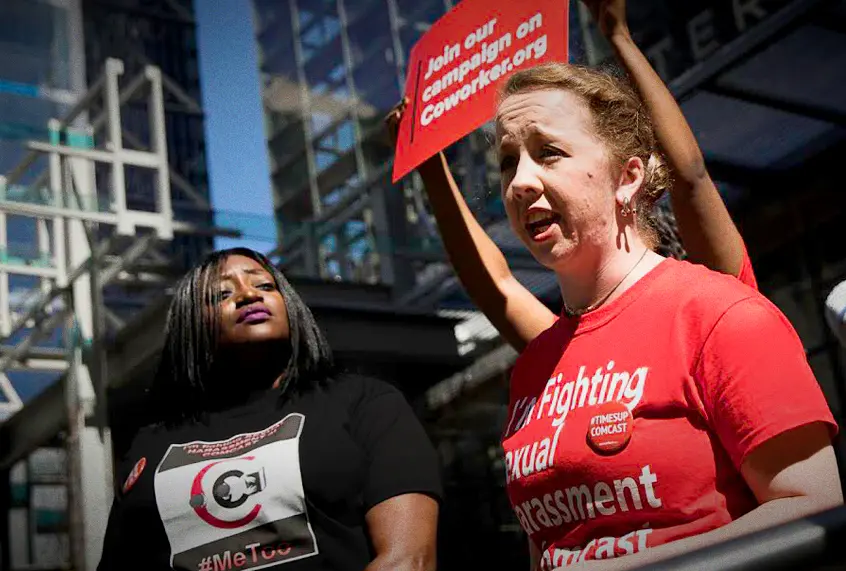
On a Wednesday in May 2018, Perry, Rhodes, and a coalition of advocates traveled to Comcast’s corporate headquarters in Philadelphia to deliver a petition hosted on Coworker.org. Garnering more than 4,000 signatures—including dozens from former and current Comcast employees and customers—the petition demands that CEO Brian Roberts take decisive action to address workplace harassment. Despite executive refusals to meet with the delegation, the demonstration marked a watershed moment for frontline workers who are demanding that the #MeToo movement extend far beyond elite white-collar spaces and protect vulnerable workers in telecommunications and call center settings.
Detailed Chronology: The Ordeals of Laterrica Perry and Rylinda Rhodes
Laterrica Perry’s Fight in Memphis
Laterrica Perry, a 30-year-old former sales representative at a Comcast facility in Memphis, Tennessee, thought reporting misconduct was the correct path to resolving a toxic work environment. In July 2017, she took the courageous step of filing an anonymous report with Comcast’s Human Resources department. She provided concrete evidence—including phone call logs and text messages—detailing sustained inappropriate behavior from her direct supervisor, which included unwanted sexual advances and explicit comments.
Rather than receiving immediate protection, Perry believes her supervisor weaponized his authority against her after she continually rejected his advances. She reports that he actively sabotaged her professional standing, denied her rightful requests for sick time, and withheld a promised letter of recommendation.
Although Perry provided contemporaneous documentation, she alleges that HR dragged its feet, taking nearly three months to officially terminate the supervisor in October 2017. By then, the damage to her professional reputation and psychological well-being was severe. The chronic stress of the harassment and subsequent retaliation left Perry diagnosed with post-traumatic stress disorder (PTSD). She was forced onto disability leave until March 2018, resulting in a devastating loss of income that required her to take hardship withdrawals from her 401(k) retirement savings just to cover basic living expenses.
To compound matters, while awaiting paperwork regarding her employment status, Perry learned on April 30, 2018, that she had been permanently fired.
"The only information I got was via email saying that they had proceeded with the actual separation, but I didn’t get the actual package that showed why I was separated," Perry revealed in an interview. "I received everything, as far as my COBRA coverage, my 401(k) information. The only thing that I had not received is the explanation for my termination. I kind of felt like that was something suspicious."
Rylinda Rhodes’ Decade-Long Battle
Rylinda Rhodes’ association with Comcast spans years of endurance, systemic silencing, and eventual advocacy. Working as a dispatch representative across four different Comcast call centers between 2007 and 2012, Rhodes alleges she experienced sexual harassment in nearly every facility she served.
The harassment turned physical on August 1, 2012, when Rhodes reported that a co-worker entered her office and groped her breasts. When she formally reported the assault, the response from management mirrored the systemic deflection reported by Perry. Instead of swift corrective action, Rhodes was subjected to institutional skepticism. She was told by managers that she was "too sensitive" or a "prude," leading her to internalize the blame—a psychological trap common among survivors of workplace abuse.
"The shame and embarrassment came from feeling powerless that this happened," Rhodes recalled. "I listened to what my supervisors and managers said, like, ‘hey, you’re sensitive,’ and I started believing that I was the problem. That was one of the hardest things to go through. Then I realized, ‘No, you are not too sensitive,’ ‘No, you’re not a prude.’ There are rules set in place to prevent this, and they did not follow the rules."
While Comcast was ostensibly investigating her claims, Rhodes was advised to apply for alternative roles within the company. Ultimately, the stress forced her onto short-term medical leave to undergo talk therapy for trauma. On August 1, 2012—the same day she faced severe administrative pressure—she was fired. Comcast’s official letter of termination cited health reasons, a move Rhodes maintains was a pretext to purge a whistleblower from the company. She has since filed an ongoing lawsuit against Comcast.
Supporting Context & Metrics: The Reality of Blue-Collar Harassment
While the cultural reckoning catalyzed by the #MeToo movement has successfully toppled powerful executives, media personalities, and politicians in elite spheres, the daily realities of blue-collar, service-sector, and hourly wage workers have historically received less structural attention.
Data highlights the scale of this hidden crisis. According to figures from the U.S. Equal Employment Opportunity Commission (EEOC), approximately 1,200 charges of sexual harassment were filed within the information industry—which encompasses telecommunications giants like Comcast—between 2005 and 2015. Many of these workplaces are heavily populated by women of color and hourly workers who lack the job security, union representation, or legal insulation of their high-income counterparts.
For these employees, speaking out carries immediate economic penalties. Call center representatives operate under strict performance metrics, tight oversight, and precarious financial margins. Losing a job due to retaliation does not merely disrupt a career; it jeopardizes housing, healthcare access, and financial survival. When Comcast workers like Perry and Rhodes band together, they are illuminating a systemic blind spot: massive corporations with vast resources failing to maintain safe, equitable environments on their own front lines.
The timing of the employees’ protests also coincided with intense scrutiny facing Comcast’s media subsidiary, NBCUniversal. During this period, the network faced a cascade of high-profile #MeToo scandals, including the firing of Today show host Matt Lauer following multiple allegations of sexual misconduct, alongside subsequent misconduct accusations leveled against veteran news anchor Tom Brokaw. Against this corporate backdrop, the contrast between NBCUniversal’s on-air reckonings and the silencing of frontline call center workers became increasingly stark.
Official Statements and Corporate Response
Comcast has consistently maintained a strict zero-tolerance policy regarding workplace misconduct. Responding to initial reports regarding Perry and Rhodes published by Jezebel, Jenni Moyer, Senior Director of Corporate Communications at Comcast, issued the following corporate statement:
"Sexual harassment, or harassment of any kind, is not tolerated at Comcast. The company was founded on a foundation of respect, integrity, and trust. We have strong policies against sexual and other forms of harassment and encourage employees to report any harassing behavior. Any allegation of harassment is taken very seriously."
However, employees argue that there is a vast chasm between corporate policy on paper and the lived reality on the ground. When Perry and Rhodes traveled to Comcast’s Philadelphia headquarters to deliver their petition, executive leadership declined to meet with them.
Despite being turned away at the door, the activists viewed the action as a significant tactical victory.
"It’s still a win. It lets them know people are watching and coming forth," Rhodes stated. "It’s also for the ones that are still suffering. To know they are not alone. We are just getting started. All women should have the freedom to be their authentic self and not a scared version because of sexual harassment."
Future Outlook: Legacy and Empowerment
As the campaign moves forward, the outlooks of its primary architects reflect a complex mix of pragmatism, solidarity, and cautious hope.
Rylinda Rhodes remains cautiously optimistic that sustained public pressure can compel Comcast to reevaluate and reform its internal HR mechanisms. She points out that not all locations within the sprawling corporate footprint are toxic; during her tenure, she experienced positive work environments that proved healthy corporate cultures are possible when management is held accountable. By sharing her story, Rhodes hopes to dismantle the isolation felt by other victims.
"The most important thing about this is sharing this to give hope to whoever is out there that feels lost, that feels like it was their fault, that feels shame and blame," Rhodes said. "I want them to know it is not their fault and that there are things that they could do to feel better and to be better. This does not have to define the rest of their lives."
Laterrica Perry, on the other hand, harbors deeper skepticism regarding Comcast’s willingness to voluntarily alter its internal protocols, noting her doubts that corporate leadership will engage constructively with the grassroots movement. Nevertheless, she views her decision to speak out as an unmitigated success in terms of personal empowerment and public advocacy.
"What I’m doing is giving a voice to the voiceless. I’m also empowering people to step forward and say if something happens to them, whether it be at Comcast or any other corporation," Perry reflected. "That’s my silver lining."
Looking ahead, Perry plans to dedicate her efforts to building external support structures and resource networks for corporate whistleblowers. By demystifying the reporting process and guiding victims through the labyrinth of post-reporting survival, both Perry and Rhodes are transforming their personal trauma into a blueprint for collective resilience. Their ongoing crusade serves as an enduring reminder that the fight for workplace dignity belongs to every worker, regardless of their position on the corporate ladder.