Executive Overview
The digital landscape of the twenty-first century is littered with the ghosts of once-dominant technological phenomena. Among the most evocative names from the early peer-to-peer (P2P) era is LimeWire—a software client that, in the mid-2000s, served as a primary gateway for millions of internet users downloading music, video, and software. However, the legal firestorms and copyright battles that ultimately forced the original platform into liquidation left a profound cultural imprint.
Today, that infamous moniker has undergone one of the most radical corporate and technological rebirths in internet history. Re-emerging as a cutting-edge artificial intelligence (AI) content publishing platform and creative studio, LimeWire has discarded its file-sharing roots in favor of the decentralized, highly lucrative frontier of generative AI.
No longer a tool for illicit media distribution, the modern iteration of LimeWire operates as a regulated, creator-first ecosystem. It seamlessly bridges the gap between sophisticated generative AI modeling, blockchain-based asset ownership, and Web3 monetization frameworks.
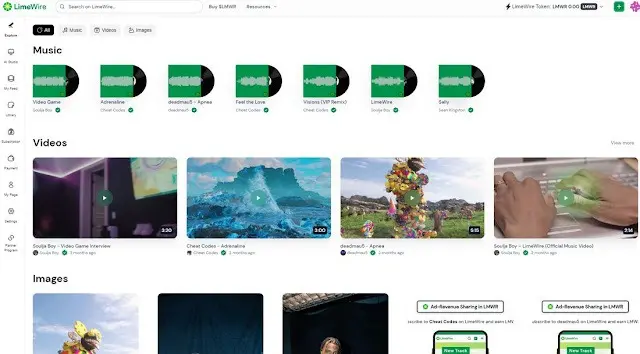
By leveraging advanced latent diffusion models such as Stable Diffusion and DALL-E, LimeWire empowers both casual enthusiasts and heavy-hitting industry icons—ranging from digital designers to globally recognized musicians like Deadmau5, Soulja Boy, and Sean Kingston—to conceptualize, mint, distribute, and monetize digital assets.
This deep-dive investigation explores the architecture of the modern LimeWire platform, analyzing its underlying AI image-generation infrastructure, its automated non-fungible token (NFT) minting mechanics, its native token economy powered by LMWR, and its tiered subscription models. In doing so, it evaluates how a legacy brand has successfully engineered a contemporary business model designed to democratize content creation while securing sustainable revenue streams for artists in the digital age.
Detailed Chronology: From Gnutella to Generative AI
To understand the strategic positioning of today’s LimeWire, one must trace the arc of its lifecycle across three distinct technological eras: the P2P Wild West, the legal fallout, and the contemporary Web3-AI convergence.
[2000–2010: P2P Era]
      │  (Gnutella network, massive popularity, copyright litigation)
      ▼
[2010–2022: Dormancy & Acquisition]
      │  (Court-ordered shutdown, brand acquisition by Austrian entrepreneurs)
      ▼
[2022–Present: The Web3 & AI Pivot]
      │  (Launch of LimeWire AI Studio, integration of LMWR token & NFT minting)
      ▼
[Future Horizon: Multimodal Expansion]
      (Upcoming deployment of AI video and audio generation tools)
1. The P2P Genesis (2000–2010)
Founded in 2000 by Mark Gorton, LimeWire quickly became the flagship application of the Gnutella network. Alongside competitors like Napster, Kazaa, and BitTorrent, it symbolized the democratization of media distribution.
At its peak, LimeWire was installed on tens of millions of computers worldwide. However, its decentralized architecture made it a primary target for the Recording Industry Association of America (RIAA). A protracted and landmark copyright infringement lawsuit—Arista Records LLC v. Lime Wire LLC—culminated in a 2010 federal court injunction ordering the software to disable its core search, downloading, and file-sharing functions. The company effectively ceased operations, entering a decade of digital obscurity.
2. The Brand Acquisition and Strategic Pivot (2022)
The dormant brand was acquired by Austrian software entrepreneurs Julian and Paul Zehetmayr. Recognizing the enduring brand recognition and cultural cachet of the LimeWire name, the new leadership team chose not to revive the old software, but rather to construct an entirely new business model aligned with the emerging creator economy.
Initially conceptualized as an NFT marketplace for digital art and music in early 2022, the platform swiftly recognized the disruptive potential of generative artificial intelligence. By pivoting toward a hybrid AI content creation and publishing suite, LimeWire positioned itself at the intersection of two of the fastest-growing technological sectors of the decade.
3. The Integration of AI Studio and Web3 Infrastructure (2023–Present)
By integrating state-of-the-art open-source and proprietary text-to-image models, LimeWire transformed into an end-to-end studio. Creators were no longer required to possess advanced graphic design skills; instead, simple natural-language prompts could generate intricate, publish-ready visual art.
Concurrently, the platform integrated blockchain technology—utilizing the Polygon and Algorand networks—to automate the conversion of digital outputs into verifiable NFTs. The launch of the native utility token, LMWR, completed the financial loop, creating a self-sustaining economy where creators could earn, trade, and spend within a unified ecosystem.
Supporting Context & Metrics: Inside the LimeWire Ecosystem
The modern LimeWire platform is structured around three core pillars: AI Content Generation, Automated Blockchain Minting, and Monetization via Ad-Share and Tokenomics.
1. Advanced AI Image Generation Framework
At the heart of the LimeWire Studio lies a flexible generative engine that supports industry-leading models, including:
- Stable Diffusion (Versions 2.1 and XL): Renowned for high fidelity, compositional coherence, and open-source flexibility.
- DALL-E 2: Integrated to provide robust semantic understanding and rich imaginative outputs based on text prompts.
Users are afforded granular control over their creative output. Creators can cycle through a vast array of aesthetic styles—ranging from photorealistic cinematic renders and hyper-detailed digital art to nostalgic pixel art, expressive anime, and analog film simulations. Furthermore, advanced parameter controls such as samplers, prompt guidance scales, and negative prompts allow experienced digital artists to fine-tune their compositions down to the pixel level.
2. Automated NFT Minting and Decentralized Ownership
Unlike traditional content platforms where digital uploads remain vulnerable to unauthorized scraping or redistribution, LimeWire embeds verifiable provenance directly into the publishing workflow.
[User Generates AI Image]
         │
         ▼
[User Clicks "Publish"]
         │
         ▼
[Smart Contract Triggers] ──► [Auto-Minting on Polygon or Algorand]
         │
         ▼
[Digital Asset Secured & Listed for Public or Subscriber-Only Access]
When a creator publishes a piece of content, the platform automatically mints the creation as a Non-Fungible Token on either the Polygon or Algorand blockchain. This end-to-end automation removes technical friction for non-crypto-native artists.
Once minted, creators retain complete autonomy over distribution:
- Public Releases: Content is indexed globally across the LimeWire community, allowing any user to view, collect, or trade the underlying NFTs.
- Exclusive Subscriptions: Creators can gate their content behind paywalls, offering exclusive access strictly to paying subscribers, thereby fostering an intimate patron-artist relationship.
3. The Economic Engine: Ad Revenue Sharing and LMWR Tokens
LimeWire’s financial model disrupts traditional social media and content hosting platforms by directly compensating creators for audience engagement.
- Ad Revenue Share: When third-party users view a creator’s published images, music, or videos on the platform, ad revenue is generated. Depending on the creator’s subscription tier, they receive between 50% and 70% of all advertising revenue generated by their content views.
- LMWR Utility Token: Creator earnings are distributed monthly in the form of LMWR, LimeWire’s native ERC-20/SPL utility cryptocurrency. LMWR is actively traded on major digital asset exchanges, including Kraken, Bybit, and Uniswap, providing immediate liquidity to creators worldwide. Additionally, users can utilize LMWR tokens natively within the platform to purchase prompt credits, fund generations, and trade community assets.
Tiered Subscription Models and Pricing Analysis
To accommodate everyone from casual hobbyists to professional digital agencies, LimeWire offers a structured, tiered subscription model. Each tier scales in computational credits, monthly generation caps, ad-revenue distribution shares, and specialized pro-level perks.
| Subscription Tier | Monthly Price | Monthly Credits | Max Image Generations | Ad Revenue Share | Pro Profile Badge | Creation History & Speed |
|---|---|---|---|---|---|---|
| Free Tier | $0 | 10 Credits | Up to 20 / day | 50% | No | Standard |
| Basic Plan | $9.99 | 1,000 | Up to 2,000 | 50% | Yes | Accelerated, Ad-Free |
| Advanced Plan | $29.00 | 3,750 | Up to 7,500 | 60% | Yes | Accelerated, Ad-Free |
| Pro Plan | $49.00 | 5,000 | Up to 10,000 | 70% | Yes | Accelerated, Ad-Free |
| Elite Plan | $99.00 | 11,250 | Up to 22,500 | 70% | Yes | Maximum Speed, Ad-Free |
Analysis of Value Propositions
- The Free Tier: Designed primarily for user acquisition and experimentation, the free tier grants 10 daily credits (roughly 20 image generations) along with a baseline 50% ad revenue share. This lowers the barrier to entry, inviting users to test the platform’s interface without financial commitment.
- Mid-Tier Plans ($9.99 – $29.00): Tailored for emerging creators and micro-influencers, these tiers substantially increase credit limits while unlocking priority processing queues and verified Pro profile badges, which enhance trust within the community.
- High-End Enterprise & Pro Tiers ($49.00 – $99.00): Aimed at professional digital artists, studios, and high-volume content creators, these tiers maximize revenue-sharing potential at 70% and provide the computational headroom necessary for extensive commercial art production.
Official Statements and Industry Reception
The strategic pivot of LimeWire has drawn significant attention from both the technology and entertainment sectors. Industry leaders and executive management have consistently emphasized the platform’s mission to bridge the technological divide between complex AI algorithms and accessible monetization.
In corporate communications regarding the launch of LimeWire Studio, executive leadership noted:
"The modern digital creator is forced to navigate a fragmented ecosystem of creation tools, social distribution platforms, and complex crypto wallets. LimeWire has been engineered to dissolve these boundaries. By combining state-of-the-art generative AI with automated blockchain minting and transparent ad-revenue sharing, we are building a unified home where art becomes an ownable, tradeable asset from the moment of creation."
Furthermore, the onboarding of prominent mainstream artists—such as hip-hop icon Soulja Boy, reggae-pop star Sean Kingston, and electronic music pioneer Deadmau5—has signaled a broader industry endorsement. By leveraging LimeWire to release limited-edition digital collectibles, music videos, and AI-assisted visual art, these artists have validated the platform’s utility as a legitimate commercial distribution channel rather than a mere novelty tool.
Cultural analysts point out that this endorsement strategy is crucial for rehabilitating the LimeWire brand. By positioning the platform as a champion of artist empowerment—specifically through features like the 2.5% secondary-sale royalty paid to creators every time their digital asset is traded—LimeWire actively distances itself from its copyright-infringing past, reframing its identity around digital property rights and fair compensation.
Future Outlook: Multimodal Expansion and Market Trajectory
As artificial intelligence technology continues to evolve at an exponential pace, LimeWire’s roadmap points toward a comprehensive multimodal future. While current operations remain heavily centered on text-to-image generation and digital graphic design, corporate disclosures indicate imminent platform expansions into AI-driven audio, music production, and video generation tools.
1. Audio and Music Generation
Given the platform’s historical association with music distribution, the introduction of AI-powered music composition tools represents a natural and highly anticipated evolution. By integrating generative audio models, LimeWire aims to allow musicians to produce backing tracks, synthetic vocal samples, and complete audio compositions via text prompts, which can then be instantly minted as collectible music NFTs and monetized through the platform’s ad network.
2. Video Synthesis and Cinematic Tools
The planned deployment of AI video generation tools will enable creators to move beyond static 2D images. By generating short-form cinematic clips, animated loops, and dynamic visual narratives, creators will be able to supply rich multimedia packages directly to their subscriber bases.
3. Proprietary AI Model Development
Beyond integrating third-party models like Stable Diffusion and DALL-E, LimeWire is actively investing in the research and development of its own proprietary AI models. Developing in-house models will grant the platform unique styling capabilities, faster processing speeds, and greater structural independence from external API providers, securing a distinct competitive advantage in an increasingly crowded generative AI marketplace.
Conclusion
LimeWire’s transformation from a controversial P2P file-sharing client into a sophisticated, AI-driven creator studio stands as a masterclass in strategic brand reinvention. By fusing generative artificial intelligence, automated blockchain asset ownership, and a robust cryptocurrency revenue-sharing model, LimeWire has successfully positioned itself at the vanguard of the Web3 creator economy.
For digital artists, musicians, and designers, the platform offers an unprecedented trifecta: ease of creation, verifiable ownership, and direct monetization. As LimeWire continues to expand its technological horizons into audio and video synthesis, it solidifies its status not merely as a relic of internet history, but as an indispensable infrastructure provider for the future of digital art.