EXECUTIVE OVERVIEW
Palo Alto Networks has released its fiscal Q1 2027 financial results, painting a vivid and instructive picture of a tech titan aggressively reshaping its destiny through capital allocation, high-stakes mergers and acquisitions (M&A), and relentless platform
consolidation. Total revenue surged 39% year-over-year to reach $3.44 billion, fueled by a staggering 66% jump in Next-Generation Security Annual Recurring Revenue (NGS ARR) to $9.73 billion, alongside a 35% increase in remaining performance obligations (RPO) totaling $21.0 billion.
Yet, beneath the headline-grabbing top-line figures lies a much more nuanced story. The vast majority of this breathtaking growth is inorganic, engineered by a string of high-profile acquisitions—chiefly the $25 billion blockbuster buyout of CyberArk and the simultaneous integration of Chronosphere earlier in the year—alongside a fresh, multi-billion-dollar bet on AI infrastructure.
For industry founders, enterprise CEOs, and public market investors alike, Palo Alto Networks’ Q1 2027 report serves as a definitive case study. It reveals how corporate M&A actually materializes in financial ledgers, exposes the widening chasm between GAAP and non-GAAP profitability driven by stock-based compensation and amortization, and demonstrates how elite cash-flow generation affords an enterprise the luxury of buying its way into emerging technological paradigms.
DETAILED CHRONOLOGY & FINANCIAL BREAKDOWN
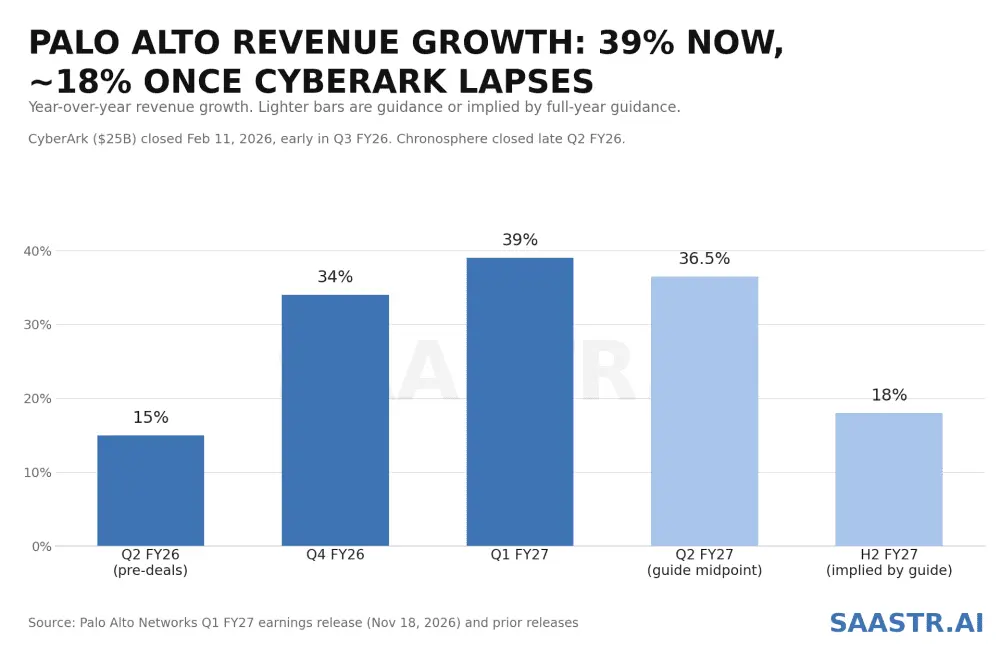
1. Headline Growth vs. Organic Reality: 39% Today, ~18% Once CyberArk Laps
To fully appreciate Palo Alto Networks’ current trajectory, one must decouple inorganic revenue injections from the underlying core business. Palo Alto completed its monumental acquisition of CyberArk on February 11, closing the Chronosphere deal in parallel. A year prior, prior to the consolidation of these assets, Palo Alto posted a formidable Q2 featuring $2.59 billion in revenue (up 15%) and NGS ARR of $6.33 billion (up 33%).
Current forward guidance lays bare the sheer weight of these acquisitions. While Q1 celebrated a 39% year-over-year revenue expansion, Q2 is guided to a moderated 36% to 37%. Looking at the full fiscal year 2027, management’s midpoint guidance sits at $14.545 billion.
By taking the FY27 midpoint, subtracting Q1’s $3.445 billion and Q2’s projected ~$3.54 billion, the implied second-half revenue scales to approximately $7.56 billion. Compared to the second half of FY26—which brought in roughly $6.42 billion—this indicates an organic-plus-inorganic blended growth rate of about 18% once CyberArk’s financials are fully baked into both comparative periods.
[FY26 H2: ~$6.42B] -------- (Post-CyberArk Lap) -------- [FY27 H2 (Implied): ~$7.56B]
                                                                  │
                                                        (~18% YoY Growth Rate)
At a massive scale of $14.5 billion in revenue, an 18% growth clip actually represents a modest re-acceleration compared to the ~15% standalone rate Palo Alto maintained a year prior. The acquisitions did not merely add top-line volume; they successfully re-energized the core engine. For executives navigating their own growth strategies, the lesson is clear: always model the business post-lap, and ensure your board understands the distinction between rented expansion and organic momentum.
2. The Anatomy of a Beat-and-Raise: Underwriting the Future
Palo Alto’s performance relative to its own guidance parameters further underscores management’s bullish sentiment. Last quarter, the company projected Q1 total revenue between $3.300 billion and $3.310 billion, with a full-year revenue target ranging from $14.10 billion to $14.20 billion.
The reality significantly outperformed these expectations. Q1 actuals came in at $3.445 billion—surpassing the top end of the guidance range by roughly $135 million. Rather than following the traditional corporate playbook of passing the exact beat through to the annual figures, management aggressively raised full-year expectations to a range of $14.52 billion to $14.57 billion.
This $395 million raise at the midpoint represents nearly triple the size of the Q1 revenue beat. Simultaneously, NGS ARR guidance was elevated by $375 million, moving from a range of $11.075–$11.175 billion up to $11.475–$11.525 billion.
This threefold raise signifies that leadership is actively underwriting the subsequent three quarters using hard, visible pipeline rather than speculative hope. As the Chief Financial Officer noted during the earnings call:
"Given the current threat environment and demand we see ahead of us, we are materially raising our full-year guidance."
SUPPORTING CONTEXT & METRICS
3. The GAAP vs. Non-GAAP Divide: The Real Cost of a $30 Billion M&A Spree
While top-line growth and cash generation commanded attention, the widening delta between GAAP and non-GAAP earnings illuminated the structural cost of aggressive, debt-and-stock-fueled consolidation.
For Q1 2027, Palo Alto reported:
- GAAP Operating Income: $96 million (compared to $309 million in the prior-year period)
- Non-GAAP Operating Income: $1.059 billion (compared to $746 million previously)
This translates to a razor-thin 2.8% GAAP operating margin against a robust 30.7% non-GAAP margin—a single-quarter gap of approximately $963 million. This massive variance is driven by stock-based compensation, the ongoing amortization of acquired intangibles, and one-off transaction expenses. Every time Palo Alto executes a multi-billion-dollar acquisition, this GAAP drag expands.
On the net income front, GAAP net income registered at $482 million, though this figure was heavily skewed by a historical tax adjustment yielding a $(457)M tax benefit. Stripping away this one-time adjustment reveals an underlying GAAP net income of roughly $25 million on $3.44 billion of revenue.
Crucially, non-GAAP operating income still grew by 42% year-over-year, proving that the core operating business remains fundamentally healthy. However, for private startup founders eyeing a strategic exit via acquisition, this dynamic is critical to understand: strategic buyers view your valuation through the lens of multi-year amortization charges that will permanently sit on their future Profit and Loss statements.
4. Buying the Future: The $4.5 Billion All-Stock Acquisition of Applied Compute
Demonstrating that its appetite for expansion remains unabated, Palo Alto Networks used the earnings announcement to unveil its acquisition of Applied Compute, a pioneer in post-training and inference optimization for open-weight AI models.
Valued at $4.5 billion in an all-stock transaction (inclusive of $500 million in cash and pre-paid compute commitments), the deal raised eyebrows across Silicon Valley because Applied Compute disclosed zero revenue or customer metrics at the time of the announcement. Founder-led intelligence channels noted that the company had scaled to over $100M in annualized run-rate within 18 months of founding, but the core thesis of the purchase is talent and proprietary capability.
Applied Compute Buyout Structure:
├── Valuation: $4.5 Billion (All-Stock)
├── Cash/Pre-paid Compute: $500 Million
├── Revenue Disclosed: None at announcement
└── Strategic Intent: Internal post-training for 35+ planned AI models
Following the transaction’s close, Applied Compute co-founder and CEO Yash Patil will step into the role of Co-Chief AI Officer at Palo Alto Networks. The Applied Compute research team will spearhead the integration of artificial intelligence across Palo Alto’s entire product portfolio while training proprietary security models.
OFFICIAL STATEMENTS & STRATEGIC VISION
CEO Nikesh Arora articulated the overarching strategic imperative behind the Applied Compute deal during the investor briefing, emphasizing the convergence of AI architecture and cybersecurity:
"Every enterprise is going to run a mix of open and closed models, and every one of those models needs to be secured."
Arora also revealed a common playbook in enterprise technology acquisition: Palo Alto initially encountered Applied Compute’s platform not as an investor or acquirer, but as a prospective customer running rigorous internal evaluations. Once leadership witnessed the technical supremacy of the platform firsthand, the decision was made to buy rather than build.
Furthermore, management reaffirmed its long-term financial framework, projecting confidence despite the operational headwinds of digesting CyberArk, Chronosphere, and Applied Compute simultaneously:
"Our profitable growth framework continues to scale effectively, reinforcing our confidence in achieving 40% adjusted free cash flow margin in FY28."
FUTURE OUTLOOK & STRATEGIC TAKEAWAYS
5. Cash Flow is King: Why Free Cash Flow Fuels the Acquisition Machine
The engine that powers Palo Alto Networks’ aggressive consolidation strategy is its phenomenal cash generation. In Q1—historically its seasonally strongest quarter—the company pulled in $1.937 billion in adjusted free cash flow, representing a 56.2% FCF margin (compared to $1.713 billion or 69.2% a year prior).
For the full fiscal year, management guides to a non-GAAP operating margin of 29.5% and an adjusted FCF margin of 38.0%. The ultimate corporate horizon points toward a 40% adjusted FCF margin by fiscal year 2028.
The ultimate strategic takeaway of Palo Alto Networks’ Q1 2027 performance is a lesson in financial discipline. A technology company growing at 15% organically with a stagnant cash position cannot afford to buy its way into market dominance. Conversely, a disciplined enterprise that pairs steady baseline growth with elite, world-class cash-flow conversion possesses the ultimate strategic optionality. Palo Alto made the foundational decision years ago to run an operationally efficient business, and that exact decision is what enables it to dictate the terms of modern cybersecurity and AI infrastructure consolidation today.