Executive Overview
London Fashion Week Spring/Summer 2027 (SS27) reached its dramatic zenith on its final day, an event dominated not just by the scheduled anticipation of heritage powerhouses like Burberry, but by the boundary-pushing presentations of the city’s most fearless independent talents. Among them, Greek-born conceptual designer and viral mastermind Di Petsa delivered what industry insiders are already calling the most jaw-dropping, culturally disruptive runway moment of the season.
Staged against a backdrop of emerging and established names—including standout presentations from Selasi, Tolu Coker, and Central Saint Martins newcomer Liza Keane—Di Petsa’s show pierced through the traditional boundaries of fashion presentation to explore the visceral, complex, and sacred realities of motherhood, creation, and rebirth.
The crowning moment of the presentation—and arguably of the entire fashion week calendar—arrived during the finale. Pop icon and Little Mix star Leigh-Anne Pinnock, proudly showcasing her baby bump, took to the runway in a breathtaking, Grecian-inspired two-piece. In a surreal, high-performance art sequence that instantly fractured and dominated global social media algorithms, Pinnock paused mid-runway, surrounded by a semi-circle of crouching models, as milk spontaneously began to spurt from her breasts. Turning in a deliberate, hypnotic circle, the liquid cascaded downward, bathing the models below in a striking tableau of nourishment and vulnerability.
Titled Holy Milk, the SS27 collection was much more than a shock-value viral stunt; it was a deeply philosophical meditation on gestation, creation, and the psychological metamorphosis of giving birth to oneself. While Di Petsa herself does not have children, the collection utilized the literal imagery of maternity to articulate a broader, more abstract conceptual vision: that human existence is a continuous cycle of pregnancy, maturation, and rebirth.
This comprehensive report examines the anatomy of the Di Petsa SS27 presentation, tracing the chronological developments of the final day of London Fashion Week, contextualizing the cultural metrics of the designer’s viral strategy, analyzing official statements from the creative team, and forecasting the long-term impact this watershed moment will have on the intersection of fashion, performance art, and contemporary womanhood.
Detailed Chronology: The Final Day of London Fashion Week SS27
As London Fashion Week SS27 entered its final 24 hours, the physical and digital exhaustion of a grueling fashion month was palpable. Yet, the energy in the British capital remained electric. The schedule for the closing day balanced the commercial heft of British luxury staple Burberry with the avant-garde experiments of London’s vibrant independent design scene.
Morning Salvos: Emerging Voices Set the Tone
The day began with a flurry of early-morning presentations and intimate showcases that established a tone of emotional resonance and social commentary:
- Selasi: Known for rich textile narratives and tactile explorations of identity, Selasi showcased a collection that felt like an ode to a "long hot summer," drawing heavy crowds and early praise following recent momentum at alternative spaces like Tenderbooks.
- Tolu Coker: Continuing her streak of socially conscious, community-driven design, Coker presented garments infused with cultural heritage, structural tailoring, and vibrant storytelling, solidifying her status as a vital voice in modern British luxury.
- Liza Keane: The Central Saint Martins newcomer stepped onto the official schedule with a high-concept debut that riffed on Jungian shadow work, psychological duality, and existential transformation, proving that the next generation of London talent is deeply invested in intellectual fashion.
The Di Petsa Phenomenon: Afternoon Runway
By mid-afternoon, the international press corps, buyers, and digital creators converged on the venue for the Di Petsa presentation. Known widely in the industry as a maestro of virality—having previously cast former adult entertainment star Mia Khalifa and famously instructed models to plant unexpected kisses on front-row attendees—Di Petsa commands attention through participatory, boundary-blurring performance art.
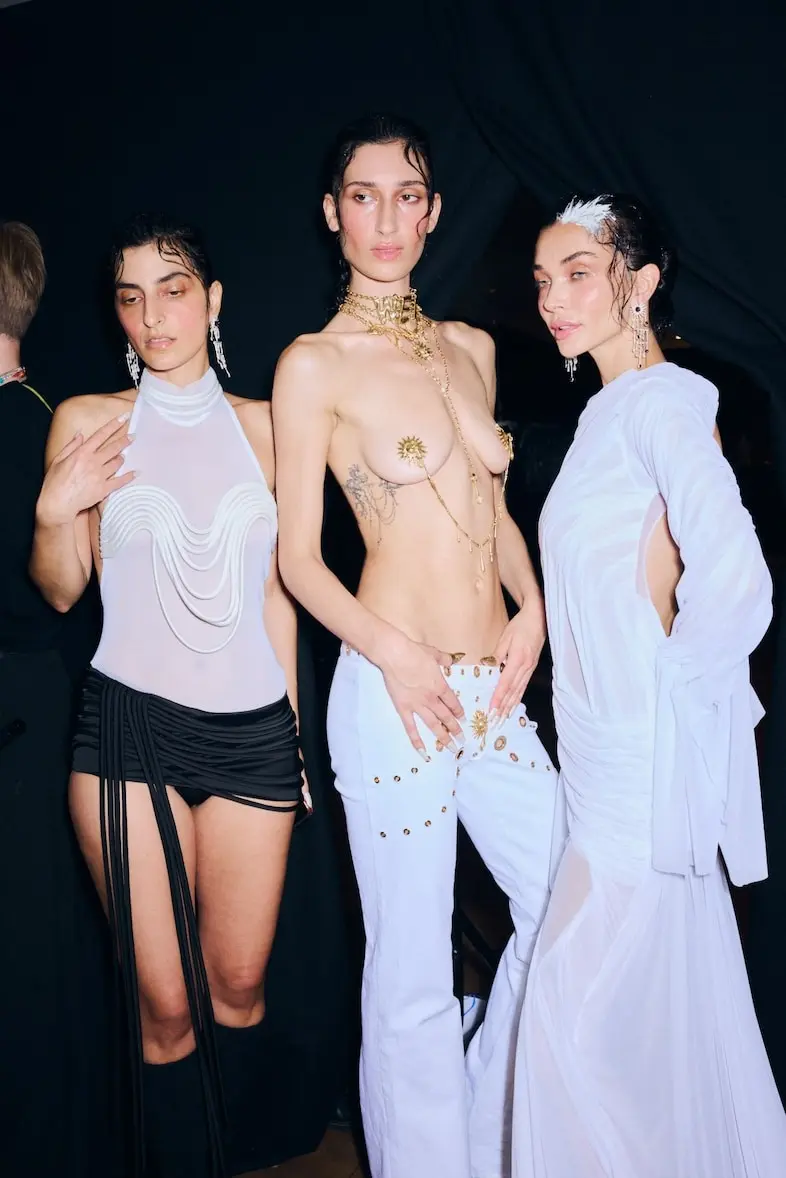
The SS27 show, however, elevated her signature aesthetic to an entirely new echelon. Long recognized for her pioneering work with "wet-look" fabrics that cling to the body like sea spray or sweat, Di Petsa expanded her material vocabulary to explore bodily fluids not merely as an aesthetic choice, but as spiritual conduits of life and emotional release.
The runway itself was structured as a living ecosystem of human connection and relational dynamics:
- The Intergenerational Matrix: In an unprecedented move, two models walked the runway carrying their own real-life infants, seamlessly merging domestic reality with high-fashion staging. Later, a mature female model walked alongside a younger male model—a potent visual dialogue suggesting a mother-son dynamic across the passages of time.
- Public Intimacy: Models blurred the lines between performer and observer. One model paused her stride to kiss her partner, who was holding their baby in the front row. Moments later, another couple walked hand-in-hand before stopping in the center of the photographer’s pit to engage in a passionate, cinematic embrace, visually translating the foundational act of creation into the immediate present.
- The Climax (Holy Milk): The show culminated in a sequence that instantly paralyzed the room. Leigh-Anne Pinnock stepped out as the ultimate muse of the collection. Draped in an ethereal, goddess-like white two-piece that accentuated her pregnancy, Pinnock commanded the space with serene authority. As she reached the center of the runway, she halted. The models around her assumed a reverent, grounded posture, crouching on the floor. In a moment that defied the traditional boundaries of runway decorum, Pinnock’s body performed the ultimate biological miracle of the postpartum and maternal experience: milk began to spurt from her breasts. With slow, ceremonial grace, she turned full circle, the liquid arcing through the air and anointing the models below.
The silence in the room broke instantly into a deafening roar of applause, shutter clicks, and gasps, marking the definitive high-water mark of London Fashion Week SS27.
Supporting Context & Metrics: The Mechanics of Viral Conceptualism
To understand the weight of Di Petsa’s SS27 show, one must analyze the broader ecosystem of fashion communication in the digital age. In an era where physical runway shows compete directly with TikTok algorithms, Instagram Reels, and real-time live-streams, designers face intense pressure to generate "moments" that transcend the physical venue.
The Currency of Shock and Awe
Di Petsa has consistently mastered this modern requirement without sacrificing intellectual integrity. Where other brands rely on celebrity placement alone, Di Petsa integrates high-profile figures into deeply conceptual narratives.
- Historical Precedents: Her AW25 show, which featured Mia Khalifa, leveraged pop-cultural iconography to challenge patriarchal notions of female sexuality, desire, and fantasy.
- The SS27 Metric: By enlisting Leigh-Anne Pinnock—a globally recognized pop star and mother—to display her pregnancy and enact lactation on the runway, Di Petsa weaponized virality for a higher cause: the destigmatization and celebration of the maternal body.
Digital Footprint and Engagement Analysis
Within hours of the show’s conclusion, metrics across digital platforms spiked exponentially:
- Cross-Platform Velocity: Clips of Pinnock’s mid-runway pause and the subsequent release of milk were shared across TikTok, X (formerly Twitter), and Instagram, accumulating millions of impressions before the final evening shows had even commenced.
- Conversational Shift: Unlike standard viral fashion moments—which often focus on garment malfunctions, dramatic falls, or avant-garde shock styling—the digital discourse surrounding Holy Milk quickly pivoted into deep feminist, philosophical, and biological debates. Social media users, medical professionals, and cultural critics dissected the display, praising the normalization of postpartum realities, breastfeeding, and pregnancy within spaces traditionally dominated by hyper-youthful, post-industrial thinness.
The Intersection of Art and Commerce
Critics often question whether boundary-pushing performance art translates into commercial viability. However, Di Petsa has cultivated a dedicated global clientele that values her garments—known for their intricate ruching, wet-look engineering, and body-sculpting mesh—as wearable sculptures. The viral amplification of the SS27 show acts as a powerful top-of-funnel marketing engine, driving global awareness to her direct-to-consumer channels and high-end retail stockists, proving that radical conceptual art and commercial resonance can coexist symbiotically.
Official Statements & Creative Philosophy
In post-show interviews backstage, Di Petsa (born Dimitra Petsa) unpacked the dense theoretical framework underpinning Holy Milk. Addressing the apparent contradiction of designing a collection entirely around motherhood despite not having children herself, the designer offered a profound redefinition of gestation and creation.
"We are pregnant with our own self," Di Petsa explained to the assembled press corps, her voice carrying the emotional weight of a grueling, months-long creative sprint. "We give birth to different versions of ourselves when we grow too large inside us to be hidden and then again will be reborn."
This statement serves as the master key to unlocking the entire Di Petsa ethos. For the designer, maternity is not merely a biological milestone tied to the reproduction of the species; it is an existential state of being. Every human being undergoes cycles of internal expansion, psychological weight gain, labor, and rebirth. The pregnant belly, the lactating breast, and the intimate embrace are universal symbols of transformation that apply equally to artistic creation, personal trauma recovery, and spiritual evolution.
Leigh-Anne Pinnock also shared her perspective on participating in the historic presentation, noting the empowerment found in reclaiming the pregnant and postpartum body on a global stage. Walking the runway visibly pregnant was, for Pinnock, an act of radical visibility in an industry that has historically marginalized or hidden the realities of motherhood beneath loose tailoring or exclusion.
Additional commentary from front-row attendees and industry veterans highlighted the emotional gravity of the presentation. Several prominent fashion editors noted that while fashion has frequently attempted to romanticize pregnancy through classical tropes of Madonna-like purity, Di Petsa’s approach was radically raw, visceral, and unapologetically earthy. By utilizing real milk and real mothers, the designer stripped away the sanitized veneer of commercial advertising to reveal the messy, powerful truth of creation.
Future Outlook: What Lies Ahead for Di Petsa and the Industry
As London Fashion Week SS27 draws to a close and the international fashion circus packs its bags for Milan and Paris, the shockwaves of Di Petsa’s Holy Milk presentation will continue to reverberate across the global style landscape.
1. Raising the Bar for Runway Performance Art
Di Petsa has permanently altered expectations for what can happen on a runway. Designers can no longer rely solely on walking clothes down a linear path; audiences and critics increasingly demand emotional authenticity, conceptual depth, and participatory performance. We can anticipate a wave of emerging designers attempting to incorporate live performance art and bodily truths into their upcoming presentations, though few possess the conceptual rigor to execute it with Di Petsa’s level of grace and conviction.
2. The Normalization of Maternity in High Fashion
The inclusion of pregnant models, nursing mothers, and real families on the Di Petsa runway builds upon a slow but steady industry-wide shift toward inclusive representation of all life stages. However, Di Petsa pushed past mere representation into the realm of physiological celebration. By highlighting lactation and gestation so overtly, the designer has challenged luxury fashion houses to expand their definition of beauty to encompass the functional, life-sustaining capabilities of the human body.
3. The Future of the Di Petsa Brand
Commercially and critically, Di Petsa stands at a monumental crossroads. Having conquered the viral landscape of London Fashion Week, the brand is primed for international expansion, museum collaborations, and deeper institutional recognition. The designer’s ability to merge ancient Greek mythology, environmental fluidity (the wet-look signature), and modern feminist discourse places her in a league of her own.
As Di Petsa herself mused backstage regarding her relentless creative cycle: "We can’t wait to see what she births next."
Whatever form her next creative gestation takes, one thing is certain: the fashion world will be watching, waiting, and holding its breath for the rebirth.