Executive Overview
In a monumental milestone for open science and human spaceflight, NASA has publicly released approximately 800 gigabytes of pristine scientific data generated during the historic Artemis II mission. This unprecedented archive—representing nearly a full terabyte of information—documents humanity’s first crewed return to the vicinity of the Moon in over half a century.
The comprehensive repository includes 11,000 full-resolution images and videos, 8.5 hours of spoken observations, meticulous astronaut notes, exhaustive transcripts, and high-definition photographs captured directly from the onboard cameras of the Orion spacecraft. Described by the space agency as the first set of planetary science data obtained outside Earth—and, crucially, directly by human hands—since the twilight of the Apollo program in the 1970s, this data dump marks a paradigm shift in how space agencies share deep-space discoveries with the global scientific community and the public alike.
While the raw data is primarily engineered for the rigorous demands of planetary geologists, flight engineers, heliophysicists, remote-sensing experts, and meteoroid-impact specialists, the public-facing components offer an immersive window into lunar exploration. Alongside the massive dataset, NASA has published three definitive foundational reports: the Artemis II Preliminary Lunar Science Report, the Artemis II Lunar Science Operations Report, and the Artemis II Lunar Science Data User Guide.
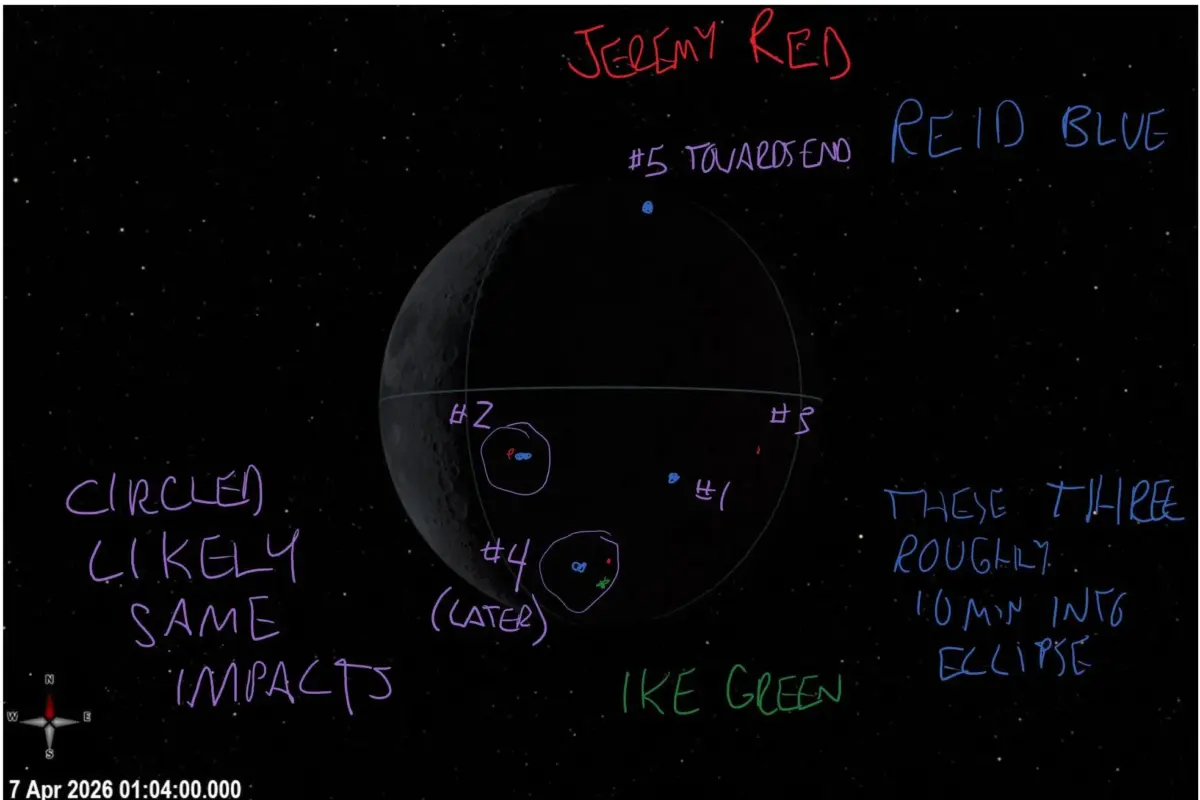
Initial analyses of these files have already yielded groundbreaking discoveries, including the direct observation of five distinct meteoroid impacts on the lunar surface during a solar eclipse. As NASA sets its sights on establishing a permanent human presence at the lunar South Pole, the insights extracted from this 800-gigabyte trove will serve as the operational and scientific bedrock for the future of interplanetary civilization.
Detailed Chronology: From Launch to Data Liberation
To understand the immense value of this newly released archive, it is necessary to retrace the trajectory of Artemis II, a mission that reinvigorated a global passion for lunar exploration and tested the absolute limits of modern life-support, navigation, and habitation systems.
The Buildup and Launch
For years, the Artemis program loomed on the horizon as a conceptual successor to Apollo. While Artemis I successfully demonstrated the uncrewed capabilities of the Space Launch System (SLS) and the Orion capsule, Artemis II represented the ultimate threshold: putting human lives back on the line in deep space. The mission was designed to test Orion’s critical life-support systems while carrying a four-person crew on a complex, multi-day lunar flyby trajectory.
During the mission, the astronauts did not merely ride as passengers; they acted as active field scientists in the vacuum of space. They pointed cameras at targeted geological formations, recorded real-time oral logs detailing visual anomalies, and executed complex maneuvers to test Orion’s operational resilience thousands of miles from Earth.
The Lunar Flyby and the Eclipse Event
A defining chapter of the Artemis II mission occurred when the spacecraft swung around the far side of the Moon, putting the crew out of direct communication with Earth and treating them to views of the lunar surface that no human eyes had witnessed since Apollo 17 in 1972.
During this phase, the spacecraft navigated a precise 54-minute solar eclipse. While the shadow of the celestial alignment swept across the lunar landscape, the astronauts maintained a vigilant watch. This unique lighting condition was not merely a scenic backdrop; it became a crucible for scientific observation. It was within this specific 54-minute window that the crew witnessed and recorded rare, high-velocity meteoroid impacts flashing across the dark lunar disk—observations that have now been immortalized in the newly released telemetry and video files.
Return, Debriefing, and Data Processing
Following a textbook splashdown and recovery, the mission transitioned from an operational triumph to an analytical marathon. Over the subsequent months, NASA scientists, data engineers, and archivists labored to curate, sanitize, and format the telemetry, audio logs, and imagery captured by the crew.
The goal was to transform raw, unformatted spacecraft packets into structured, accessible formats compliant with the rigorous standards of NASA’s Planetary Data System (PDS). By consolidating 8.5 hours of audio, thousands of metadata-rich images, and operational logs into a centralized repository, NASA has effectively bridged the gap between raw flight data and actionable, peer-reviewable science.
Supporting Context & Metrics: Inside the 800-Gigabyte Archive
The scale of the Artemis II data release is staggering, reflecting the exponential advancements in digital sensor technology, high-bandwidth communications, and onboard data storage since the analog era of Apollo.
Breakdown of the Repository
To appreciate the sheer volume and granularity of the information now available to the global scientific community, consider the following metrics:
- Total Data Volume: ~800 gigabytes (approaching 1 terabyte of raw and processed scientific files).
- Visual Assets: 11,000 full-resolution photographs and high-definition video files captured from Orion’s exterior and crew-operated interior cameras.
- Audio Archive: 8.5 hours of continuous spoken observations, environmental commentary, and real-time mission logs recorded by the astronauts.
- Supplementary Documentation: Thousands of pages of transcripts, handwritten notes, and annotated photographs.
- Core Reference Documents: Three primary administrative and scientific publications—the Preliminary Lunar Science Report, the Science Operations Report, and the Data User Guide.
Interdisciplinary Utility
NASA’s intentional design of the archive ensures that its utility extends far beyond traditional geology. The dataset has been categorized to serve several specialized scientific verticals:
- Planetary Geologists: Can analyze high-resolution imagery of the lunar regolith, assessing variations in color, texture, and mineralogical composition across different lunar terrains.
- Flight Engineers: Can review environmental telemetry and hardware performance metrics to refine life-support systems and structural tolerances for Artemis III and beyond.
- Heliophysicists: Can utilize data gathered during orbital phases and eclipse events to study solar wind interactions and radiation environments outside Earth’s protective magnetosphere.
- Telecommunications and Remote Sensing Specialists: Can evaluate signal degradation, optical clarity, and sensor performance across extreme distances and thermal gradients.
- Meteoroid Impact Experts: Can leverage the optical flashes recorded during the lunar eclipse to calculate impact frequencies, mass distributions, and kinetic energy yields of small space debris colliding with the Moon.
Accessing the Archive: PDS and Public Portals
NASA has structured public access to cater to both professional researchers and space enthusiasts.
For the data scientist and academic researcher, raw files, metadata tables, and specialized FITS (Flexible Image Transport System) files are hosted directly on the Planetary Data System (PDS) geosciences node. Researchers can ingest these files into custom software pipelines for deep analytical modeling.
For educators, students, and amateur astronomers seeking a more approachable format, NASA has launched a dedicated Artemis II science portal. This user-friendly interface allows visitors to download the three foundational reports, browse curated photo galleries with astronaut annotations, and stream excerpts from the 8.5-hour audio library. Furthermore, platforms like the PDS Imaging Atlas provide interactive tools to explore mission audio and crew camera logs intuitively.
Official Statements and Expert Analysis
The release of the Artemis II dataset has prompted widespread commentary from NASA leadership, mission scientists, and academic researchers who view the archive as a vital stepping stone toward sustainable deep-space exploration.
Perspectives from NASA Leadership
In official agency releases accompanying the data drop, NASA representatives emphasized that the mission was explicitly designed to generate open, actionable science from day one.
"We are not simply visiting the Moon to leave flags and footprints; we are returning to establish a sustained scientific presence," noted senior program officials during the archive’s rollout. "The data captured by the Artemis II crew represents the first true planetary science dataset generated by human hands beyond Earth in over fifty years. By making this near-terabyte of information instantly accessible to the global community, we are accelerating the pace of discovery and democratizing deep-space research."
The Scientific Consensus
Independent researchers have echoed these sentiments, highlighting the immediate practical applications of the data, particularly regarding surface operations.
Dr. Elena Vance, a planetary geologist specializing in impact mechanics, remarked on the significance of the eclipse observations: "Catching five meteoroid impacts live during a brief solar eclipse is an extraordinary stroke of luck paired with exceptional crew vigilance. These impacts—caused by centimeter-scale fragments—are notoriously difficult to track from Earth-based telescopes due to glare and atmospheric distortion. Having direct, human-verified visual and telemetry data of these impacts gives us critical ground truth. It completely changes how we calculate the structural risks of surface habitats."
Engineering teams are equally enthusiastic about the high-resolution imagery captured near the terminator—the shifting boundary line between lunar day and night. Because the sun sits very low on the horizon near the lunar South Pole—the designated landing zone for upcoming Artemis missions—the lighting conditions create long, distorting shadows and extreme contrast challenges.
"The terminator photographs and operational notes give our navigation and robotics teams a preview of the visual hazards our astronauts will face," explained flight systems engineer Marcus Thorne. "Understanding how terrain features, rocks, and crater rims appear under low-angle solar illumination is essential for training both human crews and autonomous hazard-avoidance algorithms."
Future Outlook: Translating Data into a Lunar Civilization
The publication of the Artemis II archive is not merely a retrospective look at a successful mission; it is an active blueprint for the future. Every gigabyte of data processed, every audio transcript analyzed, and every meteoroid impact cataloged serves a direct operational purpose for the phases of the Artemis program that lie ahead.
Paving the Way for Artemis III and Beyond
As NASA and its international partners prepare for Artemis III—the mission intended to land the first humans on the lunar South Pole in over half a generation—the margin for error shrinks dramatically. The South Pole is scientifically prized for its permanently shadowed regions (PSRs), which are believed to harbor vast deposits of water ice. However, it is also one of the most mechanically and environmentally challenging terrains on the Moon.
The topographical data, lighting assessments, and thermal telemetry released in this archive will be directly integrated into mission simulators. Astronauts training for surface extravehicular activities (EVAs) will use these exact environmental models to practice navigation, sample collection, and emergency response procedures under realistic lunar lighting constraints.
The Evolution of Open-Source Space Science
Furthermore, NASA’s commitment to open science sets a new precedent for international space exploration. By bypassing restrictive proprietary data embargoes and immediately pushing 800 gigabytes of raw, high-value data into the public domain, the agency is inviting universities, private aerospace firms, and independent researchers worldwide to contribute to lunar science.
This crowd-sourced analytical approach ensures that the discoveries extracted from Artemis II will not be limited to a select group of government contractors. Instead, a global cohort of scientists can probe the dataset, cross-referencing it with lunar orbital missions like the Lunar Reconnaissance Orbiter (LRO) and international probes.
Conclusion: A Legacy Carved in Digital Stone
Fifty-three years after the final footsteps of the Apollo program faded into the lunar dust, humanity has crossed the threshold once more. The Artemis II mission proved that our technological and biological capacity for deep-space exploration remains intact. Now, through the liberation of 800 gigabytes of rigorous scientific data, NASA has ensured that the triumphs of the Orion crew belong not just to the history books, but to the collective future of science.
As researchers sift through the audio logs, decode the high-resolution imagery, and model the meteoroid impacts recorded in the dark of a lunar eclipse, they are laying the intellectual foundation for a permanent human outpost on another world. The data is out there—open, waiting, and ready to be decoded by the next generation of explorers.