Executive Overview
For years, enterprise software marketing has painted a utopian picture of fully autonomous customer experience (CX). Software vendors routinely boast of artificial intelligence agents capable of deflecting 80%, 90%, or even 100% of incoming customer queries without human intervention. Yet, for e-commerce executives trying to manage mounting support costs, the reality of deploying these models often falls short of the glossy pitch decks.
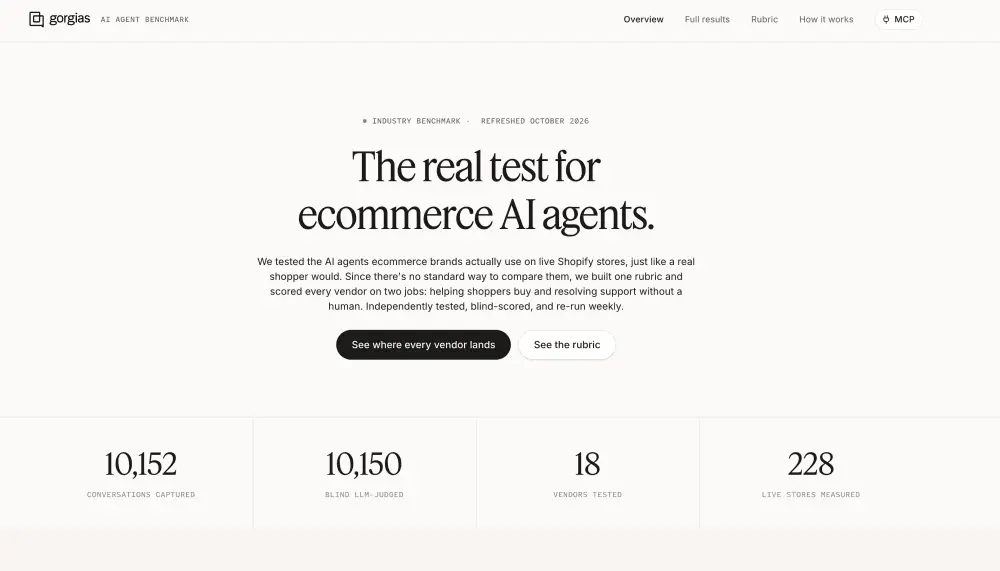
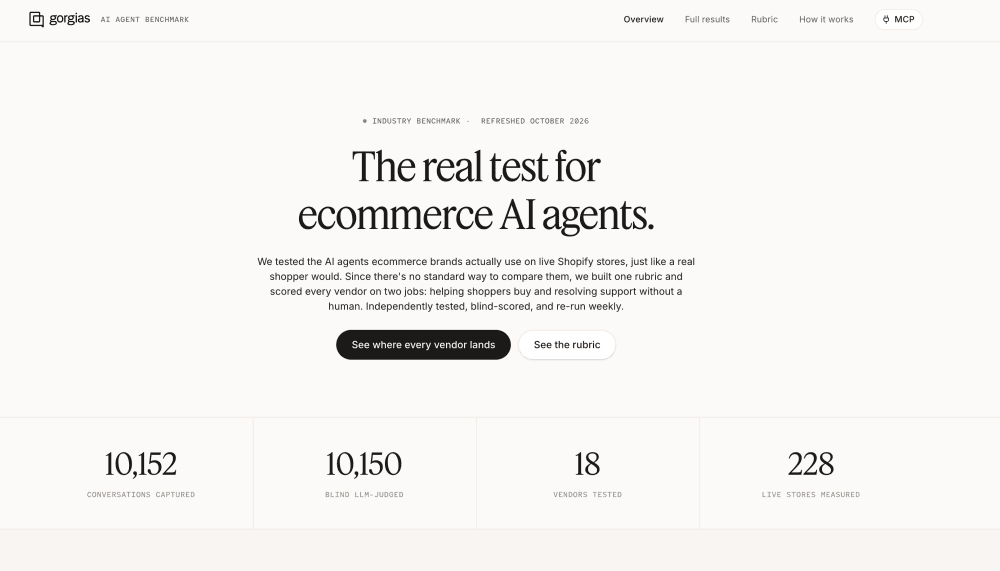
Now, a comprehensive and rigorous new study is stripping away the marketing hype. Gorgias, a $100M ARR customer experience leader for e-commerce (backed notably by the SaaStr Fund), has published a public benchmark evaluating 13 leading AI agent vendors. Unlike traditional software evaluations—which typically rely on controlled sandboxes, synthetic product catalogs, or heavily scripted vendor demos—this benchmark subjects the agents to the chaotic reality of live operations.
Testing the tools across 212 real, mid-market e-commerce stores carrying active inventory, the evaluation used identical customer messages for every vendor. A blinded judge scored each response against 26 distinct binary checks, while programmatic validations verified factual claims regarding live pricing, return policies, and stock-keeping units (SKUs) directly against active storefronts.
The findings deliver a sobering reality check to the software industry: the absolute best-performing AI agents fully resolve roughly 70% of conversations end-to-end. Meanwhile, the typical vendor struggles to resolve even half, hovering below 50%.
Even more startling for legacy buyers, out-of-the-box AI solutions bundled directly into major platforms like Zendesk, Intercom, and Klaviyo consistently underperformed, capping out at or below 42% automation. As businesses increasingly look to artificial intelligence to protect profit margins and scale operations, this benchmark provides an indispensable, data-driven roadmap for separating genuine technological capability from hollow vendor promises.
Detailed Chronology: How the Benchmark Was Built and Executed
To understand the weight of these findings, one must examine the methodology behind the evaluation. For months, industry observers have debated how to accurately measure AI performance in customer support. Traditional metrics—such as "ticket deflection" or customer satisfaction (CSAT) scores collected via biased surveys—often obscure the true operational burden placed on human support teams.
Designing the Evaluation Framework
Gorgias set out to eliminate subjective bias by establishing a transparent, open-source testing ground. The core of the methodology rests on several non-negotiable principles:
- Live Production Environments: The 13 participating vendors were evaluated across 212 live e-commerce stores. No sandboxes or simulated databases were permitted.
- Unified Test Prompts: Every agent received identical, real-world customer inquiries drawn from actual shopping scenarios.
- Blind Judging: Human evaluators scored the responses without knowing which vendor generated them.
- Programmatic Verification: Factual assertions made by the AI—such as whether a discount code was active, what a specific return window entailed, or if an item was in stock—were checked programmatically against the live store database.
Defining "Resolution"
One of the most revealing aspects of the study is its strict definition of a successful resolution. In the context of this benchmark, "resolved" means zero human touch.
If an AI agent hands off a conversation to a human representative, deflects the customer out of the channel ("Please email us" or "Call our support line"), or forces the user into an external contact form, the interaction is categorized as a failure. The auditor never explicitly asks for a human agent; every single handoff or channel deflection is the AI’s own decision.
This strict criterion starkly contrasts with the reporting dashboards provided by many SaaS vendors. In typical customer-facing software analytics, an interaction is often counted as "automated" simply if the AI responds and a predetermined window (such as 72 hours) passes without human intervention. Under that looser definition, a frustrated customer who abandons the chat in disgust counts as a successful resolution. Under the Gorgias benchmark, that same abandoned customer is rightly classified as an unresolved failure.
Supporting Context & Metrics: Performance Breakdown
The benchmark data exposes deep performance fractures across the vendor landscape, separating high-performing systems from undercooked integrations.
Automation vs. Quality: The Core Metrics
When looking strictly at automation rates—the percentage of engaged conversations successfully handled without human intervention—the top five vendors averaged 70%, the median vendor sat at 48%, and the weighted field average landed at 46%.
However, evaluating automation in a vacuum can be dangerously misleading. A high automation rate paired with low-quality answers creates a catastrophic operational feedback loop. For example, if an AI agent quickly closes a ticket by providing an incorrect return window, the customer will inevitably return with a follow-up complaint. That secondary contact ultimately costs the business far more time and money than handling the inquiry correctly the first time.
When cross-referencing automation with blind quality scores (graded on a scale from 0 to 100), only three vendors managed to clear both high bars (achieving over 64% automation and a quality score above 65): Yuma, Decagon, and Gorgias.
Other notable performers revealed distinct strategic tradeoffs:
- Ada successfully closed a high volume of conversations but scored significantly lower on answer quality, trailing top quality performers by nearly 27 points.
- Sierra tied with Yuma for the highest quality score on the board, yet struggled to break the 50% threshold in overall automation.
The Problem with Bundled Helpdesk AI
For many digital brands, the path of least resistance is to adopt the AI features bundled into their existing helpdesk, CRM, or email marketing platforms. However, the data sounds a clear warning against this approach.
Platforms like Zendesk, Intercom, and Klaviyo—solutions that e-commerce brands already pay heavily to utilize—all failed to exceed a 42% resolution rate in this live test. On this evidence, buying the native, bundled AI add-on from a legacy helpdesk provider is statistically one of the weakest options available on the market.
Topic-by-Topic Performance: Order Tracking vs. Policy Pages
The benchmark also analyzed how agent performance fluctuated depending on the nature of the customer inquiry:
- Policy Questions: Inquiries answered directly from static policy pages (e.g., "What is your shipping policy?") scored the highest across the board.
- Dynamic Lookups: Questions requiring real-time system lookups, database checks, or complex judgment calls scored significantly lower.
Alarmingly, order tracking—historically the single largest ticket category for online retailers—sat near the bottom of the capability list. Across the entire field of vendors, only about one-third of post-sale tracking inquiries reached a successful, automated finish. Furthermore, order tracking scores trailed return policy queries by an average of 17 points, reflecting the immense difficulty AI systems face when attempting to interface cleanly with back-end logistics and warehouse management systems.
The Mystery of Declining Performance
Perhaps the most troubling finding in the report is that 9 out of 10 vendors actually lost ground on automation over a four-week tracking period. Quality metrics followed a similar downward trajectory, with nine out of ten vendors seeing their quality scores drop.
While the benchmark does not definitively diagnose the root cause of these declines, industry experts point to several contributing factors: backend model updates that inadvertently alter behavior, store configuration drift, or increasingly complex testing parameters. Regardless of the catalyst, the data proves a vital operational lesson: the sky-high automation rate observed during a vendor’s initial product pilot will rarely match the baseline performance realized a month later in production.
Official Statements & Industry Reactions
The release of the benchmark has sent ripples through the software and venture capital communities, prompting intense debate over software transparency, pricing models, and implementation realities.
Industry veterans have emphasized that technical capability is only half the battle. In practice, factors such as robust onboarding, rigorous identity checks, authentication guardrails, and escalation rules account for the massive performance gap between a mediocre 45% deployment and a top-tier 70% deployment. Notably, these guardrails are almost universally configured by the brand itself, not just the underlying large language model.
Furthermore, the pricing implications of these findings are direct and financial. Platforms like Gorgias AI Agent operate on a usage-based pricing model, charging businesses approximately $0.90 per successfully resolved conversation. Because "resolution" directly dictates cost, e-commerce leaders are being strongly advised to get every vendor’s precise, contractual definition of a billable resolution in writing before signing enterprise agreements.
Future Outlook: Strategic Takeaways for E-Commerce Leaders
As artificial intelligence continues to mature, executives cannot afford to build their financial forecasts on marketing brochures and vendor aspirations. Based on the rigorous data unveiled in this benchmark, business leaders must adopt a pragmatic, highly disciplined approach to AI adoption:
- Recalibrate the Business Case: Build operational budgets and financial models assuming a realistic ceiling of 65% to 70% automation, and restrict consideration to top-tier vendors. For bundled legacy helpdesk tools, plan for a modest 20% to 42% resolution rate.
- Evaluate Dual Metrics: Never select a vendor based on automation rates alone. Always demand verifiable proof of response quality alongside automation percentages, tested across the exact same operational dataset.
- Audit Against Your True Ticket Mix: Do not rely on generic benchmark averages. If your support queue is dominated by "Where is my order?" (WISMO) queries, recognize that average resolution rates will likely drop due to back-end integration friction.
- Conduct Independent Cold Tests: Before committing to a contract, take 30 real support tickets from the previous month, open incognito sessions on the vendor’s live reference customer sites, and measure real resolutions manually using the public evaluation rubric.
- Establish Continuous Monitoring: Because performance metrics can fluctuate over time due to model updates and configuration drift, organizations must audit and re-test their production AI agents on a strict monthly schedule.
Ultimately, while autonomous AI agents are rapidly becoming table stakes for modern e-commerce operations, they are not yet a silver bullet. Transparency, rigorous testing, and continuous oversight will remain the ultimate arbiters of success in the enterprise AI landscape.