In the fast-evolving landscape of cloud computing, maintaining optimal infrastructure is a monumental challenge for engineering teams. Organizations continuously struggle to balance the four pillars of modern cloud architecture: cost optimization, security, performance efficiency, and operational resilience. Traditionally, addressing these concerns has required tedious manual audits, deep familiarity with hundreds of shifting service best practices, and reliance on generic checklists that often fail to capture the unique nuances of a business.
Today, Amazon Web Services (AWS) is fundamentally shifting this paradigm with the public preview announcement of the AWS Well-Architected Agent. Positioned as a breakthrough AI-powered service, the Well-Architected Agent acts as an expert virtual cloud architect embedded directly into your environment. By dynamically correlating utilization metrics, resource configurations, and complex application topologies across more than 65 AWS services, the agent delivers contextual, business-aligned optimization strategies complete with ready-to-implement remediation packages.
Far more than a simple dashboard or static rule engine, this service evaluates cloud infrastructure with the sophisticated reasoning of a seasoned human architect. It respects declared corporate goals, surfaces cross-pillar trade-offs, and provides automation-ready solutions—ranging from updated Infrastructure as Code (IaC) templates to direct CLI commands and console execution paths. Delivered via AWS Support for customers with active support plans, the public preview marks a watershed moment for automated cloud governance, promising to drastically reduce operational overhead while accelerating engineering velocity.
Detailed Chronology: How the AWS Well-Architected Agent Works
To understand the transformative nature of the AWS Well-Architected Agent, one must examine its end-to-end operational workflow. Designed to integrate seamlessly into existing DevOps and cloud engineering pipelines, the agent moves from initialization to automated remediation through a structured, multi-step lifecycle.
Phase 1: Onboarding and Profile Configuration
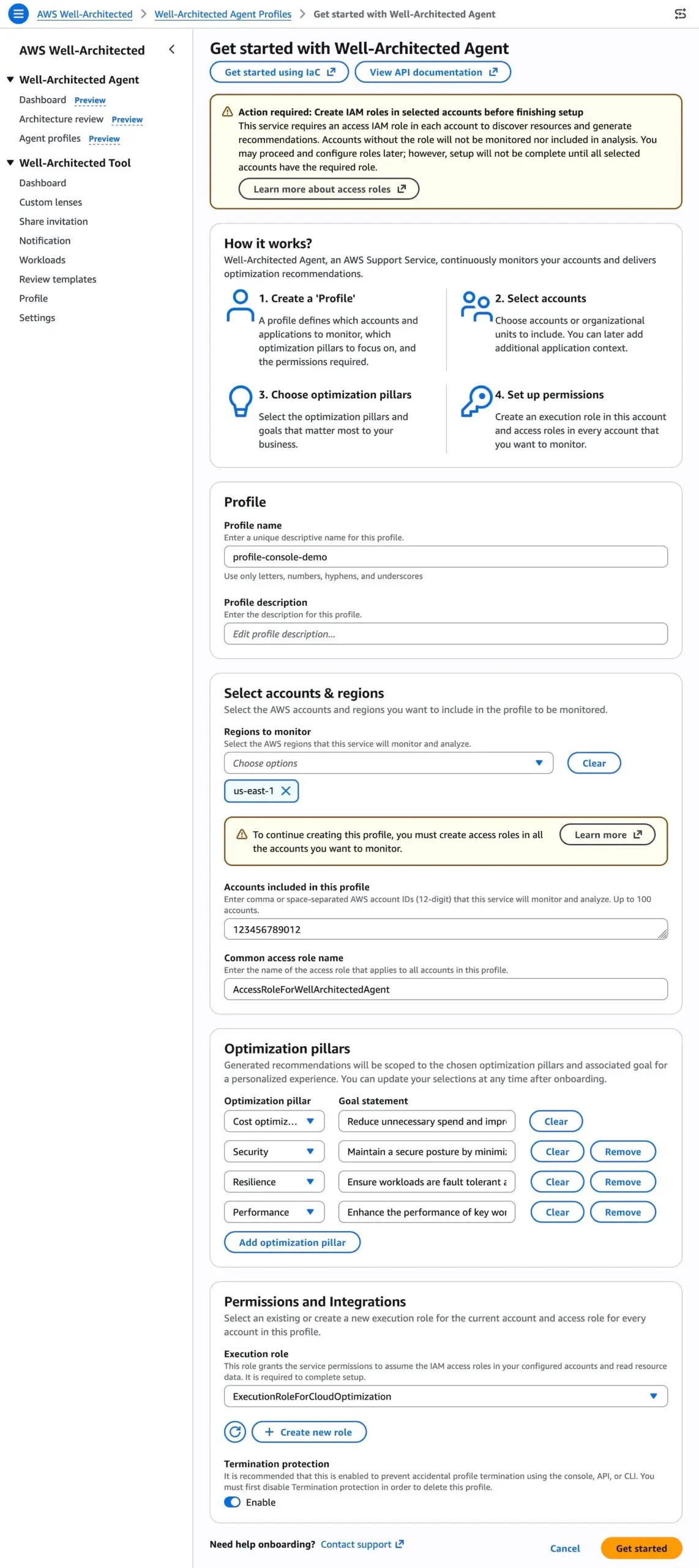
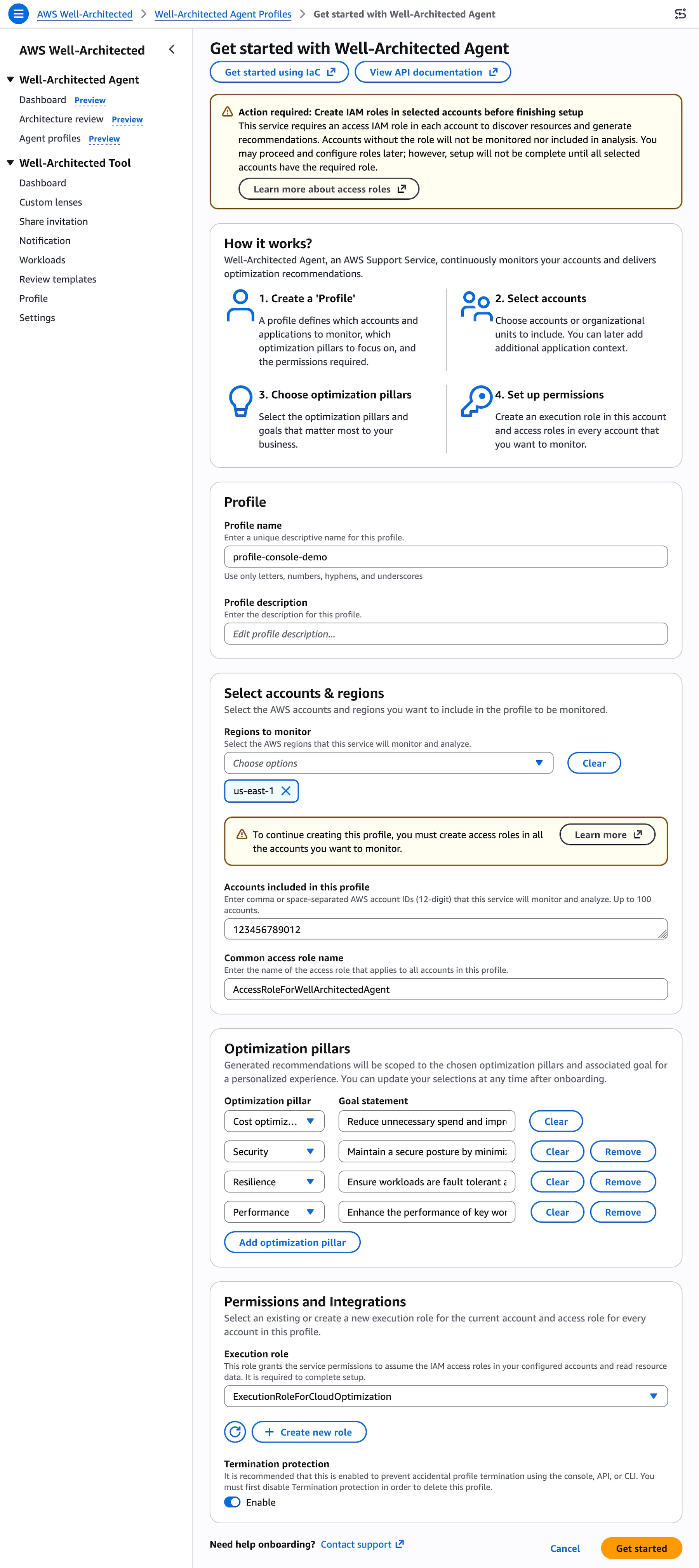
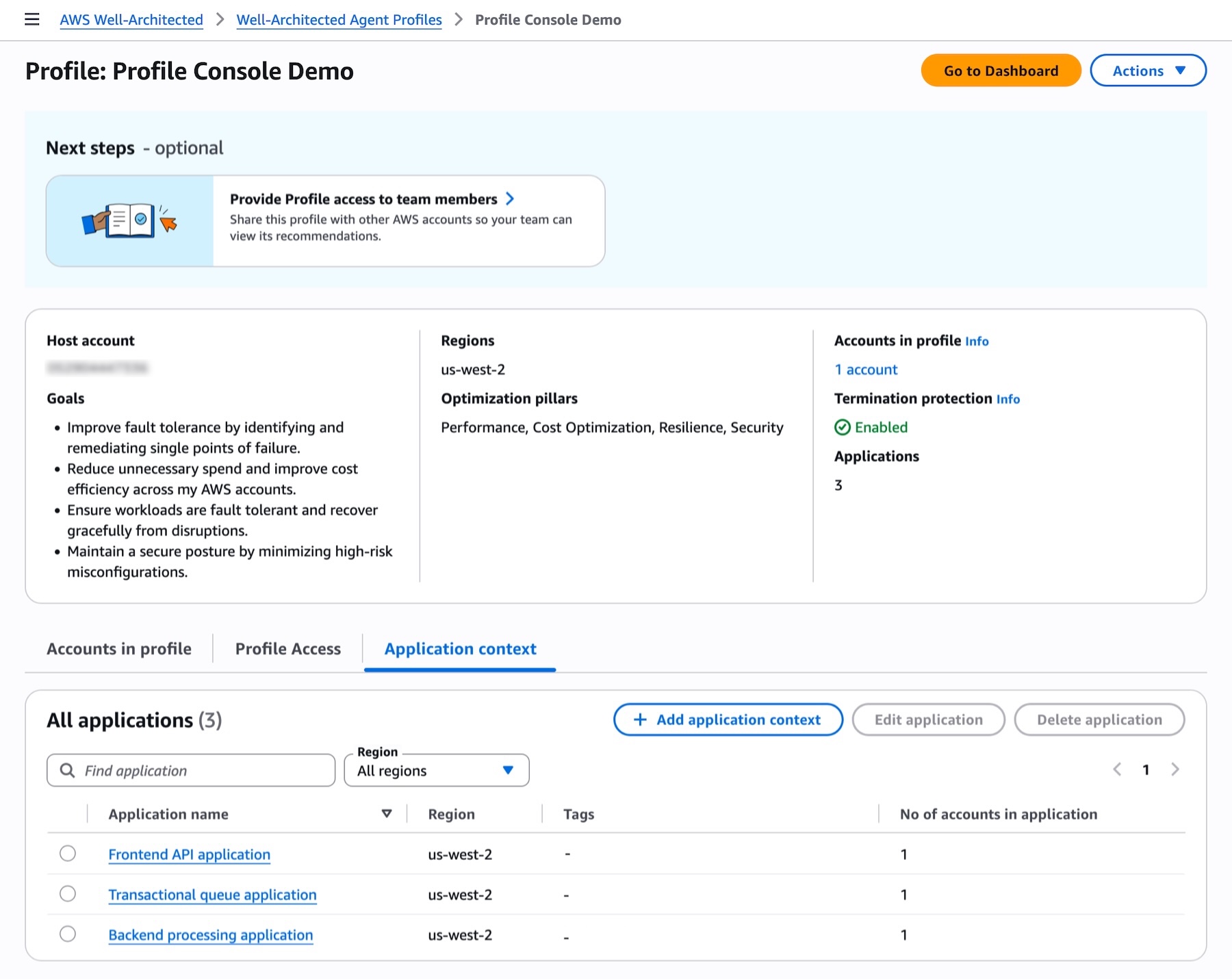
The journey begins within the AWS Well-Architected console, where administrators initiate the service by selecting Get started with Well-Architected Agent. During this foundational step, users establish an Agent Profile. This profile dictates the strict boundaries of what the agent can access, which accounts and AWS Regions are slated for monitoring, and which optimization pillars take precedence for the organization.
Crucially, the agent requires securely provisioned, customer-managed AWS Identity and Access Management (IAM) roles. These roles grant the agent read-only access to necessary resource configurations, utilization metrics, and application topology without compromising underlying security postures. Once configured, the agent initiates its deep-dive analysis, generating initial resource and application recommendations within 24 hours.
Phase 2: Contextualization and Pre-Deployment Reviews
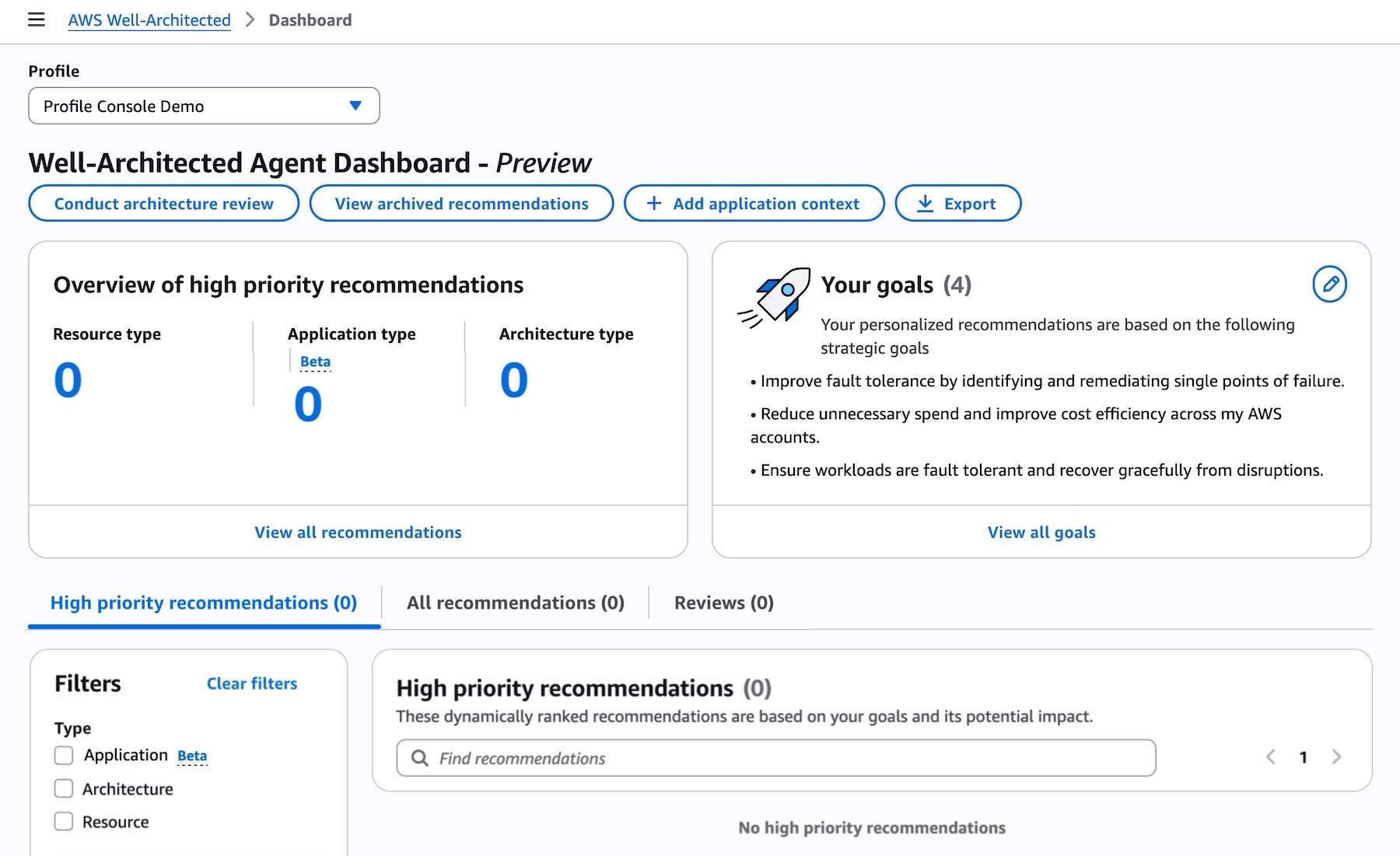
Generic recommendations often fail because they lack business context. The Well-Architected Agent solves this by allowing teams to inject application-specific metadata. Through the Add application context dashboard feature, engineers can associate specific AWS accounts, regions, services, and resource-identifying tags with distinct business applications. This ensures that the generated recommendations reflect actual business impact rather than abstract metrics.
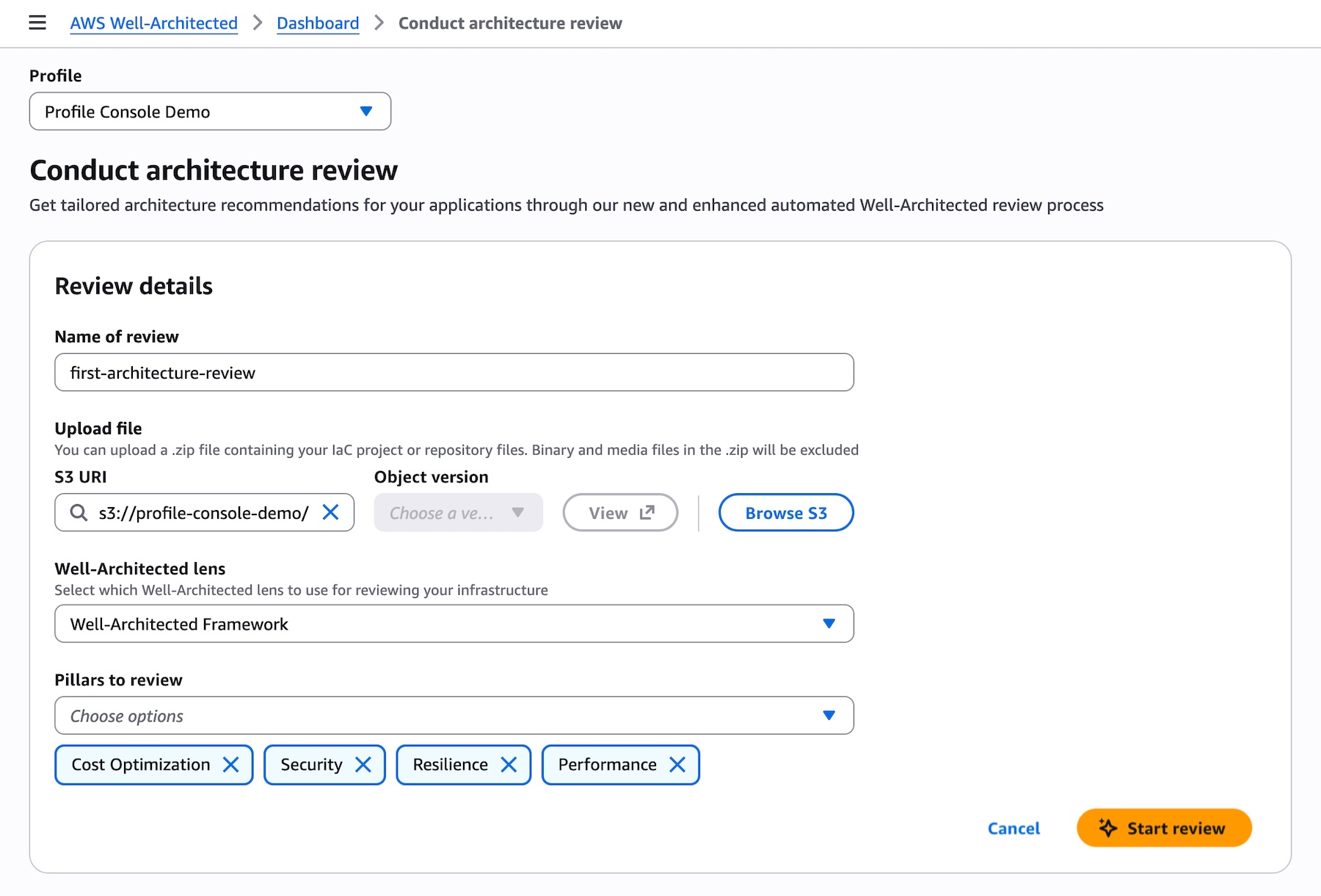
Moreover, the agent extends its analytical prowess beyond live environments into pre-deployment workloads. By choosing Conduct architecture review on the dashboard, engineering teams can upload a .zip archive containing their Infrastructure as Code projects—whether written in Terraform, AWS CloudFormation, or the AWS Cloud Development Kit (CDK). The agent inspects these templates against chosen Well-Architected lenses, identifying architectural flaws before a single resource is ever provisioned in production.
Phase 3: Prioritized Analysis and Trade-Off Evaluation
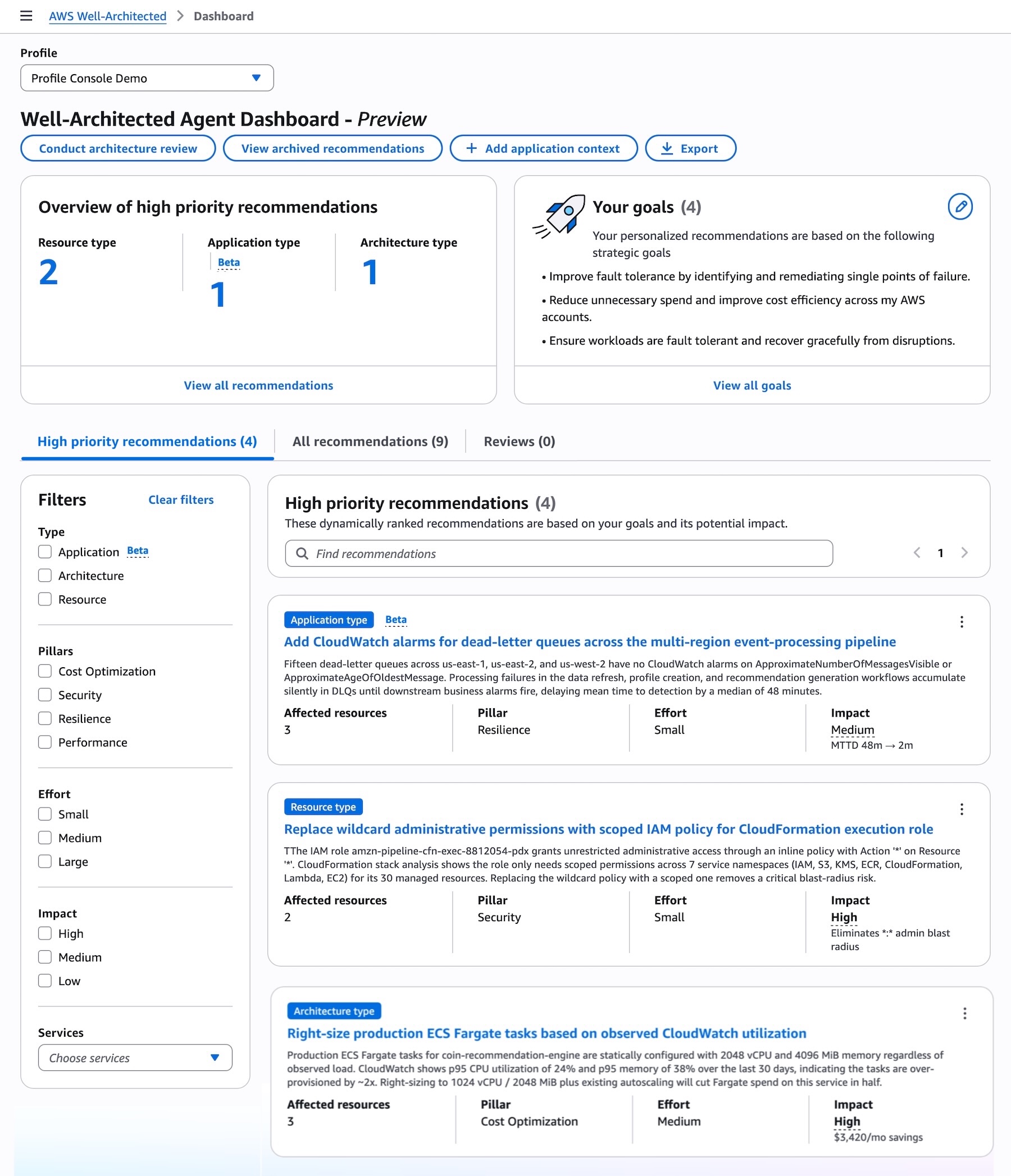
Once the analysis is complete, the agent presents a unified, prioritized list of recommendations. These findings are ranked not just by severity, but specifically against the business goals declared in the agent profile.
Clicking on a specific recommendation reveals a comprehensive breakdown:
Root Cause Insights: Detailed explanations of why the agent flagged a particular resource.
Impact Analysis: Clear visibility into how addressing an issue in one pillar (e.g., security) might affect another (e.g., cost or performance).
Remediation Paths: Tailored, multi-vector fixes targeting the affected AWS resources.
Phase 4: Automated Remediation and Workflow Integration
The true power of the Well-Architected Agent lies in its execution phase. By selecting Start remediation, engineers are presented with actionable resolution types. Depending on the finding, the agent can generate:
Console Guidance: Step-by-step instructions for manual verification and deployment.
Updated IaC Code Blocks: Direct code modifications (such as updated AWS CDK functions or CloudFormation/Terraform snippets) that engineers can copy and paste directly into their source control repositories.
For teams operating at scale, the agent supports API access and deep integration with developer workflows. By leveraging the AWS MCP Server and associated plugins, developers can query recommendations, search documentation, and interact with the agent programmatically inside their preferred AI coding environments.
Supporting Context & Metrics: The Architectural Imperative
The launch of the AWS Well-Architected Agent arrives at a critical juncture in enterprise cloud adoption. As multi-account cloud environments scale into thousands of microservices, manual governance has become mathematically and operationally unsustainable.
The Burden of Manual Audits
Historically, cloud optimization relied heavily on periodic Well-Architected reviews—often conducted manually via spreadsheets, internal workshops, or third-party consultants. While valuable, these reviews suffered from several systemic limitations:
Temporal Lag: By the time a manual review report was finalized and published, the underlying cloud infrastructure had already evolved, rendering parts of the report obsolete.
Siloed Expertise: Security engineers focused solely on security, financial controllers fixated on cost reduction, and developers chased performance—frequently resulting in conflicting changes.
Lack of Contextual Synthesis: Standard scanning tools flagged unencrypted S3 buckets or over-provisioned EC2 instances, but they rarely understood whether an over-provisioned database was intentionally staged to handle an upcoming seasonal traffic spike.
The AI Advantage Across 65+ Services
The AWS Well-Architected Agent bridges these gaps by acting as a continuously learning, centralized governance engine. By simultaneously evaluating telemetry across more than 65 AWS services, the agent correlates data points that human architects might miss. For instance, it can detect that a sudden increase in data transfer costs is directly correlated with an unoptimized caching layer in a serverless application, subsequently recommending both a cost-saving caching strategy and a performance-tuning parameter update.
Furthermore, the agent’s ability to ingest Infrastructure as Code shifts governance far to the left in the software development lifecycle (SDLC). Catching an architectural misalignment in a Terraform script during a pull request review is orders of magnitude cheaper and faster than refactoring a live, production-grade distributed system.
Official Statements and Industry Perspectives
While official remarks from AWS leadership emphasize the service’s commitment to reducing cognitive load for developers, industry observers and early evaluators have noted the broader implications for enterprise cloud management.
"The AWS Well-Architected Agent transforms our approach to cloud governance from reactive firefighting to proactive, automated stewardship," noted early preview participants during initial architecture briefings. *"By translating
high-level business goals directly into executable code snippets and prioritized infrastructure patches, AWS is bridging the persistent gap between architectural theory and engineering reality."*
AWS representatives have underscored that the agent is designed to complement—not replace—existing tools. Organizations can continue utilizing the standard AWS Well-Architected Tool for manual assessments and custom user-defined lenses tailored to bespoke corporate compliance frameworks. However, the agent dramatically accelerates the feedback loop, ensuring that best practices are continuously enforced rather than periodically audited.
Future Outlook: The Autonomous Cloud
The introduction of the AWS Well-Architected Agent signals a broader, industry-wide transition toward autonomous cloud infrastructure management. As artificial intelligence models become increasingly adept at reasoning over complex, distributed systems, the role of the cloud engineer is evolving from manual builder to strategic supervisor.
Looking ahead, we can anticipate several evolutionary trajectories for services like the Well-Architected Agent:
Deeper CI/CD Integration: Future iterations will likely feature native pull-request bots that automatically generate, test, and merge Well-Architected remediation patches directly into GitHub and GitLab repositories without human intervention.
Cross-Cloud Governance: As enterprises increasingly adopt multi-cloud strategies, the foundational intelligence demonstrated by AWS in understanding application topology and business context will likely be demanded across heterogeneous cloud boundaries.
Predictive Remediation: Moving beyond current capabilities—which analyze existing utilization and static code—next-generation agents will utilize predictive modeling to foresee traffic spikes, security vulnerabilities, and budget overruns before they materialize.
Getting Started Today
For organizations eager to pilot this next-generation capability, the AWS Well-Architected Agent is available immediately for public preview. While the agent can onboard workloads from any AWS commercial region, initial management and profile configuration controls are accessible via the AWS Well-Architected console in three primary regions: US East (N. Virginia), US East (Ohio), and US West (Oregon).
The service is included as part of existing AWS Support plans, delivered directly through AWS Support channels. Enterprises participating in the preview are encouraged to submit feedback via their standard AWS support contacts, helping shape the future of automated, AI-driven cloud architecture.