Executive Overview
Fifteen years after the catastrophic Deepwater Horizon blowout unleashed an unprecedented torrent of hydrocarbons into the northern Gulf of Mexico, groundbreaking scientific research reveals a grim reality: the disaster’s deepest victims have not recovered.
A comprehensive, multi-year study published in the Proceedings of the National Academy of Sciences documents what researchers are calling the fastest and most severe faunal decline ever recorded in Earth’s largest ecosystem type. Spanning hundreds of miles of the deep-pelagic zone—the pitch-black water column that accounts for roughly 90 percent of the Gulf’s total volume—animal populations collapsed by 60 to 85 percent in the years following the 2010 disaster. Foundational species, including krill, lanternfish, squid, shrimp, and octopuses, were decimated, triggering cascading trophic failures that have gutted apex predator populations and left the ecosystem trapped in a state of permanent impairment.
Remote, crushing in pressure, and shrouded in eternal darkness, the deep ocean has long been perceived as a sanctuary buffered from the ravages of human industrial activity. Yet, this new empirical evidence shatters that illusion. By synthesizing extensive physical net sampling, acoustic echosounder surveys, and genetic data, scientists have systematically eliminated alternative hypotheses—such as temperature fluctuations and oxygen depletion—to pin the blame squarely on the lingering remnants of the BP oil spill and the chemical dispersants applied to combat it.
As regulatory bodies weigh the risks of emerging deep-sea industries like seabed mining, the Deepwater Horizon legacy serves as a haunting cautionary tale. It demonstrates that industrial catastrophes can push vulnerable, slow-adapting deepwater habitats past a point of ecological resilience, fundamentally altering ocean chemistry and food webs before baseline conditions can even be fully understood.
Detailed Chronology: The Anatomy of a Disaster and Its Aftermath
April 20, 2010: The Explosion
The disaster began on a spring evening roughly 50 miles southeast of the Mississippi Delta, where the Deepwater Horizon ultra-deepwater semi-submersible drilling rig was operating at the Macondo Prospect for British Petroleum (BP). A sudden, catastrophic surge of high-pressure methane gas burst from the wellbore, bypassing safety barriers and shooting up the drill column. The resulting series of massive explosions engulfed the rig in fire, killing 11 crew members and injuring 17 others.
After burning intensely for nearly 36 hours, the crippled rig sank to the seafloor on April 22, shearing the marine riser pipe and opening an unchecked conduit from the Earth’s crust directly into the marine environment.
The 87-Day Uncontrolled Plume
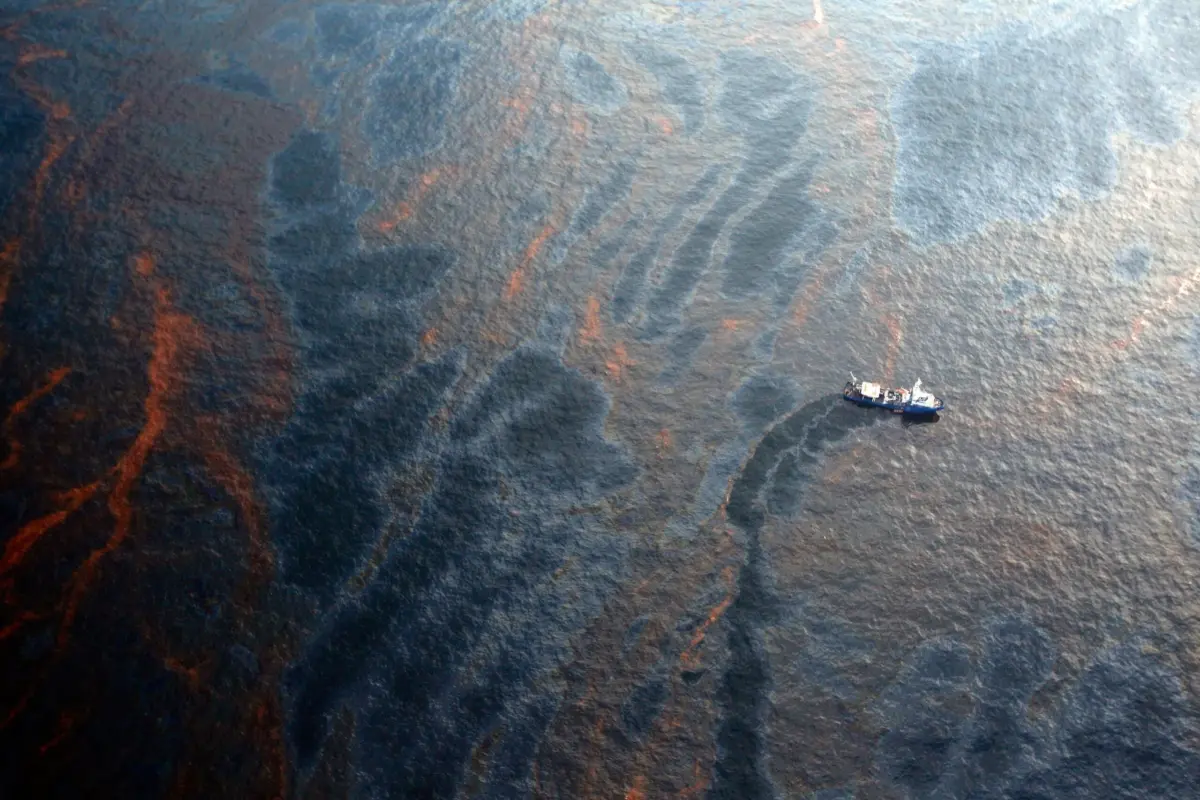
What followed was the largest accidental marine oil spill in human history. For 87 agonizing days, oil and gas spewed uncontrollably from a broken blowout preventer nearly a mile beneath the ocean surface. By the time the well was successfully capped on July 15, 2010, an estimated 4.9 million barrels (approx. 205.8 million gallons) of crude oil had flooded the Gulf.
The volume was staggering: equivalent to about 400 tanker trucks discharging continuously, or enough raw petroleum to fill 1.2 million passenger vehicles. Simultaneously, the fractured well ejected roughly 7.7 billion cubic feet of fossil gas directly into the deep sea—a daily release rate of 88 million cubic feet, sufficient to power the heating and electricity needs of over 820,000 U.S. homes for a year.
In a desperate attempt to mitigate the visible surface slick that threatened sensitive coastal wetlands, government agencies authorized BP to apply 1.84 million gallons of chemical dispersants (primarily Corexit). Rather than eliminating the oil, these chemical agents broke the hydrocarbons down into microscopic droplets, forcing a significant portion of the toxic load to remain suspended within the water column at mid-to-deep depths, directly targeting the creatures inhabiting the abyss.
The Slow-Motion Ecological Collapse
While public attention was justifiably riveted to images of oil-soaked pelicans, dying sea turtles, and ruined salt marshes along the coast, a silent catastrophe was unfolding miles below the surface.
According to the PNAS study, the deep-pelagic ecosystem did not experience an immediate, singular wipeout; instead, it entered a delayed, agonizing spiral. Populations of midwater organisms plummeted by 60 to 85 percent between 2011 and late 2014. Krill and lanternfish—small, highly abundant organisms that form the vital energetic bridge between microscopic primary producers and large pelagic predators—bore the brunt of the toxicity.
As these foundational populations crashed, genetic bottlenecks began to emerge within surviving groups, drastically reducing genetic diversity. Without this diversity, species lose the adaptive capacity required to weather future environmental shocks, locking the region into a diminished state characterized by severely limited ecological resilience.
Supporting Context & Metrics: The Science of the Abyss
To understand the magnitude of this ecological collapse, one must examine the rigorous methodologies deployed by researchers to peer into the ocean’s twilight and midnight zones.
Tracking the Unseen: Methodology of the PNAS Study
Monitoring life in a habitat that ranges from 650 feet to over a mile beneath the surface presents monumental logistical challenges. Researchers established a massive sampling grid surrounding the Macondo well site. To build a robust baseline, they utilized data from nine intensive months of sampling conducted in 2011, subsequently comparing it against nine distinct surveys executed between 2015 and 2023.
The scientific armada utilized a trifecta of investigative tools:
- Stratified Net Hauls: Specialized, large-mouth nets equipped with opening-and-closing mechanisms were lowered from slippery research vessel decks to precise depths. By hauling these nets at both high noon and midnight, scientists accounted for the Diel Vertical Migration (DVM)—a daily biological phenomenon where vast numbers of midwater animals ascend to shallower layers at night to feed and retreat to the dark depths by day.
- Acoustic Echosounders: Ship-mounted scientific sonars beamed sound waves down into the water column, measuring acoustic backscatter (the intensity of sound reflected off the bodies of swimming marine life). This provided an independent, continuous check against physical net catches.
- Genetic Sampling: Tissue samples from surviving populations were analyzed to detect signatures of inbreeding, population contractions, and genetic bottlenecks.
When marine ecologists reviewed the data streams, all three independent lines of evidence—net counts, acoustic telemetry, and genetic markers—pointed in the exact same direction. By systematically ruling out confounding variables such as historical water temperature shifts, oceanic dead zones (hypoxia), and natural climatic cycles, researchers confirmed that the Deepwater Horizon spill was the single parsimonious catalyst for the collapse.
Trophic Cascades and Chemical Interference
The lingering hydrocarbons and toxic dispersant residues did not merely kill organisms outright; they disrupted the fundamental biological mechanisms governing survival in the deep sea. Many midwater organisms rely heavily on acute chemical senses—specifically, a highly developed sense of smell (olfaction)—to navigate pitch-black waters, evade predators, and locate prospective mates.
Toxicological studies conducted in the wake of the spill demonstrated that dissolved petroleum compounds impair chemosensory functions. Unable to detect chemical cues in the dark, animals failed to reproduce efficiently.
This disruption quickly cascaded upward through the marine food web. Dr. Tracey Sutton, a professor of marine and environmental sciences at Nova Southeastern University and lead author of the study, notes that the loss of dense prey patches starved out larger, deep-diving predators. A separate 2024 study documented an 80 percent population decline in deep-diving toothed whales across the region.
"We used to have a big resident population of sperm whales right off the Mississippi River, but we haven’t seen a sperm whale in 10 years," Sutton observed. Large predators require concentrated, high-calorie aggregations of prey to survive; when the midwater forage base collapsed, the apex predators vanished alongside them.
Furthermore, this biological desertification threatens a critical planetary service: the biological carbon pump. Healthy deep-sea ecosystems naturally transport immense quantities of carbon dioxide from the atmosphere down to the deep ocean floor via the daily migration and excretion of biomass. With midwater animal populations decimated by up to 85 percent, the ocean’s capacity to sequester carbon has been measurably compromised.
Official Statements & Accountability
In the wake of the disaster, the federal government, along with state and tribal trustees, initiated massive natural resource damage assessments (NRDA) designed to quantify the ecological injuries and mandate restoration.
In April 2016, BP agreed to a historic $20.8 billion civil settlement—the largest environmental damage settlement in U.S. history. This legal agreement included up to $8.8 billion specifically earmarked for natural resource damages and environmental restoration projects across the Gulf Coast. While these funds have supported extensive marsh replanting, oyster reef reconstruction, and barrier island restoration, critics and independent scientists note that a disproportionate share of restoration dollars targets nearshore and coastal environments, leaving the invisible, ravaged deep-pelagic realm largely unattended.
Independent experts have stepped forward to validate the rigor of the new findings and emphasize their broader implications:
-
Dr. Bruce Robison, Senior Scientist, Monterey Bay Aquarium Research Institute:
"The research is comprehensive and carefully composed. There is no other study that I know of with such an incredible number of net samples… It is important for the public to understand just how disastrous this oil spill was. The Gulf has not recovered, and it’s been over 15 years."
-
Dr. Jeffrey Drazen, Marine Ecologist, University of Hawaii at Manoa:
"Three lines of evidence—net hauls, acoustic surveys, and genetic sampling—corroborate each other, which is unusually strong evidence to support his conclusions. Through logical elimination, and without actually pointing a finger, they leave no doubt that the oil spill is the cause of the decline."
Despite the massive financial penalties levied against BP, the scientific consensus highlights a sobering reality: money can fund coastal marsh grasses, but it cannot resurrect a collapsed deepwater food web or instantly restore genetic diversity lost in the abyss.
Future Outlook: Lessons from the Dark and the Threat of Deep-Sea Mining
As humanity looks increasingly toward the oceans to fuel modern technological demands, the lessons of the Deepwater Horizon disaster carry urgent geopolitical and environmental weight.
The authors of the PNAS study warn that the profound vulnerability exposed in the Gulf of Mexico serves as an ominous warning for emerging oceanic industries—most notably, deep-sea mining. Corporations and governments worldwide are currently eyeing the abyssal plains and mid-ocean ridges for mineral-rich polymetallic nodules containing cobalt, nickel, copper, and rare earth elements essential for electric vehicle batteries and renewable energy infrastructure.
Proponents of deep-sea mining often argue that dredging mineral crusts thousands of meters below the surface is environmentally preferable to terrestrial mining. However, the Deepwater Horizon experience proves that industrial activities in the deep sea can trigger widespread, irreversible ecological degradation. Deep-sea mining operations would discharge vast plumes of wastewater laden with heavy metals, fine sediments, and industrial lubricants directly into the water column, threatening midwater ecosystems with the exact kind of chronic toxic exposure that crippled the Gulf.
Furthermore, the study underscores that industrial actors are moving to exploit and alter deepwater habitats before baseline ecological conditions are even understood. If a single offshore well blowout can trigger the fastest and most severe faunal collapse ever documented in Earth’s largest ecosystem type—and leave it functionally unrecovered a decade and a half later—society must fundamentally reevaluate its willingness to gamble with the health of the deep ocean.
The northern Gulf of Mexico remains a wounded sea. Beneath the sunlit waves and the busy shipping lanes, an invisible wilderness bears the permanent scars of human hubris—a silent, darkened monument to the fragility of life in Earth’s deepest waters.