Executive Overview
In modern cloud-native architectures, managing containerized workloads at scale presents a continuous balancing act between flexibility, security, and operational overhead. For platform engineering teams operating on Amazon Elastic Container Service (Amazon ECS), configuring and maintaining ingress networking for hundreds—or even thousands—of microservices has long been a notorious bottleneck.
Traditionally, every time a new service was spun up, engineers were required to manually provision, wire together, and continuously lifecycle-manage a sprawling web of infrastructure dependencies. This included Application Load Balancers (ALBs), AWS Certificate Manager (ACM) TLS certificates, AWS WAF web access control lists (web ACLs), custom security groups, and complex DNS routing rules. As services scaled up, scaled down, or underwent continuous deployment cycles, keeping these disparate components in strict synchronization became a breeding ground for configuration drift, security vulnerabilities, and deployment friction.
To fundamentally eliminate this per-service operational tax, Amazon Web Services (AWS) has announced the official launch of Amazon ECS Gateway.
Operating as a powerful new account-level resource, Amazon ECS Gateway reimagines how ingress networking is handled for containerized workloads. By shifting the burden of dynamic provisioning and infrastructure lifecycle management directly to Amazon ECS—while retaining strict resource creation inside the customer’s AWS account—the service establishes a clean separation of duties. Platform teams can define centralized networking policies and shared entry points, while application developers can seamlessly attach their services to pre-configured gateways with minimal friction.
Featuring intelligent host-based routing that allows up to 25 distinct services to share a single Application Load Balancer, ECS Gateway significantly optimizes infrastructure costs and reduces the consumption of scarce cloud resource quotas. Available today in all commercial AWS Regions where Amazon ECS is supported at no additional charge, ECS Gateway marks a major evolutionary milestone in simplifying container management at enterprise scale.

Detailed Chronology: The Evolution of ECS Ingress and the Birth of ECS Gateway
The Traditional Burden of Container Ingress
To understand the profound impact of Amazon ECS Gateway, it is vital to examine how containerized networking evolved on AWS and the friction points that necessitated this new architectural paradigm.
Since its inception, Amazon ECS has provided developers with a highly scalable, secure, and tightly integrated container orchestration engine. However, as organizations transitioned from monolithic applications to sprawling microservices architectures, the networking perimeter grew exponentially.
In a classic ECS deployment model, connecting a service to the outside world meant binding it to a target group behind an ALB. While effective for small-to-medium deployments, this approach quickly broke down at enterprise scale:
- Per-Service Provisioning Bottlenecks: Platform teams were inundated with tickets to provision dedicated ALBs or carefully configure listener rules on existing ones for every new microservice.
- Certificate and Security Overhead: Issuing ACM certificates, attaching them to load balancer listeners, writing AWS WAF rules, and mapping granular security groups required complex automation scripts (often managed via Terraform, AWS CloudFormation, or custom CI/CD pipelines).
- Configuration Drift: As services were deprecated, renamed, or scaled across Availability Zones, stale load balancer rules, orphaned target groups, and unmanaged security group entries accumulated, degrading security posture and inflating cloud bills.
The Architectural Breakthrough
Recognizing these systemic challenges, AWS engineers designed Amazon ECS Gateway to inject automation and native intelligence directly into the orchestration layer. Rather than treating ingress networking as an external exercise performed prior to service deployment, ECS Gateway integrates ingress into the core service lifecycle.
The architectural foundation of ECS Gateway relies on an account-level resource abstraction coupled with a flexible many-to-many relationship model. A single ECS Gateway can be associated with up to 10,000 distinct ECS clusters, and conversely, an individual cluster can support up to five gateway associations. This multi-faceted design gives platform teams the unprecedented ability to partition traffic logically—segregating public-facing internet traffic from private, VPC-internal traffic—while maintaining centralized governance.

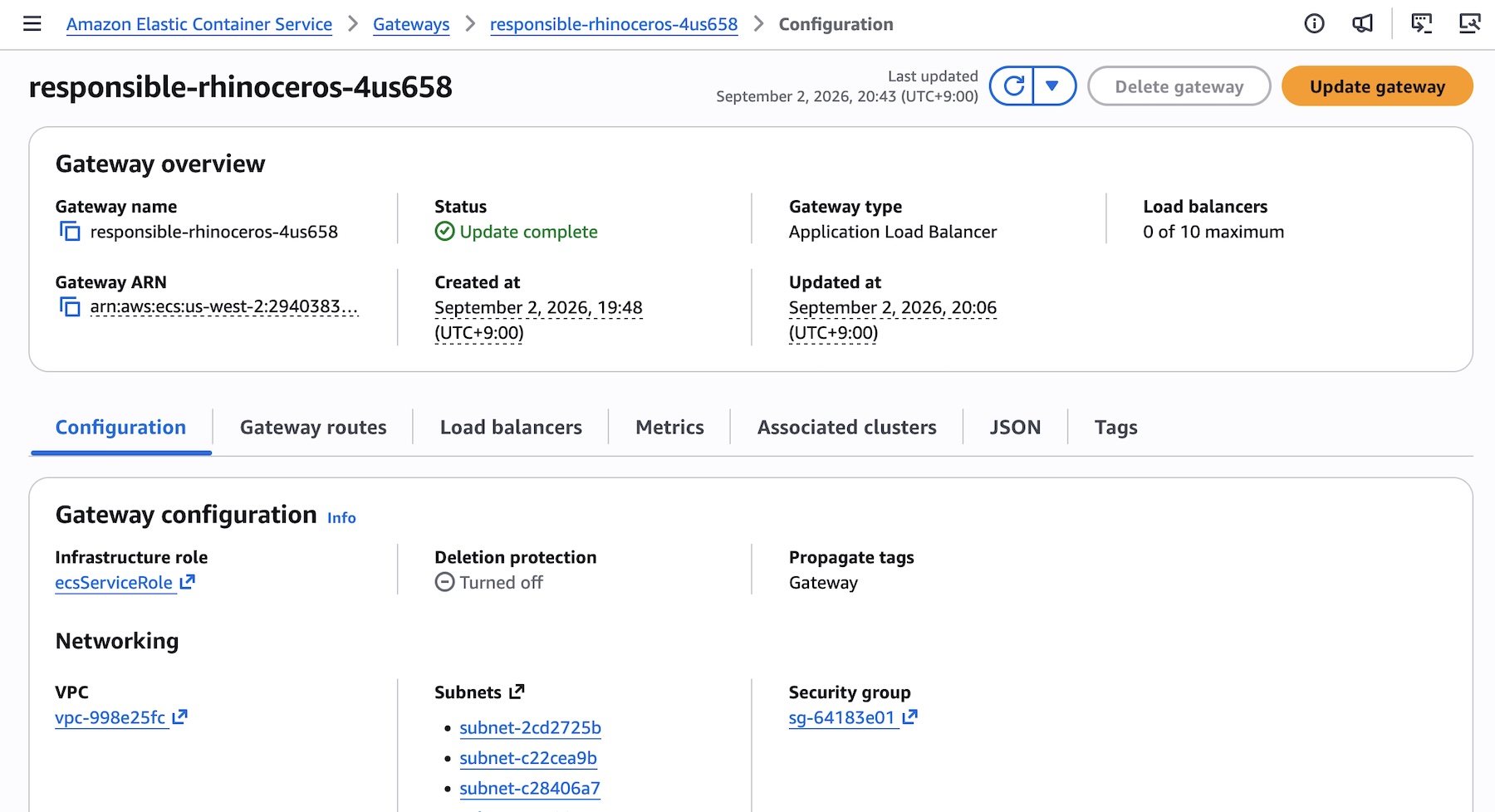
When a platform engineer provisions a gateway, they supply a dedicated AWS Identity and Access Management (IAM) infrastructure role. This role grants Amazon ECS the precise permissions required to instantiate and govern underlying networking components—such as ALBs, security groups, and ACM certificates—directly within the customer’s account. No actual infrastructure is provisioned immediately upon gateway creation; instead, resources are dynamically synthesized on-demand the moment an ECS service connects via a gateway connector.
Supporting Context & Metrics: Under the Hood of ECS Gateway
To fully appreciate the efficiency gains of Amazon ECS Gateway, one must examine its mechanics, operational lifecycle, and cost-optimization capabilities in detail.
Cost Optimization via High-Density Host-Based Routing
One of the most compelling engineering features of ECS Gateway is its intelligent host-based routing capability. In legacy architectures, organizations frequently fell into two financial and operational traps:
- Provisioning a dedicated ALB for every single microservice, which drove up fixed infrastructure costs exponentially (given that each ALB incurs a baseline hourly charge).
- Over-consolidating services onto monolithic, manually managed load balancers, creating brittle dependency chains where a configuration error on one team’s route could disrupt unrelated services.
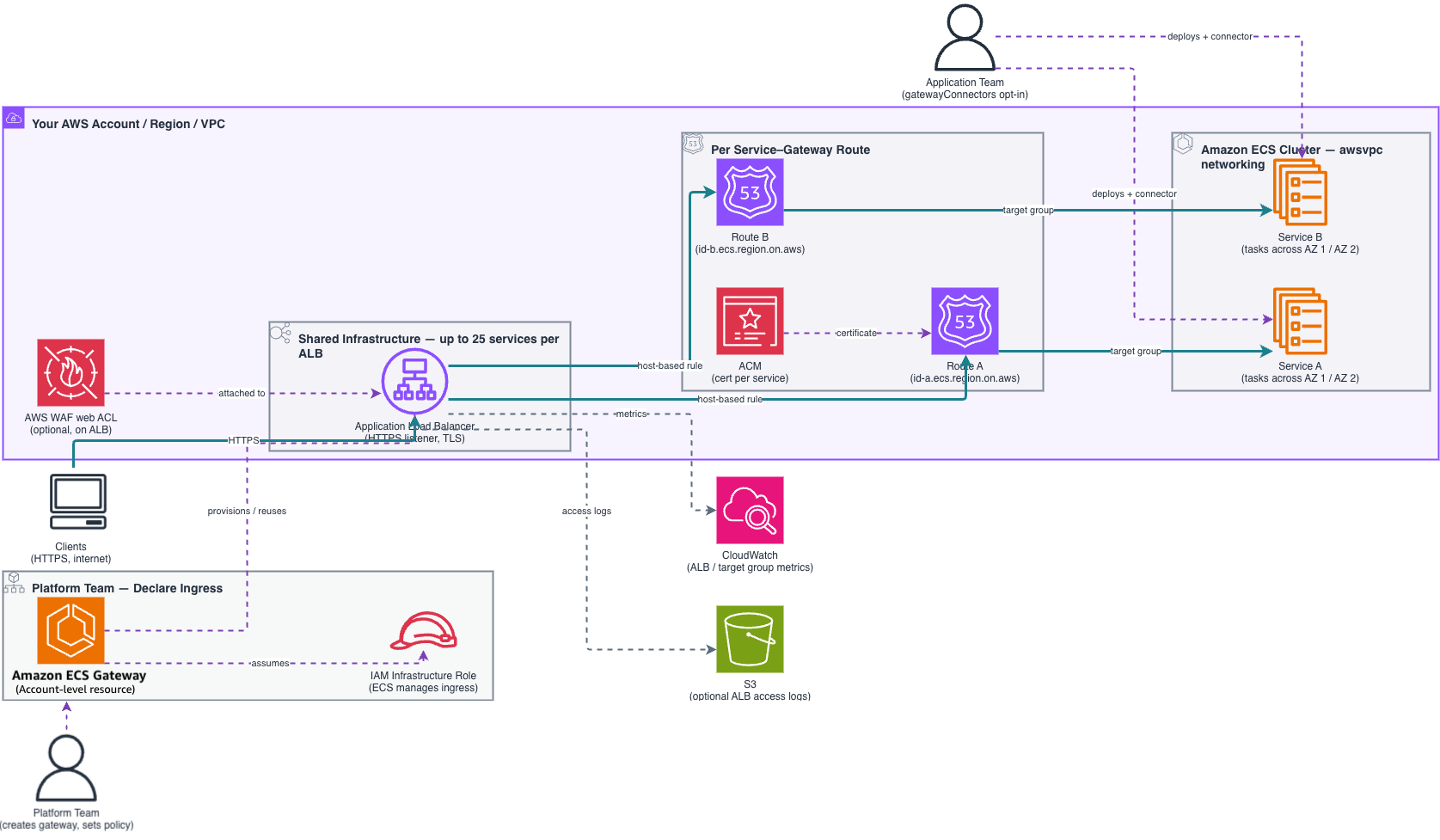
Amazon ECS Gateway solves this dilemma by allowing up to 25 unique services to share a single Application Load Balancer securely. ECS manages this density automatically. When the first service connects to a gateway, ECS provisions the initial ALB. As services scale and approach the 25-service threshold, ECS dynamically provisions a new ALB, scaling up automatically up to a user-defined maximum limit (maxAlbCount). When services are decommissioned and capacity frees up, ECS gracefully scales down the underlying infrastructure.
The Deployment and Connection Lifecycle
The workflow of deploying and consuming an ECS Gateway is engineered for maximum developer velocity and operational safety:
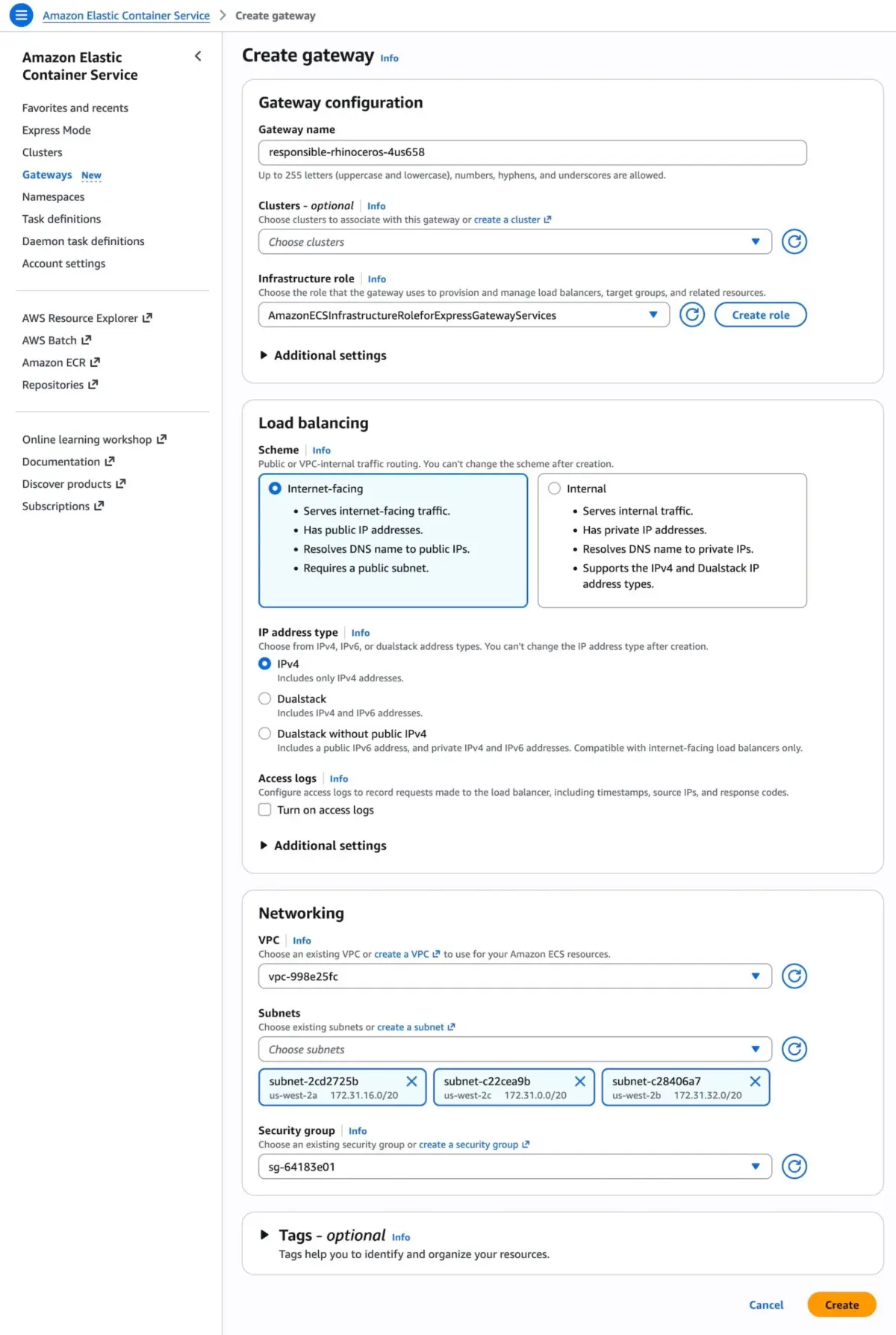
- Gateway Creation: Platform teams instantiate a gateway via the AWS Management Console, AWS CLI (
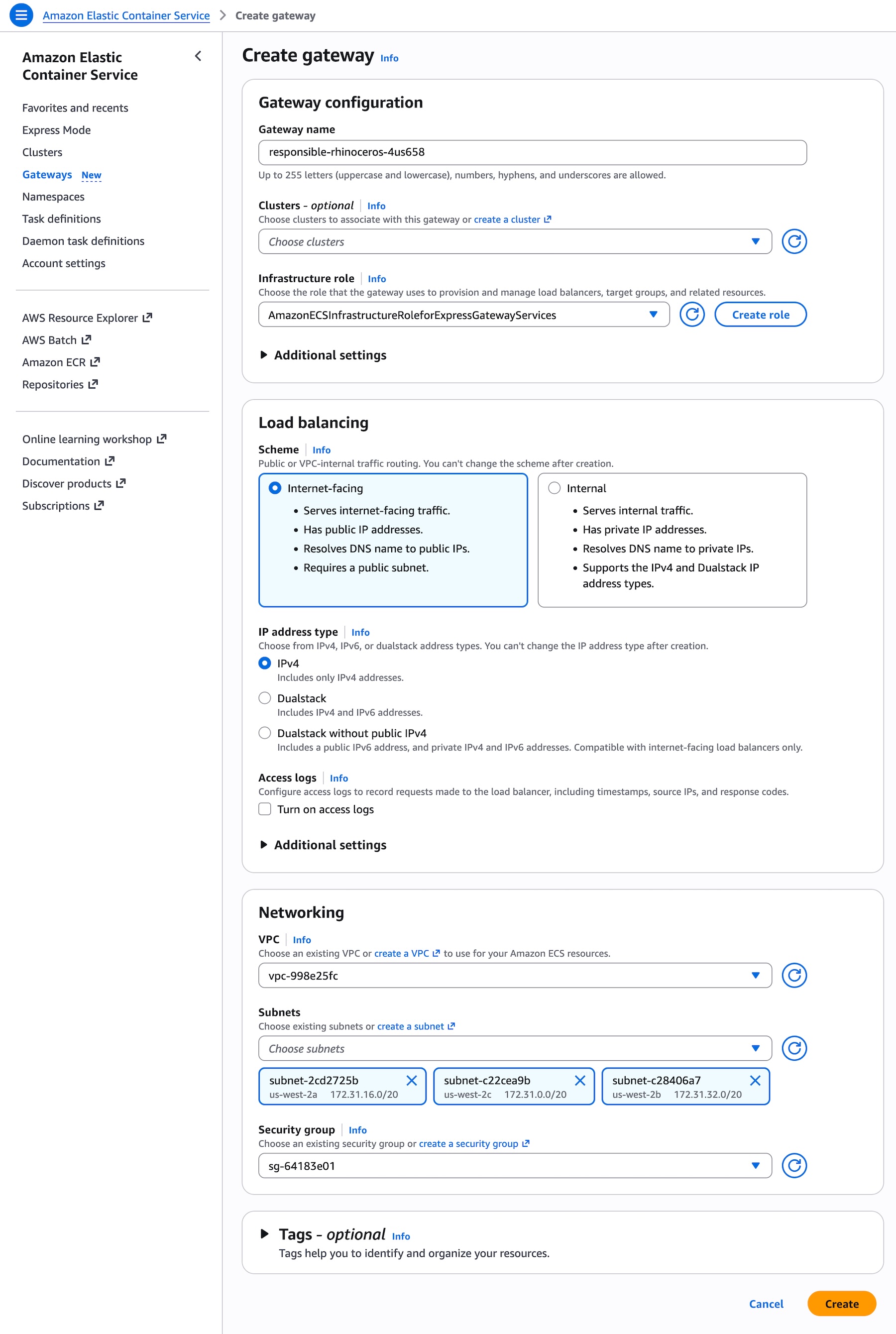
CreateGateway), or Infrastructure-as-Code tools. They define the gateway name, infrastructure IAM role, network configurations (subnets, IP address types like IPv4), and routing scheme (internet-facingorinternal). - Cluster Association: Using commands such as
AssociateGatewayWithCluster, the gateway is linked to one or more ECS clusters, making its ingress capabilities available to any service residing within those boundaries. - Service Integration: Application teams integrate the gateway directly into their service definition (
CreateServiceorUpdateService) by appending a gateway connector configuration:"portName": "api", "filters": "accessTypes": ["PUBLIC"] - Incremental Adoption: For organizations with existing legacy load balancers, ECS Gateway supports a seamless migration path. Services can adopt ECS Gateway incrementally via
UpdateService, allowing both ingress paths to run concurrently. This enables rigorous validation of the new gateway endpoint before legacy load balancer configurations are safely retired.
Automated Provisioning and Cleanup
At deployment time, Amazon ECS evaluates the gateways associated with the target cluster. A gateway is deemed compatible if its access type matches the service connector filter, it resides within the same VPC, and it spans all Availability Zones utilized by the service’s configured subnets.
Upon establishing a connection, ECS orchestrates a comprehensive provisioning sequence:
- Allocates the service to an ALB with available headroom (or provisions a new one if limits are reached).
- Generates a unique, ready-to-use ACM certificate and DNS hostname.
- Instantiates a listener rule that routes incoming traffic for that specific hostname directly to the service’s target group.
- Configures isolated service security groups that accept inbound traffic exclusively from the corresponding ALB security group.
Once initialization concludes, the gateway route transitions to an ACTIVE status, and the microservice endpoint is instantly primed to receive production traffic. Crucially, when an ECS service is scaled down to zero or deleted, ECS automatically reverses the workflow, purging orphaned target group bindings, cleaning up DNS entries, and releasing unneeded ALB capacity to prevent cloud resource sprawl.
Official Statements and Industry Perspective
While AWS has long dominated the container orchestration landscape with Amazon ECS and Amazon Elastic Kubernetes Service (Amazon EKS), industry analysts and cloud architects have frequently pointed out that ingress configuration remained an area ripe for native simplification.
In internal technical briefings accompanying the launch, AWS engineering leads emphasized that ECS Gateway was built specifically in response to direct enterprise feedback regarding operational drag.
"Platform engineering teams want to empower application developers to move fast, but they cannot afford to sacrifice security, cost control, or governance," noted a senior product manager on the Amazon ECS team. "With Amazon ECS Gateway, we are bridging that gap. We have taken the complex, multi-step chore of configuring ALBs, certificates, WAF rules, and security groups and automated it entirely at the account level. Platform teams set the boundaries and security guardrails once; application teams simply connect their services and get a secure, production-ready endpoint instantly."
Industry commentators have echoed these sentiments, noting that ECS Gateway positions Amazon ECS as an increasingly formidable choice for organizations seeking high-productivity container management without the steep operational curve often associated with raw Kubernetes ingress controllers (such as Traefik, NGINX Ingress, or Gateway API implementations).
Furthermore, AWS has ensured that modern AI-assisted workflows are fully supported from day one. Engineering teams can programmatically manage ECS Gateway architectures by leveraging the AWS MCP Server and associated plugins within their preferred AI coding assistants and IDEs, enabling natural-language orchestration of complex gateway deployments.
Future Outlook: What ECS Gateway Means for Enterprise Cloud Architecture
The release of Amazon ECS Gateway signals a broader industry shift toward intent-based networking in cloud-native computing. As microservices architectures continue to scale into the hundreds and thousands of discrete components, manual infrastructure provisioning is rapidly becoming an obsolete anti-pattern.
Looking forward, the introduction of ECS Gateway is expected to accelerate several key architectural trends:
1. The Maturation of Platform Engineering
By establishing a hard architectural boundary between infrastructure administration (managed by platform teams via IAM roles and gateway configurations) and workload deployment (managed by product teams via service connectors), ECS Gateway provides a textbook implementation of Platform Engineering principles. Organizations can build self-service internal developer platforms (IDPs) with absolute confidence that developers cannot inadvertently misconfigure security groups or expose internal services to the public internet.
2. Tighter Cost Governance in FinOps
With cloud budgets under continuous scrutiny, the ability to pack up to 25 services behind a single shared ALB without manual routing gymnastics represents an immediate financial win. Organizations migrating legacy per-service ALB architectures to ECS Gateway will likely see significant reductions in their monthly AWS load balancing expenditures. Furthermore, automated scale-down policies ensure that idle infrastructure does not silently drain corporate budgets.
3. Deepening Integration with AI-Driven DevOps
The Day-1 integration of ECS Gateway with the AWS MCP Server highlights AWS’s strategic alignment with AI-assisted software delivery. As development teams increasingly rely on Large Language Models (LLMs) and specialized coding agents to architect cloud systems, having clean, declarative APIs like CreateGateway and AssociateGatewayWithCluster ensures that AI tools can safely provision, audit, and modify complex networking topologies without human error.
Conclusion
Amazon ECS Gateway is available today across all commercial AWS Regions where Amazon ECS is operational. Because there is no additional service fee for ECS Gateway itself, customers pay solely for the underlying AWS resources provisioned within their accounts (such as ALBs, ACM certificates, CloudWatch logs, and data transfer).
For platform teams battling configuration drift, deployment bottlenecks, and escalating networking overhead, Amazon ECS Gateway delivers a welcome, highly automated solution—transforming container ingress from a painful administrative chore into a streamlined, frictionless developer experience.