In a significant architectural leap for modern data infrastructure, Amazon Web Services (AWS) has announced a powerful new capability for Amazon Aurora PostgreSQL. Organizations can now directly query operational data alongside analytical data lakes stored in Apache Iceberg and Apache Parquet formats, utilizing their existing PostgreSQL applications, tools, and native syntax.
By embedding the high-performance analytical engine DuckDB directly into the database architecture, AWS has removed the traditional requirement for complex, brittle, and expensive extract, transform, and load (ETL) pipelines. Databases no longer need to duplicate historical datasets from Amazon S3 into local transactional storage just to enrich live applications.
This technological integration allows enterprises to bridge the traditional chasm between transactional processing (OLTP) and analytical processing (OLAP). Whether powering real-time executive dashboards, enriching live financial transactions with years of historical context, or engineering autonomous AI agents capable of reasoning over both live system states and deep archival stores, developers can execute these operations through a single, unified interface. Supported on Aurora PostgreSQL major versions 17 (starting with 17.11) and 18 (starting with 18.6), this feature is available across all commercial and AWS GovCloud regions at no additional software cost, signaling a fundamental transformation in how hybrid analytical and transactional workloads will be architected moving forward.
Detailed Chronology and Technical Architecture
The Integration of DuckDB: Bridging OLTP and OLAP
The genesis of this capability traces back to a strategic engineering alignment: the DuckLabs team, principal maintainers of the high-performance analytical database project DuckDB, recently joined Amazon. This collaboration has allowed AWS to internalize the engine’s legendary vector-optimized analytical efficiency and embed it directly into the core runtime of Amazon Aurora PostgreSQL.
Previously, running analytical queries across massive, long-term datasets required reverse-ETL pipelines or heavy data duplication. Operational data inside Aurora had to be continually exported to Amazon S3, or historical data from data lakes had to be prepopulated into dedicated database tables. These workflows generated severe operational overhead, inflated storage bills, and introduced critical data latency gaps.

With DuckDB embedded directly inside the Aurora PostgreSQL engine, the operational boundary has shifted. Query processing happens natively inside the database environment without triggering additional network hops or moving underlying datasets. Uncommitted writes inside the live transactional tables can now be joined cleanly with massive, compressed Apache Parquet files or Apache Iceberg tables residing in Amazon S3 and S3 Tables.
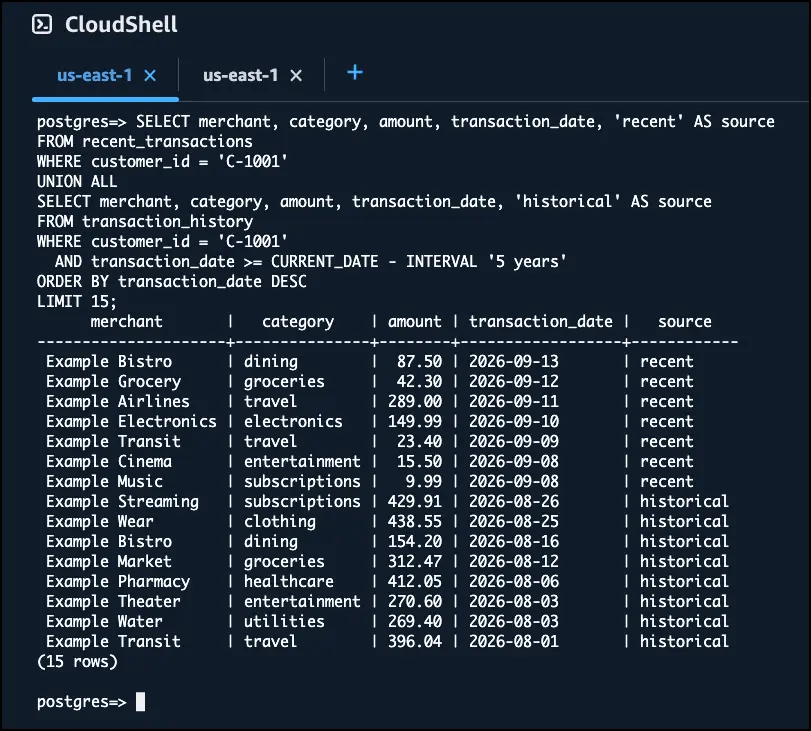
-- Unified querying across live operational data and archival S3 storage
SELECT merchant, category, amount, transaction_date, 'recent' AS source
FROM recent_transactions
WHERE customer_id = 'C-1001'
UNION ALL
SELECT merchant, category, amount, transaction_date, 'historical' AS source
FROM transaction_history
WHERE customer_id = 'C-1001'
  AND transaction_date >= CURRENT_DATE - INTERVAL '5 years'
ORDER BY transaction_date DESC
LIMIT 15;
Setup, Federation, and Execution
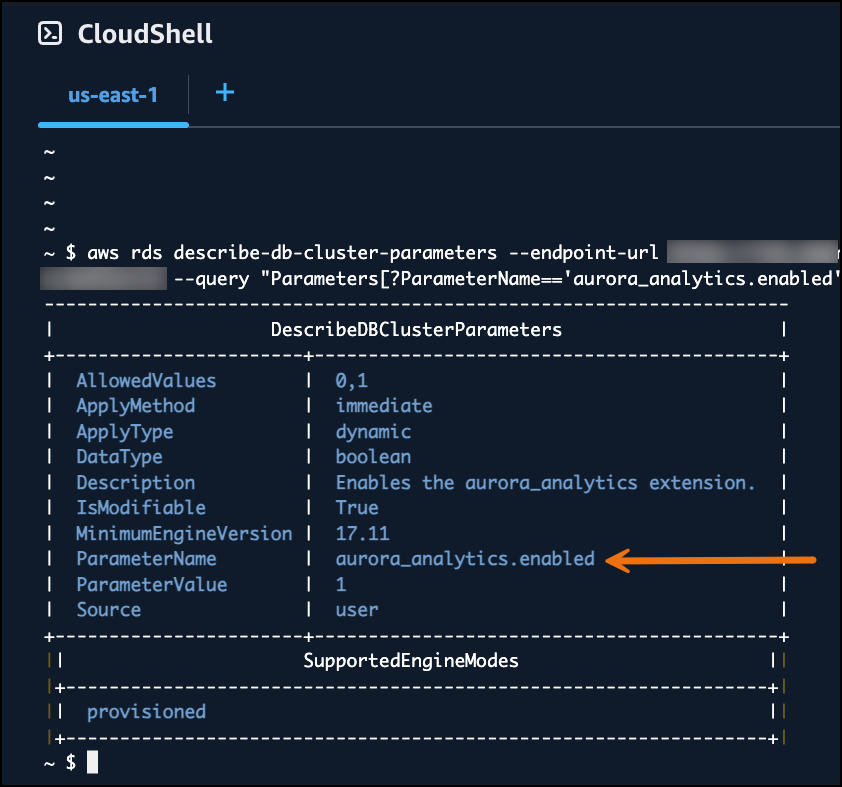
Enabling this capability requires minimal configuration via standard AWS management interfaces or command-line clients. Administrators must establish an Amazon Aurora PostgreSQL cluster running version 17.11+ or 18.6+, attach an AWS Identity and Access Management (IAM) role provisioned with the AuroraAnalytics feature permission, and activate the extension via a standard SQL command:
CREATE EXTENSION aurora_analytics;Once the extension is active, administrators can point to data lakes stored in Amazon S3 by mapping foreign tables. Notably, Aurora automatically infers schemas directly from Parquet metadata and Iceberg table definitions using empty parentheses in the CREATE FOREIGN TABLE statement, eradicating the administrative burden of manual schema definitions. Furthermore, bulk schema imports can be executed using standard IMPORT FOREIGN SCHEMA statements tied directly to an AWS Glue Data Catalog database.
CREATE FOREIGN TABLE transaction_history ()
SERVER aurora_analytics_server
OPTIONS (
    location 's3://<my-bucket>/finance/transaction_history.parquet',
    format 'parquet'
);
Beyond single-bucket S3 integrations, the platform supports Iceberg REST Catalog (IRC)-compatible endpoints through AWS Glue Data Catalog federation. Once registered with Glue, developers can query external catalogs seamlessly, joining multiple disparate data silos in a single transaction without altering existing data governance frameworks.
Supporting Context & Metrics: Performance and Optimization
Advanced Query Optimizations
Directly querying multi-terabyte data lakes from an operational database naturally raises concerns regarding latency, network saturation, and computational bloat. To mitigate these bottlenecks, AWS has engineered several intelligent execution optimizations directly into the Aurora analytics engine:

- Predicate Pushdown: Filters specified in the
WHEREclause are evaluated as close to the data source as possible, ensuring that unnecessary rows are filtered out before being processed by the runtime engine. - Column Pruning: Queries that reference only a subset of columns (e.g., selecting
amountandtransaction_datefrom a table with fifty attributes) will read exclusively those specific columns from Amazon S3, drastically reducing I/O overhead. - Intelligent Caching: Frequently accessed analytical data blocks are cached directly within the Aurora database instance memory. Subsequent queries targeting identical partitions execute significantly faster, bypassing remote storage retrieval entirely.
Diagnostic Observability
Engineers can monitor and audit analytical performance dynamically using built-in statistical functions. By invoking aurora_analytics_stat_statements(), database administrators gain granular visibility into query execution metrics, including:
- Total rows scanned from storage layers.
- Exact byte volumes read from Amazon S3.
- Cache hit ratios and memory utilization profiles.
Strategic Tiering: Materialization for Ultra-Low Latency
While direct querying handles most exploratory, auditing, and AI-driven workflows effectively, certain production applications demand single-digit-millisecond latency profiles. For these hot paths, AWS provides seamless pathways to materialize remote data lake assets directly into native Aurora PostgreSQL tables using standard commands such as CREATE TABLE AS SELECT, INSERT INTO ... SELECT, or MERGE INTO.
This materialized data can be queried locally with maximum performance. Moreover, read-heavy analytical scans can be offloaded entirely to Aurora read replicas, protecting the primary writer instance from performance degradation.
Official Statements and Industry Implications
The architectural shift introduced by this release addresses a glaring bottleneck in modern cloud engineering: the dichotomy between operational agility and analytical scale.
Industry analysts note that as enterprises rapidly scale artificial intelligence and machine learning initiatives—particularly autonomous AI agents—the predictability of data consumption patterns has vanished. Traditional architectures relied on pre-built pipelines that ingested known datasets into operational systems. However, modern AI agents require dynamic, real-time reasoning across arbitrary historical archives and live operational feeds. Pre-replicating every conceivable dataset is practically and financially impossible.
By embedding DuckDB into Aurora PostgreSQL, AWS provides a framework where operational applications and AI systems can dynamically query what they need, exactly when they need it, using standard SQL semantics. The open-source foundations of DuckDB also guarantee that future performance upgrades and feature sets developed by the broader open-source community will flow continuously into the AWS ecosystem, compounding the long-term utility of the service.
Future Outlook: The Next Era of Unified Data Architecture
The introduction of direct data lake querying inside Amazon Aurora PostgreSQL points toward an inevitable convergence of operational and analytical database paradigms. As enterprise data strategies mature, the artificial barriers separating transactional data stores from data lakes are dissolving.
For database administrators, data engineers, and software architects, the implications are profound:
- Reduction of Infrastructure Footprint: The decommissioning of complex, costly reverse-ETL microservices and synchronization pipelines will yield immediate infrastructure savings.
- Accelerated Application Development: Developers can build complex, context-aware features—such as fraud detection systems leveraging five years of deep-archive data alongside live mempool transactions—using familiar database constructs.
- Enhanced AI Readiness: Enterprise AI agents gain immediate access to institutional memory, bridging the gap between real-time operational state and deep historical context without custom data ingestion code.
Available today across all commercial and AWS GovCloud regions at no additional software cost (users pay only for incremental compute consumption and standard S3 API request charges), this feature establishes a new benchmark for database extensibility. As AWS continues to blur the lines between storage tiers and execution engines, organizations that adopt unified querying strategies will unlock unprecedented agility, positioning themselves advantageously in an increasingly data-driven global economy.