Date: November 12, 2026
Author: Saf Malik, Head of Content & Insights
Estimated Read Time: 5 minutes
Executive Overview
The meteoric rise of artificial intelligence and cloud computing infrastructure in the United States faces its most significant regulatory reckoning to date. According to comprehensive market intelligence data published by Cleanview, newly elected and incumbent governors across nine states are positioned to halt an astounding 158.6 gigawatts (GW) of planned data centre capacity. This figure represents a staggering 41% of the entire national data centre development pipeline.
Far from a uniform nationwide ban, the emerging legislative and executive pushbacks are driven by compounding pressures on local power grids, soaring electricity bills for everyday consumers, and environmental strains. Chief among these impacted regions is Texas, which single-handedly accounts for more than half of the exposed capacity.
While financial analysts and market researchers—including Goldman Sachs and Barclays—have flagged similar vulnerabilities, the Cleanview findings reframe the post-midterm political landscape. For hyperscalers, digital infrastructure developers, and real estate investors, the critical question is no longer whether the U.S. buildout will encounter friction, but rather how upcoming policy shifts between December and May will permanently reshape the nation’s digital footprint.
Detailed Chronology of Events
The collision course between hyper-growth data centre expansion and regional power grid limitations has unfolded rapidly over the past year, culminating in a series of administrative halts, executive directives, and local ballot initiatives.

The Texas Precedent: Acting Ahead of the Curve
Texas did not wait for the dust to settle on the midterms to address its impending power crunch. On August 3, 2026, outgoing Governor Greg Abbott issued a directive to the Public Utility Commission of Texas (PUCT) and the Electric Reliability Council of Texas (ERCOT). He ordered them to temporarily halt the approval of new data centre grid connections pending a comprehensive audit of up to 300 projects currently sitting in the queue.
The rationale behind the emergency intervention is rooted in scale. ERCOT reported that it was reviewing more than 474GW of connection requests—a staggering figure that exceeds the state’s all-time record peak power demand by more than five times.
On September 21, Governor Abbott expanded the scope of the moratorium, instructing the Texas Commission on Environmental Quality (TCEQ) to suspend air and water permits for data centres until the comprehensive audit is finalized. Consequently, ERCOT postponed its critical Batch Zero transmission planning study, locking the industry into a holding pattern.
The Political Transition in Austin
Governor-elect Gina Hinojosa has signaled an intent to introduce even stricter oversight. During her campaign, Hinojosa criticized Abbott’s measures as an "election year stunt" and pledged to enact a formal legislative moratorium. Her goal: halt all new approvals until lawmakers codify stringent consumer protections and eliminate tax subsidies for massive hyperscale developers.
However, Hinojosa’s path forward is politically nuanced. While Democrats successfully flipped the Texas House during the recent midterms, Republicans maintained a 19–12 majority in the state Senate. Any permanent regulatory framework will require a bipartisan compromise.

Crucially, the timeline of governance in Texas places immense weight on the calendar over the inauguration ceremony. ERCOT is scheduled to submit its comprehensive audit findings on December 10, presenting them directly to the PUCT on December 17. Meanwhile, the state legislature convenes from January 12 to May 31, with Hinojosa scheduled to take the oath of office just one week into the legislative session. As a result, the ultimate regulatory destiny of Texas’s data centre boom will likely be dictated by mid-December audit metrics and opening-week legislative compromises rather than an inaugural executive order.
Supporting Context & Metrics: Analyzing the Pipeline Exposure
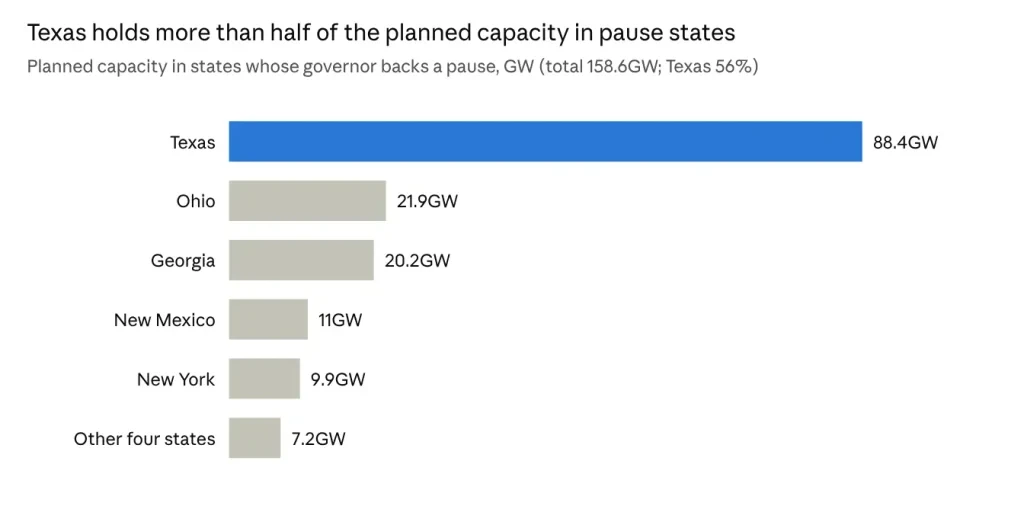
Cleanview’s analysis breaks down the 158.6GW of exposed planned capacity across nine specific states. Significantly, the firm distinguishes between speculative, early-stage pipeline developments and projects already under construction. Nationwide, 56.7GW is currently under active construction—a segment largely insulated from immediate moratoria, as most political pledges target prospective approvals.
State-by-State Breakdown of Exposed Capacity
- Texas: 88.4GW (56% of the exposed total, and over four times the volume of the next highest state). Driven by outgoing actions from Abbott and incoming legislative pushes by Hinojosa.
- Ohio: 21.9GW. Governor-elect Amy Acton advocates a "conditional moratorium" requiring developers to cover 100% of associated utility costs, utilize union labor, and meet rigorous environmental standards. Local voters exercised direct democracy on November 3, with 18 municipalities casting ballots on 21 distinct data centre measures.
- Georgia: 20.2GW. Governor-elect Keisha Lance Bottoms has championed a temporary statewide pause to evaluate the cumulative impact on retail electricity rates and environmental resources. The political momentum has shifted rapidly, with the state House reportedly flipping and Democrats securing a 3-2 majority on the Public Service Commission. High-profile developments, such as OpenAI’s 3.2GW "Project Camellia," have already faced temporary deferrals.
- New Mexico: 11GW. Governor-elect Deb Haaland has promised a day-one executive order enforcing a moratorium on large-scale facilities until rigid regulatory guardrails are established—directly impacting developments like OpenAI’s "Project Jupiter," which awaits vital air permitting.
- Secondary Exposure States (Oregon, Michigan, Wisconsin, Maine, and others): Representing smaller geographic footprints, where newly elected or incumbent leadership has either pledged new pauses or committed to extending existing restrictions. Additionally, an extra 69.2GW (18% of the national pipeline) sits in jurisdictions where newly elected officials intend to overhaul tax incentives and regulatory compliance frameworks without instituting full moratoriums.
Sector Disparity and Hyperscaler Vulnerability
Exposure to these regulatory shocks is far from evenly distributed across the technology sector. Market intelligence indicates that certain dominant players bear disproportionate risk. According to Cleanview analysts, "OpenAI’s entire planned pipeline" is situated in states where newly elected governors championed campaign platforms featuring data centre moratoriums.
Broad economic indicators mirror these findings. Goldman Sachs economists estimate that roughly 45% of planned capacity nationwide resides in states poised to tighten operational rules. Meanwhile, Barclays notes that approximately 80% of the roughly 300GW it classifies as "high probability" development sits in states that will feature a Democratic governor next year. Bloomberg Intelligence further projects that up to 10GW of expected operational capacity may fail to come online as scheduled in 2027.
Official Statements and Industry Perspectives
The overarching consensus among policy analysts and market experts is clear: the current wave of political pushback represents a pause, not a ban.

Governors across the political spectrum are utilizing temporary halts as strategic leverage to rewrite outdated utility frameworks, protect residential ratepayers from surging energy bills, and ensure grid reliability. However, the friction has triggered intense debate over where deferred capital will ultimately flow.
Gordon Johnson of GLJ Research noted the migratory nature of digital infrastructure capital:
"Texas projects that fail to secure permits in a timely manner will probably go to Louisiana, Oklahoma, or nowhere at all."
If major developers abandon restrictive states, the secondary economic impacts will follow. Fiber-optic transit routes, heavy-duty electrical interconnection agreements, and massive renewable energy power purchase agreements (PPAs) will need to pivot alongside migrating construction plans.
Future Outlook: Navigating the 2027 Infrastructure Landscape
As the industry looks ahead to events like Metro Connect USA 2027—the premier executive-level digital infrastructure gathering where major investment and interconnection deals are brokered—stakeholders must adapt to a fundamentally altered regulatory terrain.

Several critical factors will dictate whether the 158.6GW of paused capacity is permanently canceled or successfully unlocked:
- The Evolution of Cost-Allocation Models: States like Ohio are pioneering frameworks where hyperscalers must fully subsidize grid upgrades rather than passing infrastructure costs onto local ratepayers. If successful, these models could serve as a national blueprint.
- Bipartisan Legislative Compromises: In states with divided governments—such as Texas, where the executive and House lean Democratic while the Senate remains firmly Republican—moderation will be required to pass enduring statutory frameworks.
- On-Site Generation Solutions: To bypass transmission queue freezes and regulatory bottlenecks, developers are increasingly exploring dedicated behind-the-meter generation, pairing data centres directly with nuclear, geothermal, or large-scale solar and battery storage facilities.
Ultimately, while the 41% figure highlights the severity of the current regulatory headwinds, it also signals a maturing digital infrastructure market. The era of unchecked, rapid deployment is giving way to a structured, highly scrutinized phase of growth where grid stability, community consent, and environmental accountability will dictate the winners and losers of the AI boom.