Executive Overview
In the fast-evolving landscape of enterprise data architecture, organizations constantly grapple with the complexities of modernizing legacy data infrastructure. For years, the Apache Hive data warehouse software framework served as a foundational pillar for petabyte-scale analytics on Hadoop-compatible storage systems. However, as data volumes have expanded exponentially and analytical requirements have grown more sophisticated, the industry has gravitated toward open table formats that offer enhanced performance, robust ACID transaction guarantees, and advanced data management capabilities. Among these, Apache Iceberg has decisively emerged as the open standard for large-scale analytics datasets.
Recognizing the immense friction organizations face when upgrading their legacy architectures, Amazon Web Services (AWS) has announced a significant, cost-effective enhancement to its cloud storage portfolio. Amazon S3 Tables now natively support fully managed migrations of Apache Hive tables directly to Apache Iceberg. This landmark capability enables data engineering and analytics teams to upgrade their data lakes seamlessly without the traditional overhead of building custom data pipelines, provisioning dedicated compute resources, or enduring prolonged production downtime.
By automating intricate processes such as data validation, compatibility checks, type conversions, file recompression, and compaction, AWS has transformed what was once a multi-week engineering ordeal into a streamlined, API-driven operation. Production workloads can continue uninterrupted while migration jobs run in the background, minimizing table offline times to mere minutes during the final cutover phase. Available today across multiple global AWS Regions, this new functionality promises to accelerate enterprise data lake modernization by removing the technical barriers that have historically hindered transitions to open, high-performance table formats.
Detailed Chronology: The Evolution of Data Lake Migration
To fully appreciate the significance of Amazon S3 Tables’ new managed migration capability, it is essential to examine the historical trajectory of data lake architectures and the operational challenges organizations have faced when attempting to transition from legacy systems.
The Era of Apache Hive and Parquet
In the early days of big data analytics, Apache Hive established itself as the dominant data warehousing software built on top of Apache Hadoop. It provided data summarization, ad-hoc querying, and analysis of large datasets stored in compatible file formats such as Apache Parquet. When enterprises migrated their on-premises big data workloads to the cloud—predominantly onto Amazon S3—many retained the Hive table metadata model, registering their Parquet datasets within centralized metadata repositories like the AWS Glue Data Catalog.

While Hive served its purpose admirably for batch processing and basic SQL queries, it was architecturally constrained by modern standards. It lacked robust support for fine-grained concurrent updates, schema evolution without table rewrites, and efficient time-travel queries. These limitations became pronounced as analytical use cases expanded to include real-time streaming ingestion, machine learning feature stores, and complex data governance mandates.
The Rise of Apache Iceberg
Enter Apache Iceberg: an open-source, high-performance table format designed specifically for massive analytic datasets. Iceberg introduced high-level SQL table functionality to sluggish object storage files, bringing modern database reliability and performance features to data lakes. Key innovations included:
- Schema Evolution: Allowing safe, seamless column additions, drops, and renames without breaking downstream queries or requiring expensive data rewriting.
- Hidden Partitioning: Eliminating user-error risks associated with manual partition filters by automatically handling partition routing under the hood.
- Time Travel Queries: Enabling data engineers and data scientists to query historical snapshots of datasets for auditing, reproducibility, and rollback purposes.
As the industry standardized around Iceberg, enterprises faced a daunting architectural bottleneck: migrating petabytes of existing Hive-registered Parquet data into the new Iceberg format.
The Traditional Self-Managed Pain Points
Prior to the introduction of S3 Tables managed migrations, transitioning from Hive to Iceberg was an arduous engineering undertaking. Organizations typically had to:
- Build Custom Ingestion Pipelines: Write bespoke Apache Spark or Apache Flink jobs to read source Hive tables, transform data types, and write out Iceberg metadata files.
- Manage Infrastructure Compute: Provision and scale clusters of EC2 instances or serverless compute engines to handle the heavy lifting of data conversion.
- Handle Edge Cases Manually: Address data type mismatches, corrupt records, missing values, and complex partitioning schemes.
- Ensure Rollback Capabilities: Construct elaborate verification and rollback mechanisms to prevent data loss or corruption during the transition.
This process routinely consumed weeks or months of specialized engineering time, introduced operational risks, and frequently required significant planned downtime for production analytical workloads.

The Paradigm Shift: S3 Tables Managed Migration
With the launch of managed migrations within Amazon S3 Tables, AWS has systematically eliminated these operational friction points. By shifting the burden of migration logic, validation, and execution directly into the managed storage layer, AWS allows organizations to execute transformations via simple API calls, AWS CLI commands, or programmatic SDKs—fundamentally altering how enterprises modernize their analytical data estates.
Supporting Context & Metrics: Architecture and Economics
Understanding the mechanics of Amazon S3 Tables managed migration reveals a sophisticated engineering design aimed at maximizing performance while minimizing operational disruption and financial outlay.
How Managed Migration Operates Under the Hood
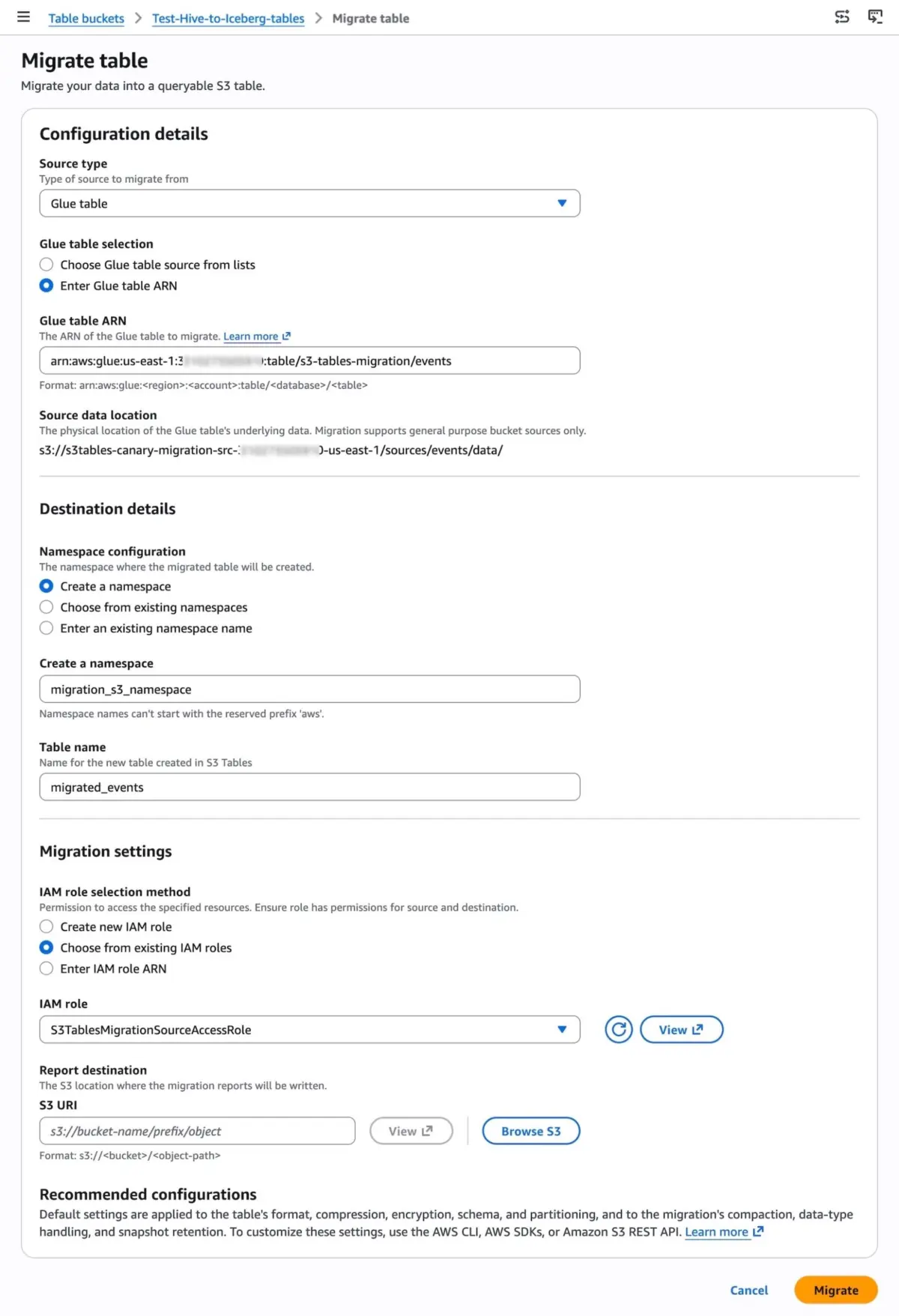
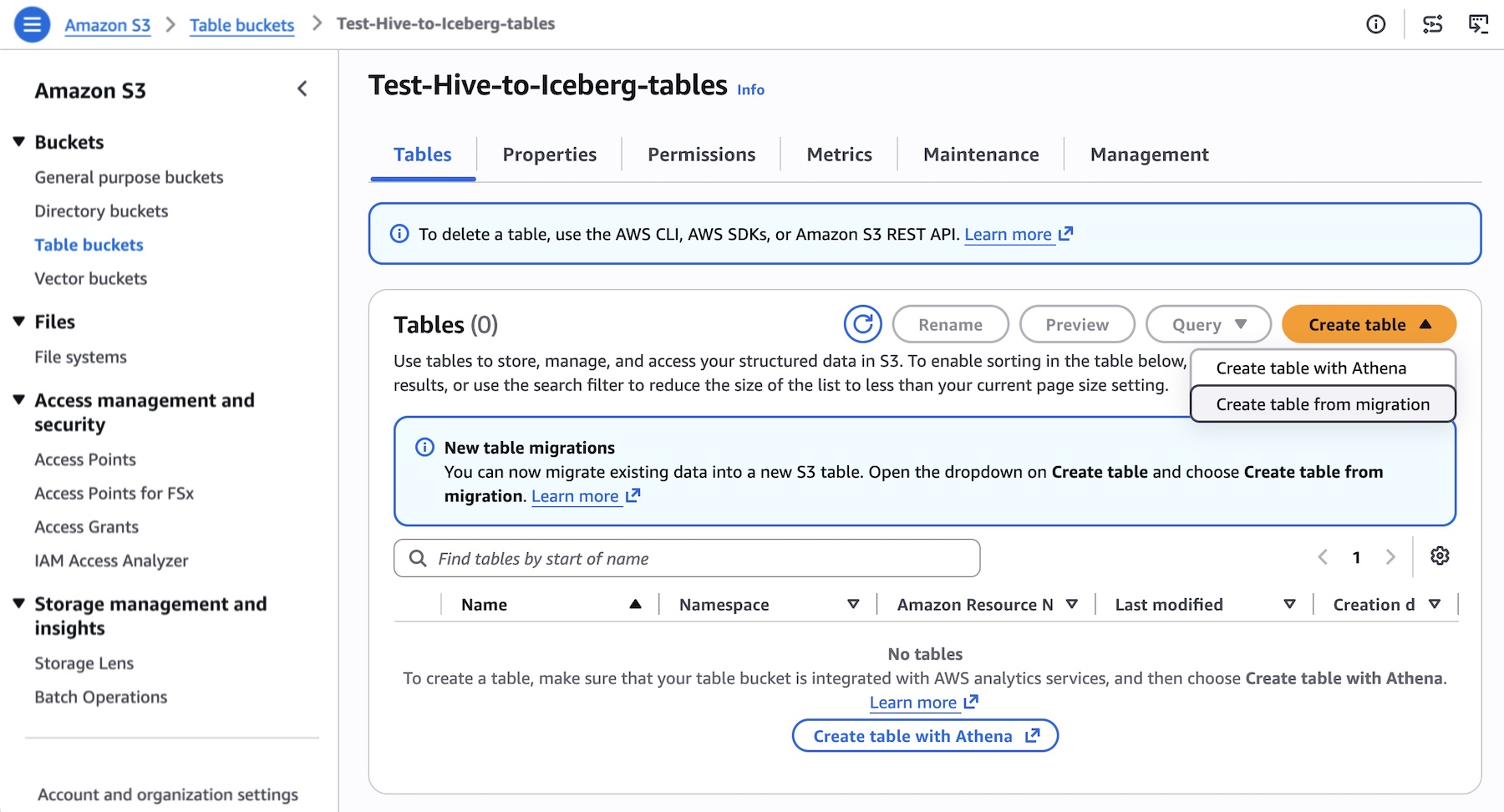
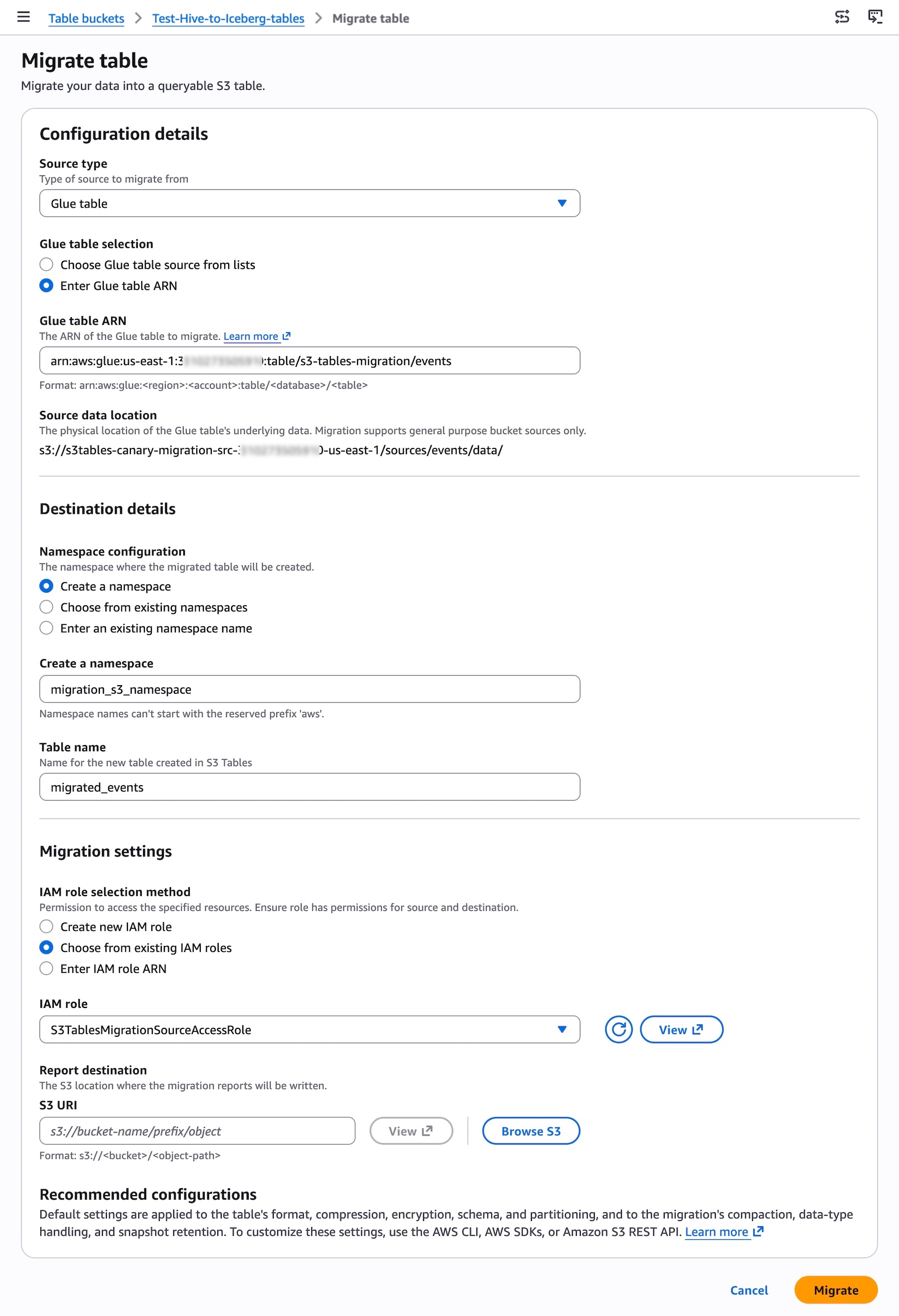
The migration workflow is structured to ensure absolute data integrity and minimal pipeline interference. When an administrator initiates a migration job—either via the Amazon S3 console or programmatically—S3 Tables executes a rigorous sequence of operations:
- Compatibility Assessment: Before copying a single byte of data, S3 Tables inspects every source object in scope. It generates comprehensive compatibility and validation reports, highlighting potential type mismatches, unmatched fields, or structural discrepancies.
- Asynchronous Data Copying and Preparation: S3 Tables manage the heavy lifting of copying source Parquet files, performing necessary type conversions, executing file recompression, and applying compaction algorithms (such as binpacking to target optimal file sizes like 512 MB).
- Continuous Syncing: Recognizing that production data lakes are dynamic environments where write operations never truly cease, S3 Tables provide a
sync-table-migrationcapability. Administrators can repeatedly synchronize the destination Iceberg table with ongoing changes in the source Hive table. Each sync operation intelligently copies only the data that has changed since the previous iteration. - Minimal-Downtime Cutover: During the active migration phase, the destination Iceberg table remains read-only to ensure consistency. Once the initial copy and subsequent syncs have closed the delta, a final cutover promotes the destination table to read-write status. The total period during which the table is offline is reduced to mere minutes.
Economic Advantages: Cost Efficiency in Modernization
Financial considerations often dictate the pace of cloud modernization initiatives. Self-managed migration approaches carried hidden costs, including compute resource consumption for conversion jobs, storage duplication expenses, and labor costs associated with troubleshooting failed custom pipelines.
Amazon S3 Tables managed migration introduces a highly competitive economic model:
- Zero Conversion Fees: Customers pay exclusively for the data copied. There are no additional platform or compute charges levied by AWS for the underlying Hive-to-Iceberg data transformation, type conversion, or compaction processes.
- Storage Tier Preservation: Source objects residing in Amazon S3 Intelligent-Tiering retain their current access tier during the migration process, preventing accidental cost spikes associated with unnecessary tier transitions or data retrieval fees.
- Optimized Storage Management: Once migrated, destination tables reside in S3 Tables—fully managed storage purpose-built to maintain Iceberg table performance as data scales, complete with automated maintenance, optimization, and replication.
Official Statements and Industry Implications
Industry analysts and AWS leadership view the release of S3 Tables managed migration as a watershed moment for open data lake architectures.
"Organizations have overwhelmingly chosen Apache Iceberg as the open standard for large-scale analytics due to its flexibility, performance, and rich feature set," noted a senior AWS storage product leader during the announcement. "However, the operational overhead of moving petabytes of legacy data from older formats like Hive has remained a persistent bottleneck. By baking intelligent migration directly into Amazon S3 Tables, we are removing the engineering tax of modernization. Our customers can now upgrade their data estates seamlessly, keeping their production workloads online, querying data instantly with engines like Amazon Athena, and avoiding the complex pipeline-building of the past."
Furthermore, the integration of managed migration capabilities into modern AI and automation toolsets—such as the AWS Agent Toolkit and the AWS Model Context Protocol (MCP) Server—signals a strategic alignment with the future of software engineering. By providing specialized skills and safety guardrails for coding agents like Kiro, AWS is empowering developers to orchestrate complex data migrations using natural language interfaces and secure, programmatic automation frameworks.
Future Outlook: The Next Wave of Lakehouse Architecture
As enterprises accelerate their adoption of generative AI, real-time analytics, and federated data architectures, the purity and performance of underlying storage formats become paramount. The launch of Amazon S3 Tables managed migration points toward a future where infrastructure upgrades are no longer disruptive, high-risk projects, but rather routine, background administrative tasks.
Accelerating the Open Table Ecosystem
With Hive-to-Iceberg migration now fully managed by S3 Tables, organizations that previously delayed modernization due to resource constraints can now unlock the advanced capabilities of Apache Iceberg—such as granular time travel, efficient partitioning, and robust ACID transactions—with minimal friction. This democratization of data architecture allows smaller engineering teams to compete on an equal footing with hyperscale technology enterprises.
Deepening AI and Agentic Integration
Looking ahead, the integration of storage migration APIs with AI coding assistants and MCP-compliant servers suggests that database and storage administration will increasingly leverage agentic workflows. Data engineers will be able to prompt AI agents to analyze compatibility reports, execute iterative synchronization jobs, and monitor cutover windows with automated guardrails ensuring compliance and data integrity.
Broadening Regional and Format Support
As S3 Tables managed migration rolls out initially across key US, European, and Asia-Pacific AWS Regions for AWS Glue-registered Parquet tables, the foundational framework is primed for expansion. Future iterations are anticipated to encompass broader regional footprints, support for additional source metadata catalogs, and expanded format conversions, solidifying Amazon S3 as the ultimate, future-proof bedrock for modern enterprise data lakes and lakehouses.
Conclusion
Amazon S3 Tables’ new managed migration capability represents a masterclass in reducing technical debt and operational friction. By transforming a notoriously complex, multi-week engineering project into a seamless, API-driven workflow, AWS has lowered the barrier to entry for Apache Iceberg adoption. With robust data validation, continuous synchronization capabilities, zero conversion fees, and deep integration with analytics engines like Amazon Athena and Amazon SageMaker Unified Studio, organizations are now uniquely positioned to modernize their data lakes swiftly, securely, and cost-effectively. As the data analytics ecosystem continues its rapid consolidation around open standards, tools like S3 Tables managed migration ensure that enterprises can transition into the future without leaving their valuable historical data behind.