By Saf Malik
Head of Content & Insights
04 November 2026
Executive Overview
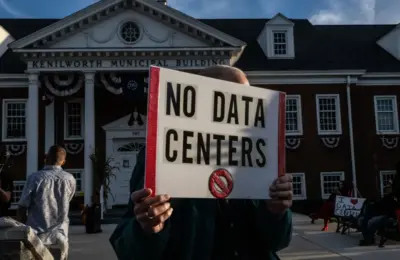
The relentless, high-speed buildout of artificial intelligence infrastructure has officially collided with local democracy. In what political analysts are calling a watershed moment for the digital economy, voters across at least 33 communities in the United States successfully enacted strict localized bans, moratoriums, and energy caps on data centres during Tuesday’s midterm elections.
Fueled by mounting public anxiety over skyrocketing electricity bills, strained municipal water supplies, and aggressive industrial land annexation, the backlash against the AI infrastructure boom has moved far beyond suburban town halls. It is now reshaping statehouses, gubernatorial mansions, and the balance of power in Congress.
According to trackers such as Data Centers on the Ballot and regional reporting, voters overwhelmingly rejected expansion plans. Out of dozens of local measures appearing on ballots nationwide, only a single initiative—in North Dakota—voted in favor of supporting unrestricted construction. Concurrently, exit polls conducted by NBC News revealed that 56% of voters considered AI and data centre development a crucial or major factor in their congressional ballots.
As Democrats wrest control of both chambers of Congress and markets react with volatility to the shifting regulatory landscape, the data centre industry faces an unprecedented reality: future multi-billion-dollar expansions will increasingly require the consent of the ballot box, not just the approval of municipal planning boards.
Detailed Chronology: A Night of Losses for the Buildout
The resistance to data centre expansion crystallised during Tuesday’s electoral contests, transforming hyper-local zoning disputes into national political lightning rods. Ballotpedia had previously cataloged 41 local data centre measures across 10 states, with 28 designed to limit development and 13 intended to facilitate it. The trajectory was unmistakable; earlier in the year, 100% of the ballot measures decided in 2026 favored greater restrictions. Tuesday’s results cemented this trend on a massive scale.
Ohio: The Epicenter of the Backlash
No state experienced the grassroots anti-data centre wave more acutely than Ohio. Hosting more votes on the issue than any other state, Ohio municipalities saw 18 separate jurisdictions vote on 21 distinct measures. At least 14 of these initiatives successfully established bans or stringent restrictions.
- Trenton, Ohio: In one of the most high-profile defeats for big tech, voters passed a sweeping ban on data centres exceeding 25MW with an overwhelming 80% majority. This local legislation directly blocked a controversial plan to annex approximately 600 acres for a massive 1,000MW Amazon Web Services (AWS) data centre campus. While the AWS project theoretically could proceed if the land remains within surrounding unincorporated townships, neighbouring St. Clair Township quickly moved to introduce its own zoning bans.
- Grove City & Wilmington: In Grove City, 55% of voters approved a charter amendment requiring mandatory public referendums on large-scale developments, specifically targeting data centres consuming more than 20MW of power or 500,000 gallons of water daily. Meanwhile, in Wilmington, roughly 80% of voters rejected rezoning requests across four separate referendums intended to clear the way for campus construction.
- Widespread Prohibition: Outright bans were similarly secured in Hubbard, Sunbury, Pataskala, Urbana, Defiance, Upper Sandusky, Piqua, Granville, and Conneaut.
The Statewide and Federal Ripple Effects
The voter rebellion did not stop at municipal boundaries; it fundamentally altered major statewide races.
In Texas—historically a haven for industrial tech investment and massive data centre pipelines—state politics experienced a dramatic shift. Democrat Gina Hinojosa secured a decisive victory in the gubernatorial race against incumbent Greg Abbott after campaigning heavily on a platform advocating for an immediate pause on new data centre projects until stricter regulatory frameworks and grid protections could be established. Governor Abbott had previously attempted to appease critics in August by halting new grid interconnection approvals pending a comprehensive state audit of nearly 300 active projects.
In Ohio’s high-stakes Senate and gubernatorial contests, anti-data centre sentiment proved to be a reliable predictor of voter behavior. CBS News exit polls indicated that constituents who fiercely opposed data centre developments in their local communities overwhelmingly cast their ballots for Democrat Sherrod Brown, helping him secure a crucial victory over Jon Husted in a race vital to the Senate’s balance of power.
Conversely, a few jurisdictions leaned into the economic potential of the displaced capital. In Florida, Republican Byron Donalds won the governorship on a pro-development platform, backed by millions in funding from pro-AI super PACs like Leading the Future. Florida is now strategically positioned to absorb the capital expenditures and capacity pipelines being squeezed out of more hostile, regulatory-heavy states.
Supporting Context & Metrics: Power Bills and Public Sentiment
To understand why the digital infrastructure boom has triggered such fierce populist pushback, one must look directly at household utility bills. The primary driver of community resistance is not an abstract philosophical objection to artificial intelligence, but rather the tangible economic pressure of rising electricity costs.
The Energy Crunch and Grid Realities
A comprehensive Reuters/Ipsos poll published in June revealed that 77% of Americans harbor deep concerns regarding the impact of data centres on their monthly electricity rates. Two-thirds of surveyed Democrats and fully half of Republicans stated they would actively oppose a data centre being constructed in their neighborhoods. Furthermore, earlier polling data from the University of Massachusetts Amherst indicated that a mere 11% of the public would support an AI data centre being built nearby.
This cross-partisan alignment has stripped the issue of traditional ideological divides, making it exceptionally difficult for developers to wait out political cycles. The friction has been stalling capital investments long before voters reached the ballot box. Data Center Watch—a research initiative operated by 10a Labs—recorded at least 75 projects valued at roughly $130 billion that were delayed or outright blocked by local opposition during the first quarter of 2026 alone. A further 45 projects worth $68 billion faced similar roadblocks in the second quarter, according to Bloomberg data.
The cost pressures are most acutely felt within PJM Interconnection, the largest regional transmission organization in the United States, where soaring data centre electricity demand is vastly outpacing the construction of new power generation capacity.

"Power bills became a voting issue, and AI infrastructure is going to pay for it," noted Nigel Green, Chief Executive of the deVere Group.
Market Volatility and Financial Realities
The electoral outcomes and legislative blockades immediately rippled through global financial markets. As the election results unfolded, AI-linked equities suffered an overnight sell-off. Nasdaq 100 futures dropped by as much as 2.4%, while S&P 500 futures dipped 1.4% before recovering. In international markets, Tokyo’s Nikkei 225 plummeted over 4% as major semiconductor and hardware suppliers—including Advantest, Kioxia, and SoftBank—faced heavy liquidation.
Lenders and private equity firms have already begun pricing community resistance, municipal litigation risks, and grid delays directly into financing terms. Meanwhile, industry leaders are exploring radical workarounds. Elon Musk, whose political action committees injected $474 million into Republican campaigns, publicly remarked on social media that "data centers in space" were beginning to look increasingly appealing as terrestrial options face insurmountable red tape.
The commercial viability of orbital compute infrastructure will take center stage at the upcoming Metro Connect USA 2027 conference in Hollywood, Florida (February 8–10, 2027), where a dedicated Space Investment Summit panel will evaluate the cost structures and financial feasibility of launching compute infrastructure into orbit.
Official Statements and Industry Response
Major technology corporations and industry advocacy groups have found themselves on the defensive following Tuesday’s electoral sweep.
Amazon Web Services (AWS) and the Data Center Coalition were immediately approached for comment regarding the 80% voter-approved ban in Trenton, Ohio, which effectively threatens their planned 1,000MW campus. While legal analysts debate whether existing industrial park construction can be grandfathered past the new municipal limitations, the political message is unmistakable: tech giants can no longer rely on quiet, behind-closed-doors zoning approvals.
At the federal level, the political landscape is now deeply fractured. The Associated Press and major networks projected that Democrats successfully flipped seven Republican-held Senate seats (including Iowa, Kansas, Ohio, Maine, North Carolina, South Carolina, and Texas), securing control of the Senate while also taking the House of Representatives.
This sets the stage for a tense divided government. A newly empowered Democratic Congress, responsive to voter anxieties over cost-of-living increases and utility rates, will directly face a White House that has aggressively championed rapid AI expansion. President Trump previously dismissed community pushback against power-hungry facilities as "all a hoax" during public addresses in September.
Analysts suggest that sweeping federal legislative action is unlikely in the near term. With both political parties possessing the leverage to block legislative agendas, financial experts like Nigel Green anticipate prolonged gridlock rather than decisive federal mandates, leaving the battleground firmly planted at the state and local levels.
Future Outlook: Navigating the Post-Midterm Landscape
As the dust settles on the 2026 midterms, data centre developers, utility providers, and institutional investors are forced to recalibrate their multi-year roadmaps. S&P Global’s 451 Research noted that as of the second quarter of 2026, the U.S. boasted 3,173 operational data centres commanding roughly 56.6GW of IT load, alongside 1,140 additional facilities in the active planning pipeline.
The events of Tuesday indicate that a rapidly growing share of that multi-gigawatt pipeline will no longer survive standard bureaucratic permitting; it will require direct, hard-fought voter consent.
Looking forward, industry observers anticipate three major structural shifts:
- A Pivot Toward Grid Modernization and Utilities: With greenfield construction facing fierce local resistance in major metropolitan and suburban hubs, investment capital is expected to rotate toward utility providers and grid-augmentation projects. Strengthening transmission lines and expanding energy generation capacity will likely take precedence over raw compute construction.
- Geographic Diversification: Developers will increasingly abandon hostile jurisdictions in the Midwest and Mid-Atlantic in favor of welcoming, pro-business southern states—such as Florida—where local governments are eager to capture high-tech capital expenditures.
- Alternative Engineering Solutions: High-density operators will accelerate exploratory investments in edge computing, modular nuclear small modular reactors (SMRs), and alternative power purchase agreements (PPAs) that do not strain local municipal grids.
The message delivered at the ballot box on November 4, 2026, was definitive: the digital infrastructure revolution cannot scale at the direct expense of local communities’ financial well-being. For the data centre industry, the path forward requires a fundamental reinvention of community engagement, transparency, and collaborative energy planning.
For further discussions on power constraints, AI infrastructure demand, and digital infrastructure investment strategies, industry leaders will gather at Metro Connect USA 2027, taking place from February 8 to 10, 2027, in Hollywood, Florida.