Executive Overview
When artificial intelligence pioneer Anthropic dropped its amended S-1 registration statement, Wall Street and Silicon Valley immediately fixated on the blockbuster headline figures. The company plans to price 825 million shares at a targeted range of $70 to $78, setting up a public debut under the ticker symbol ANT. At the top of the range, the offering values the company at an eye-watering $64.4 billion. Factoring in a massive $26 billion private placement backed by tech heavyweights—including Google, Nvidia, AMD, Broadcom, Micron, Microsoft, and TSMC—alongside the greenshoe option, total capital raised will comfortably eclipse $100 billion.
Yet, looking past the sheer size of the primary raise and the unprecedented venture syndicate reveals a secondary narrative that is quietly rewriting the rules of corporate finance: the sheer magnitude of employee and founder equity.
A granular breakdown of the amended filing shows that employee-linked equity—spanning vested options, unvested restricted stock units (RSUs), and future incentive pools—totals roughly $384 billion at the top valuation tier. Current option and RSU holders alone control an astounding $216 billion in net value. Spread across Anthropic’s roughly 5,300 employees, the headline average sits at $41 million per person.
This financial tsunami is not merely a corporate milestone; it is a structural shockwave. It dwarfs the size of the initial public offering itself by a factor of 3.4, promises to inject tens of billions of dollars in tax revenue into federal and state coffers, and arms the company with a $160 billion war chest of ungranted equity to poach the world’s top engineering talent. As the tech ecosystem digests these numbers, it is increasingly clear that Anthropic’s public debut marks the birth of a new corporate titan—and the genesis of the next great Silicon Valley mafia.
Detailed Chronology & Financial Mechanics
To understand how Anthropic engineered a public offering of this magnitude, one must trace the rapid acceleration of its valuation, headcount, and capital-raising strategy over the past 24 months.
The Path to the S-1/A
Anthropic’s journey from a research-focused safety lab to a commercial powerhouse has operated at light-speed. At the close of 2024, the company maintained a relatively lean headcount of approximately 940 employees. By late September 2026, that figure had exploded to roughly 5,300, reflecting a staggering hyper-growth phase where more than 80% of the current workforce joined the company in a span of just 21 months.
Concurrently, commercial traction has shattered historical enterprise software benchmarks. According to disclosures in the amended S-1, Anthropic’s annualized revenue run rate reached an astonishing $81 billion as of October 31, 2026—climbing by $10 billion in a single month.
Against this backdrop, the pricing schedule for the IPO has been locked in:
- Ticker: ANT
- Offering Size: 825 million shares
- Price Range: $70 to $78 per share
- Implied Valuation: Up to $64.4 billion at the top of the range
- Pricing Date: Next Wednesday night
- Trading Debut: Thursday, November 19
Deconstructing the Equity Buckets
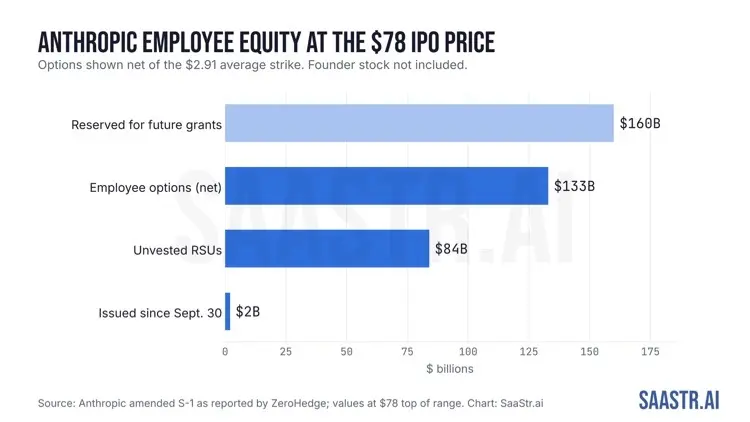
The filing details four distinct tranches of employee and future equity, laying bare a wealth distribution model unprecedented in corporate history. Evaluated at the top-of-range price of $78, the structural breakdown reads as follows:
- Employee Options: Totalling 1.77 billion shares with an average strike price of $2.91, this bucket yields a gross value of ~$138 billion. Subtracting the aggregate strike cost (~$5.2 billion) leaves a net value of approximately $133 billion.
- Unvested RSUs: Comprising 1.07 billion shares, this tranche commands a market value of ~$84 billion.
- Recent Issuances: Shares issued since September 30 for strategic acquisitions and donation matching account for 29 million shares, valued at roughly $2 billion.
- Future Grant Reserve: A massive allocation of 2.05 billion shares reserved under the 2026 equity plan and Employee Stock Purchase Plan (ESPP), valued at approximately $160 billion.
Combined, current option and RSU holders control a net value of $216 billion at the $78 mark (adjusting downward to roughly $194 billion at the $70 floor). Crucially, these figures exclude the ordinary common stock held by Anthropic’s seven co-founders, which sits entirely on top of the $216 billion employee total.
Supporting Context & Metrics: A Closer Look at the Distribution
While a headline average of $41 million per employee ($216 billion divided by 5,300 headcount) generates breathless media coverage, the reality of wealth distribution within the company is deeply nuanced.
The Pre-2025 Cohort vs. Recent Hires
Because Anthropic’s valuation has compounded exponentially, the distribution of wealth is heavily skewed toward early tenure. The average option strike price of $2.91 against a $78 public price represents a staggering 27x spread. These options are roughly 96% in the money, functioning almost identically to outright common stock.
- Early Employees: The vast majority of the $133 billion in net option value belongs to the pre-2025 cohort—a tight-knit group of roughly 1,000 individuals. For these foundational engineers and researchers, individual net worths will far exceed the $41 million average, with many sitting comfortably on nine-figure windfalls.
- Recent Additions: The approximately 4,000+ employees who joined during the massive 21-month scaling window primarily hold unvested RSUs. The $84 billion RSU pool still translates to an impressive average of roughly $20 million per person.
However, the filing also highlights significant near-term accounting impacts. Anthropic reports roughly $32.3 billion in total unrecognized stock-based compensation expense related to RSUs. Because employees received these grants at historical valuations far below the current market price, Q4 GAAP stock compensation expense will spike dramatically during the quarter the offering closes.
The Tax Tsunami
A windfall of this scale carries historic tax implications. Under U.S. tax law, RSUs are taxed as ordinary income upon settlement, while non-qualified option spreads are taxed as ordinary income upon exercise. With the vast majority of Anthropic’s workforce based in the San Francisco Bay Area, top federal and California state income tax rates combine to approach 50%.
Consequently, federal and state tax authorities are poised to collect tens of billions of dollars from Anthropic employees over the next few years. While the headline equity figures are staggering, net liquidity realized by employees will be substantially tempered by the tax man.
Official Perspectives: Founders, Capital Strategy, and Market Control
Amidst the employee wealth creation, the seven co-founders have structured a measured, long-term approach to their own liquidity and corporate governance.
The Co-Founder Secondary Sale
Each of Anthropic’s seven co-founders is offloading 3.38 million shares in the IPO—equating to roughly $264 million per founder at the $78 mark, and $1.85 billion in total secondary volume. Overall, the secondary component accounts for just 23.6 million shares (3% of the total deal), with the remaining 97% consisting of primary capital flowing directly onto the company’s balance sheet.
Industry analysts have broadly praised this balanced strategy. Five years of breakneck execution warrants meaningful liquidity, and $264 million represents a conservative fraction of their total ongoing holdings. More importantly, providing founders with personal liquidity neutralizes the short-term temptation to entertain premature acquisition offers or piecemeal secondary tenders, empowering them to optimize for a multi-decade horizon.
Control of the enterprise remains firmly anchored: the founders will continue to steer Anthropic indefinitely through specialized Class F voting shares. Furthermore, a miniscule 3% secondary float sends a powerful signal to public market investors that the founding team retains virtually all of its long-term skin in the game.
Future Outlook: Reshaping the B2B AI Landscape and the Coming "Anthropic Mafia"
The most transformative metric in the entire S-1 filing is not the $216 billion currently held by employees, nor the $64.4 billion valuation—it is the $160 billion reserved in future equity pools.
The Ultimate Recruiting Weapon
In its amended filing, Anthropic explicitly notes that competition for elite engineering and research talent "is exceptionally intense and has escalated significantly in recent periods, especially in the San Francisco Bay Area."
Armed with a public stock, an annualized revenue run rate touching $81 billion, and a $160 billion war chest of ungranted equity, Anthropic possesses an unfair advantage. No private startup can compete with the liquid, hyper-valued equity incentives Anthropic can now deploy to attract premier senior AI engineers, go-to-market leaders, and foundational research scientists. For every other B2B SaaS and artificial intelligence startup, hiring top-tier talent just became exponentially more difficult and expensive.
The Rise of the Ex-Anthropic Founder Class
Silicon Valley history demonstrates that mega-scale technology companies inevitably spawn generational entrepreneurial ecosystems. PayPal birthed a legendary mafia of founders and angel investors from a few hundred employees; Google and Facebook scaled that phenomenon into thousands.
With approximately 5,300 elite AI engineers, researchers, and operators—many under the age of 35—holding a combined $216 billion in equity, Anthropic is primed to become the incubator for the next era of enterprise technology.
Industry veterans and venture capitalists are already preparing for a massive wave of ex-Anthropic founders launching new ventures across 2027 and 2028. Many of these startups will be entirely self-funded or seeded by former colleagues who can write their own angel checks. Because these new founders will command generational wealth, they will be fiercely selective when choosing institutional venture capital partners.
As the lockup periods eventually expire and the broader market absorbs the mechanics of this historic public debut, Anthropic has firmly cemented its status as more than just a foundational AI lab. It is a tectonic wealth-generation machine that will permanently alter the landscape of technology, talent, and capital allocation for decades to come.