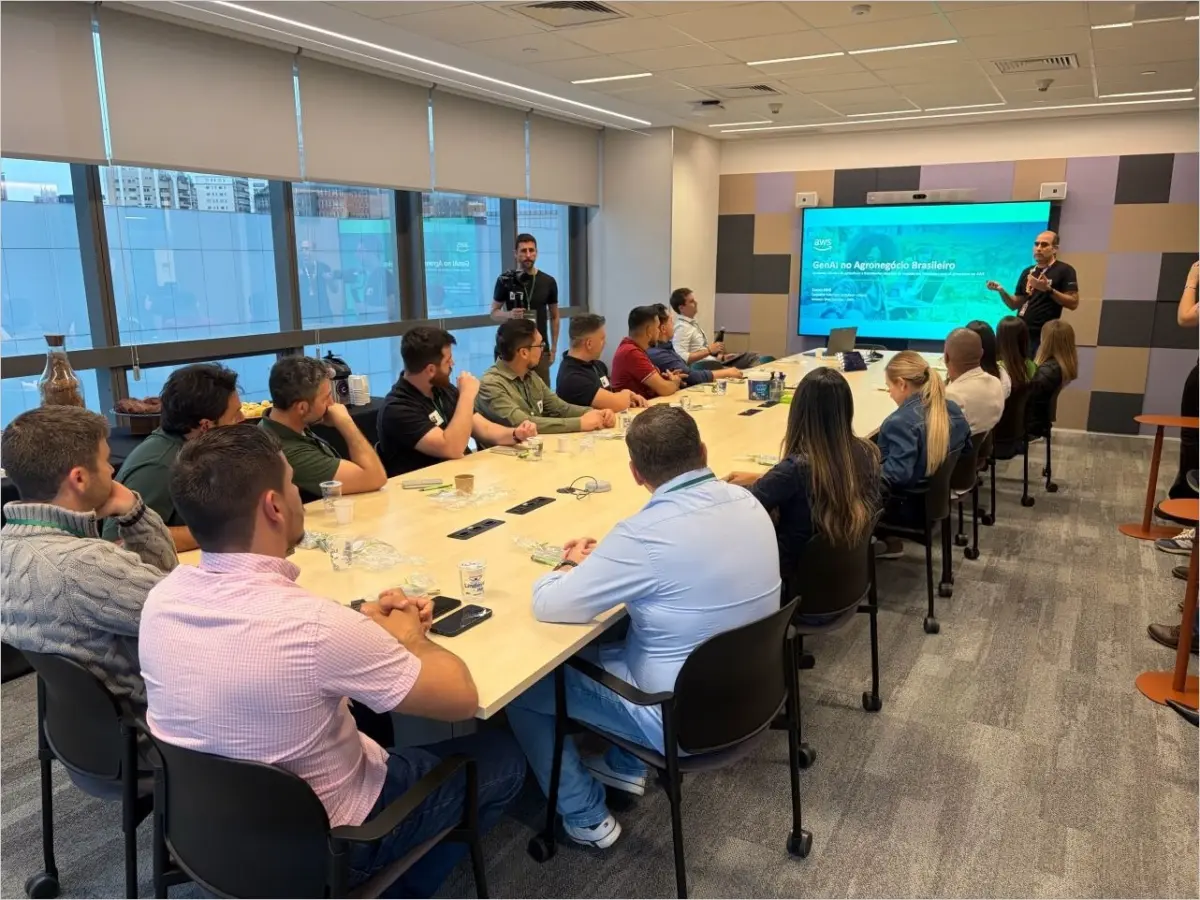
The pace of enterprise cloud engineering has shifted from a cadence of planned optimization to a continuous, high-velocity adaptation cycle. In the modern technology landscape, the traditional boundaries separating infrastructure management, artificial intelligence deployment, and security operations have effectively collapsed. This convergence was underscored during a recent presentation at the Amazon Web Services (AWS) office in São Paulo, where technology and commercial leaders from the Brazilian agribusiness sector gathered to evaluate the integration of generative AI across complex, distributed operational pipelines.
The core takeaway from that discussion was not whether AI belongs in agriculture—that debate has been settled—but rather how to deliver insights effectively to operators in the field. When an agronomist or fleet manager is navigating rural infrastructure with both hands on a steering wheel, the user interface cannot rely on a visual dashboard; it must rely entirely on voice. This operational reality highlights why seemingly routine feature updates, such as the addition of new generative voice engines, hold profound strategic weight for edge use cases.
At the same time, the enterprise security perimeter faces unprecedented strain. Recent telemetry from Amazon Threat Intelligence reveals that the historical buffer between the public disclosure of a vulnerability and its active exploitation has effectively vanished. Attackers are now routinely weaponizing zero-day flaws before patches can be distributed through standard channels.
To address this rapidly compressing threat landscape, alongside managing the relentless expansion of containerized workloads, hardware diversity, and database migrations, AWS has rolled out a sweeping suite of announcements. From the general availability of AWS Continuum for automated vulnerability remediation to the release of Amazon ECS Gateway, native PyTorch support on Trainium via TorchNeuron, and structured outputs for Claude models on Amazon Bedrock, this week’s updates reflect a unified architectural push: removing friction, automating remediation, and tightly coupling security with deployment velocity.
Detailed Chronology & Core Architectural Launches
AWS Continuum: Redefining Vulnerability Management for the Zero-Day Era
The most critical security release of the week is the general availability of AWS Continuum, a service designed to fundamentally reframe vulnerability management from a passive reporting mechanism into an active, end-to-end remediation pipeline. Traditional vulnerability scanners operate on a triage model: they scan code repositories or cloud environments, generate exhaustive lists of Common Vulnerabilities and Exposures (CVEs), assign severity labels, and hand the cognitive burden back to engineering teams. In an environment where threats manifest within hours of discovery, this model is dangerously outdated.
AWS Continuum solves this by building a dynamic, real-time context graph that maps code repositories directly to active AWS infrastructure. When a vulnerability is identified, Continuum does not merely issue a warning; it isolates and reproduces the exploitable finding within a secure sandbox environment, generating proof-of-concept code to verify real-world risk. Findings are subsequently ranked not by generic severity scores, but by their proximity to business-critical systems and actual attack paths.
Crucially, Continuum bridges the gap between identification and remediation by automatically generating a pull request containing the required fix. To maintain rigorous operational control, a strict boundary is enforced: every remediation currently requires explicit human approval before merging. Autonomous application of fixes remains gated behind future confidence thresholds, ensuring that engineering teams retain ultimate authority over production codebases while dramatically accelerating their response times. AWS Continuum is currently available in the US East (N. Virginia) and US West (Oregon) regions.
Empirical Evidence: The Disappearance of the Patch Window
The operational necessity of tools like AWS Continuum was starkly illuminated by empirical data published by Amazon Threat Intelligence during the same week. Telemetry captured by AWS honeypots (MadPot) identified active exploitation attempts of the PHP2Shell vulnerability on October 17—four full days before the underlying flaws, designated as CVE-2026-109618 and CVE-2026-109619, were publicly disclosed.
Even more alarming, fully functional proof-of-concept exploits were observed circulating across underground channels around 02:00 UTC on the official disclosure day, roughly twelve hours before the coordinated embargo was scheduled to lift at 14:00 UTC. This timeline carries a stark, undeniable message for security architects: relying on a patch window measured in days is a catastrophic miscalculation. Modern incident response and threat hunting must treat the earliest known exploitation attempt as the true baseline for investigation, rather than relying on vendor disclosure timestamps. To assist defenders, AWS simultaneously published specific AWS WAF (Web Application Firewall) mitigation rules to intercept exploitation attempts targeting these remote code execution vectors.
Amazon ECS Gateway: Decoupling Network Operations from Application Delivery
In the realm of container orchestration, Amazon ECS Gateway introduces a streamlined architectural pattern designed to simplify how microservices are exposed to external or internal traffic. Historically, managing Application Load Balancers (ALBs), listener rules, target groups, security groups, and Transport Layer Security (TLS) certificates required complex coordination between centralized platform engineering teams and decentralized application developers.
Amazon ECS Gateway cleanly divides these responsibilities. Platform teams define a single, unified gateway encompassing the organization’s subnets, security groups, TLS certificates, listener configurations, and AWS WAF web ACLs. Application developers then opt in simply by attaching a lightweight gateway connector to their service definitions. Behind the scenes, Amazon ECS automatically provisions an ACM certificate, assigns a unique DNS hostname, configures listener rules, generates target groups, and establishes strict security group boundaries that admit traffic exclusively from the designated Application Load Balancer.
The economic and operational efficiencies of this model are substantial:
High Density: Up to 25 distinct services can share a single Application Load Balancer.
Elastic Provisioning: ECS automatically provisions the initial ALB upon first connection and gracefully decommissions ALBs when they are no longer required.
Cluster Scale: A single gateway can be associated with up to 10,000 clusters, with a maximum of five gateways permitted per cluster.
Incremental Adoption: Existing services can adopt the gateway incrementally using standard UpdateService API calls without disrupting existing load balancer configurations.
Amazon ECS Gateway is available at no additional charge across all commercial AWS regions where Amazon ECS is supported.
Supporting Context & Technical Metrics
Beyond core security and networking infrastructure, AWS has introduced significant enhancements across machine learning operations, compute hardware abstraction, and database modernization.
Machine Learning and High-Performance Compute
Amazon Polly Generative Engine Upgrade: The generative speech engine has received a major capability expansion, growing its catalog to 57 distinct generative voices across 11 languages and 25 locales. The update introduces 14 new voices spanning 9 locales, marking the general availability of Hindi and Finnish generative voices for the first time. Crucially, the update includes two new high-fidelity Brazilian Portuguese voices: Leo and Carolina. Designed as a drop-in upgrade, existing applications can leverage these more natural-sounding models without modifying voice names, API parameters (SynthesizeSpeech), or pricing structures.
TorchNeuron (Public Beta): Aimed at breaking hardware lock-in for deep learning workloads, AWS announced TorchNeuron, an open-source PyTorch backend designed to run models natively on AWS Trainium chips. By simply modifying tensor placement (.to('neuron')), developers can execute training and inference workloads on Trainium2 and Trainium3 instances without rewriting core model code. Eager execution and torch.compile remain fully functional, backed by the Neuron Kernel Interface for custom operators.
SageMaker AI Training Sessions: Amazon SageMaker AI now offers fully managed training sessions as a generally available feature. Developers retain complete control over the post-training loop—including custom loss functions and specialized reward signals—while SageMaker abstracts away the underlying GPU allocation, distributed execution orchestration, fault recovery, and checkpoint storage. Billing is metered strictly against processed tokens, pausing entirely while custom reward functions score evaluation batches. This release coincides with expanded native support for advanced foundation models, including Muse Glimmer, Qwen 3.8, and Ministral 3.
Structured Outputs on Amazon Bedrock: Enterprise automation workflows relying on Anthropic Claude models via Amazon Bedrock can now enforce strict, schema-compliant JSON outputs natively. By eliminating the need for custom parsing, regex extraction, and error-prone retry logic, developers can reliably automate complex downstream tasks such as extracting line items from financial reports, parsing unstructured clinical notes, or routing enterprise support tickets based on semantic intent.
Zero-Downtime Migration for ElastiCache Serverless: Organizations managing self-managed Valkey or Redis OSS instances on Amazon EC2 can now migrate directly to Amazon ElastiCache Serverless for Valkey with zero downtime. The service manages online data synchronization and cutover workflows natively, ensuring zero returned errors to connected clients during the transition, measured against standard ElastiCache SLA definitions.
Official Statements and Industry Insights
The convergence of artificial intelligence, autonomous security, and distributed edge computing highlights a broader philosophical shift in cloud architecture. In his keynote address to Brazilian agribusiness leaders in São Paulo, the presenting technologist emphasized that traditional industries are no longer adopting technology simply for administrative efficiency; they are deploying it at the direct point of operational friction.
"When your user has both hands on a steering wheel across hundreds of acres of arable land, the interface is not a screen—it is a voice," the speaker noted, highlighting the critical importance of localized natural language processing models like the upgraded Amazon Polly voices in Brazilian Portuguese.
This philosophy of removing friction extends directly into software development and security architecture. In discussing the release of AWS Continuum and the accompanying telemetry data regarding the PHP2Shell vulnerabilities, security analysts reiterated that the velocity of modern cyberattacks demands an automated, graph-based defense posture.
"A patch window measured in days is an artifact of a bygone era," security telemetry reports indicate. "When proof-of-concept exploits circulate within hours of disclosure—and often before public notification—defensive tooling must operate at machine speed, linking repository context directly to live infrastructure vulnerabilities with verifiable proof."
Future Outlook
As the enterprise technology sector looks ahead to the closing months of 2026, the roadmap points toward deeper autonomy, tighter hardware-software co-design, and increasingly sophisticated agentic workflows.
The upcoming AWS re:Invent conference, scheduled for November 30 to December 4 in Las Vegas, will serve as the primary proving ground for these technologies. With over 2,200 specialized sessions now live in the scheduling catalog, the core themes of the conference are expected to center on agentic orchestration, cost-optimized tokenomics for coding assistants, and fully autonomous remediation pipelines.
Furthermore, community-driven initiatives—such as the AWS Community Day Brasil Norte in Belém—demonstrate the global decentralization of cloud expertise, ensuring that localized enterprise challenges, from voice-first agricultural interfaces to high-availability financial migrations, continue to drive the evolution of the AWS ecosystem.
Organizations that successfully integrate automated security boundaries like AWS Continuum, decouple network topology via ECS Gateway, and embrace hardware-agnostic machine learning frameworks will find themselves uniquely positioned to navigate the compressed threat and innovation cycles of the future. The era of manual patching and static infrastructure management has officially closed; the era of autonomous, continuous cloud engineering has begun.