By Saf Malik
Senior Content and Insights Manager
30 September 2026
Executive Overview
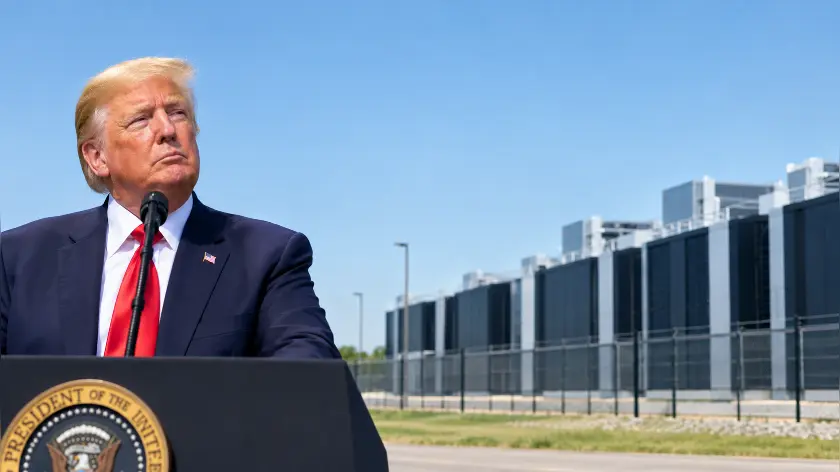
The rapid, unyielding expansion of artificial intelligence infrastructure has officially collided with a powerful wave of grassroots political and economic resistance. US President Donald Trump has doubled down on his administration’s unwavering support for the explosive growth of domestic data centres, insisting that big technology companies will successfully navigate community relations and ensure local populations feel "happy" about heavy construction in their backyards.
However, this high-stakes federal backing—reiterated following a high-profile White House summit on September 29, 2026—clashes sharply with mounting local pushback. As the United States barrels toward the pivotal November 3 midterm elections, the tension between hyper-scaled digital infrastructure development and local resource conservation has become a defining political flashpoint.
While tech giants and federal officials trumpet voluntary safety frameworks and infrastructure pledges, data reveals that local opposition is scaling at an unprecedented rate. Billions of dollars in proposed data centre investments are being delayed, altered, or blocked outright as communities across 49 states push back against soaring electricity bills, grid strain, and rapid landscape industrialization. For developers, operators, and lawmakers alike, the central question of 2026 remains unchanged: Can voluntary corporate promises and federal encouragement bridge the widening gap between the demands of the AI revolution and the realities of local communities?
Detailed Chronology: A High-Stakes September in Washington
The political dynamics surrounding AI and data centres reached a boiling point during the final week of September 2026, driven by strategic White House engagements and legislative maneuvers.
The September 29 White House Summit
On Tuesday, September 29, 2026, President Trump hosted a high-level luncheon at the White House, bringing together the most influential leaders in the global technology sector. The guest list read like a who’s who of the artificial intelligence and semiconductor boom:
- Dario Amodei, CEO of Anthropic
- Greg Brockman, President of OpenAI
- Sundar Pichai, CEO of Google and Alphabet
- Mark Zuckerberg, CEO of Meta
- Elon Musk, CEO of xAI
- Jensen Huang, CEO of Nvidia
The primary deliverable of the gathering was the signing of a landmark document titled the White House Accord on Super Intelligence: Joint Commitment on Frontier Responsibilities. Designed to preempt heavy-handed federal regulation, the accord commits signatories to establishing a four-tier oversight structure for frontier AI models. This structure includes rigorous internal controls, dedicated internal oversight teams, independent external auditors, and a specialized independent board committee. Furthermore, signatories agreed to convene regularly to establish baseline safety standards, with provisions indicating that these voluntary steps could eventually be codified into law.
Yet, the framework immediately drew skepticism. The accord lacks mandatory requirements to publish audit results or publicly disclose the identities of the independent auditors. President Trump defended the agreement as "morally binding"—despite its lack of direct legal enforceability—and revealed that his administration is actively considering a 10-person advisory board to oversee ongoing AI safety measures.
The voluntary nature of the framework drew sharp rebukes from Capitol Hill. Prominent critics, including Senator Elizabeth Warren, lambasted the approach. "Self-regulation? That’s a recipe for disaster," Warren warned, reflecting deep partisan divisions over how—or if—the federal government should police the rapidly advancing AI sector.
Addressing the Midterm Political Fallout
During the post-summit press briefing, reporters pressed President Trump on whether his aggressive promotion of power-hungry data centres could jeopardize Republican chances in the upcoming November 3 midterm elections.
Dismissing concerns over voter backlash, Trump maintained that major technology corporations are fully aware of local sensitivities and are prepared to appease host regions by "making massive contributions to communities." This assertion attempts to frame data centre developments not as a drain on local resources, but as engines of local economic revitalization through tax revenues, infrastructure investments, and community funding programs.
Supporting Context & Metrics: Opposition Measured in Billions
President Trump’s optimistic outlook on community relations stands in stark contrast to empirical data tracking nationwide pushback against digital infrastructure projects. Resistance to data centre construction has surged to unprecedented heights, evolving from isolated neighborhood complaints into a coordinated, multi-state political movement.

The Rising Tide of Local Resistance
According to comprehensive research published by the market intelligence group Data Center Watch, the friction between developers and local populations is hitting historic peaks:
- Q2 2026 Bottlenecks: Between April and June 2026, at least 45 distinct data centre projects—representing a staggering cumulative value of nearly $68 billion—were officially blocked, delayed, or heavily restricted by local opposition. This figure accounts for more than half of all large-scale developments proposed during the quarter.
- A Record-Breaking First Half: This followed an even more volatile first quarter, which saw at least 75 projects valued at approximately $130 billion run into severe local roadblocks. This marked the largest single-quarter total for opposition-driven delays on record.
- Cumulative Impact: Combined, the first half of 2026 has witnessed roughly 120 projects worth nearly $200 billion face substantial hurdles. Capacity’s reporting from earlier in September confirmed that active anti-data centre community groups now operate across 49 out of 50 states.
Preemptive Moratoriums and Legislative Action
Rather than waiting for zoning applications to land on their desks, municipal and state governments are increasingly taking pre-emptive defensive measures. Communities across the country are issuing blanket moratoriums on industrial rezoning for digital infrastructure.
Concurrently, state legislatures are moving aggressively to assert local control. More than 300 data centre-related bills have actively progressed through over 30 state legislatures throughout 2026. These measures target everything from water usage and acoustic pollution to zoning boundaries and grid integration timelines.
Official Statements and Legislative Countermeasures
At the core of the local backlash is a fundamental anxiety over electricity bills and grid reliability. As data centres require gigawatt-scale power inputs to train and operate advanced large language models, everyday ratepayers fear footing the bill for necessary utility upgrades.
The Ratepayer Protection Pledge
Recognizing this political vulnerability, the federal government has leaned heavily on corporate accountability measures. In March 2026, the White House brokered the Ratepayer Protection Pledge, initially signed by industry heavyweights including Amazon, Google, Meta, Microsoft, OpenAI, Oracle, and xAI. Under this agreement, tech firms committed to building, sourcing, or purchasing the exact clean power their facilities require, while fully absorbing the financial burden of the grid upgrades they trigger.
The scope of this initiative widened significantly in July 2026, expanding to encompass more than 200 additional utilities, data centre developers, rural electric cooperatives, and state agencies. According to White House figures, the expanded pledge now covers roughly 80% of all power delivered to US homes and businesses.
Congressional Action: The Ratepayer Protection Act
Moving beyond voluntary pledges, Capitol Hill has sought to enshrine these principles into federal law. Earlier in September 2026, the House of Representatives overwhelmingly passed the Ratepayer Protection Act in a bipartisan 417-to-3 vote.
The legislation fundamentally alters how state utility regulators evaluate massive energy consumers. It mandates that regulators enforce standards requiring large-load facilities—principally data centres—to cover 100% of the incremental costs associated with the generation, transmission, and distribution upgrades required to serve them. By legally insulating residential and small-business ratepayers from infrastructure cost overruns, lawmakers hope to neutralize the economic grievances driving local opposition.
Future Outlook: What It Means for Operators and Developers
As the United States approaches the November 3 midterm elections, the landscape for digital infrastructure developers is characterized by a complex paradox.
On one hand, the signal emanating from Washington remains decisively pro-expansion. The federal government recognizes that maintaining global dominance in artificial intelligence requires a massive, unbroken buildout of high-performance computing facilities. For data centre operators, political backing from the highest levels of government provides long-term regulatory certainty and structural encouragement.
On the other hand, this backing comes with stringent, non-negotiable caveats:
- Financial Self-Sufficiency: Operators can no longer rely on subsidized energy models. They must demonstrate that their projects are entirely self-contained regarding power procurement and grid enhancement costs.
- Proactive Community Engagement: Promises of future economic contributions—as highlighted by President Trump—must be delivered upfront. Developers face an environment where passive public relations campaigns are insufficient; building trust requires immediate, tangible community benefits and transparent communication.
- Navigating Preemptive Restrictions: With local opposition shifting from reactive project protests to pre-emptive state and municipal moratoriums, site selection strategies must evolve. Navigating the regulatory maze will require deep engagement with local stakeholders long before breaking ground.
Ultimately, whether voluntary corporate accords, federal ratepayer legislation, and community charm offensives will be sufficient to quell the multi-billion-dollar resistance movement remains to be seen. As the industry looks ahead to major sector convenings like Metro Connect USA 2027, digital infrastructure leaders must prove they can scale not only technologically and financially, but socially and politically as well.