Executive Overview
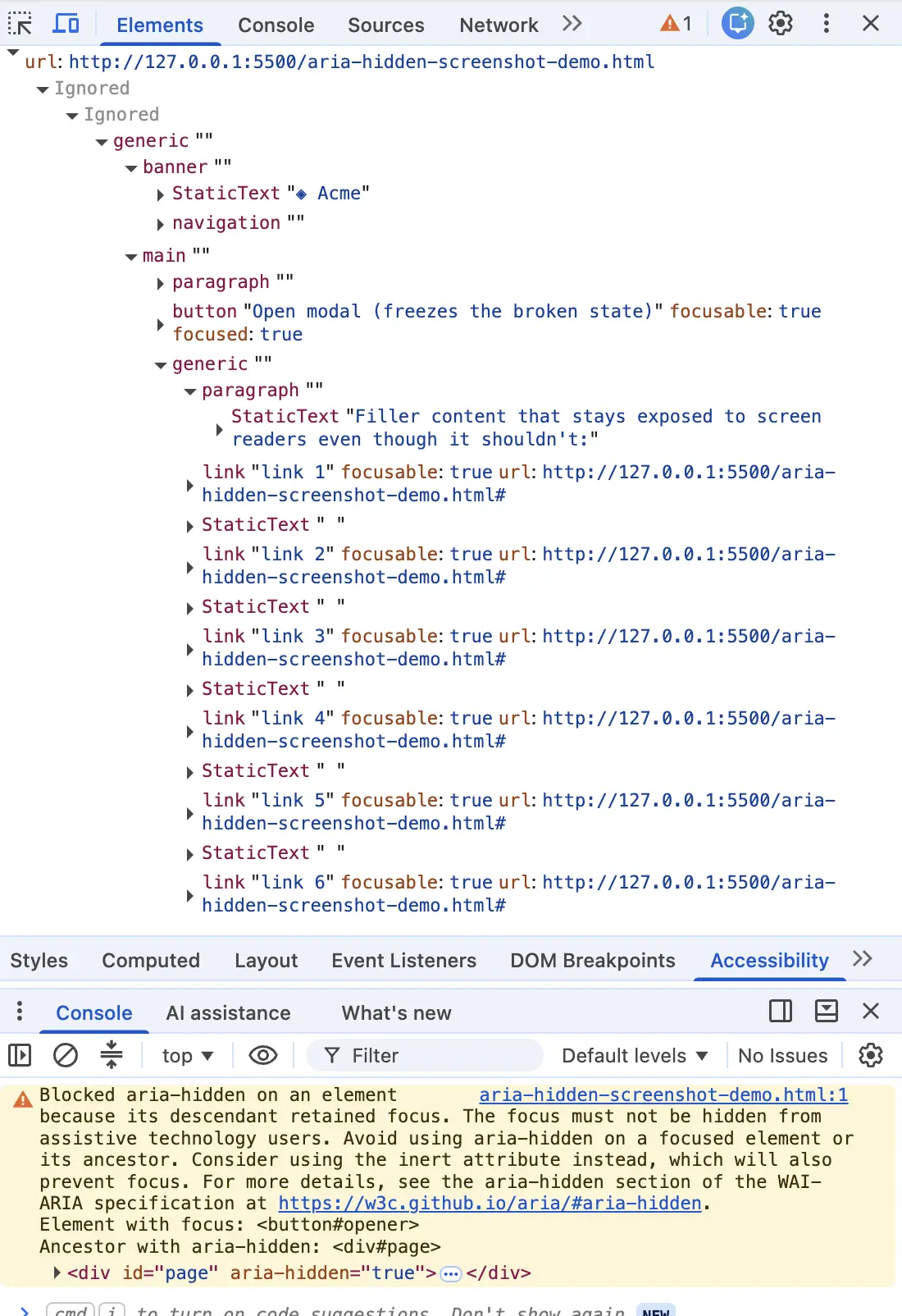
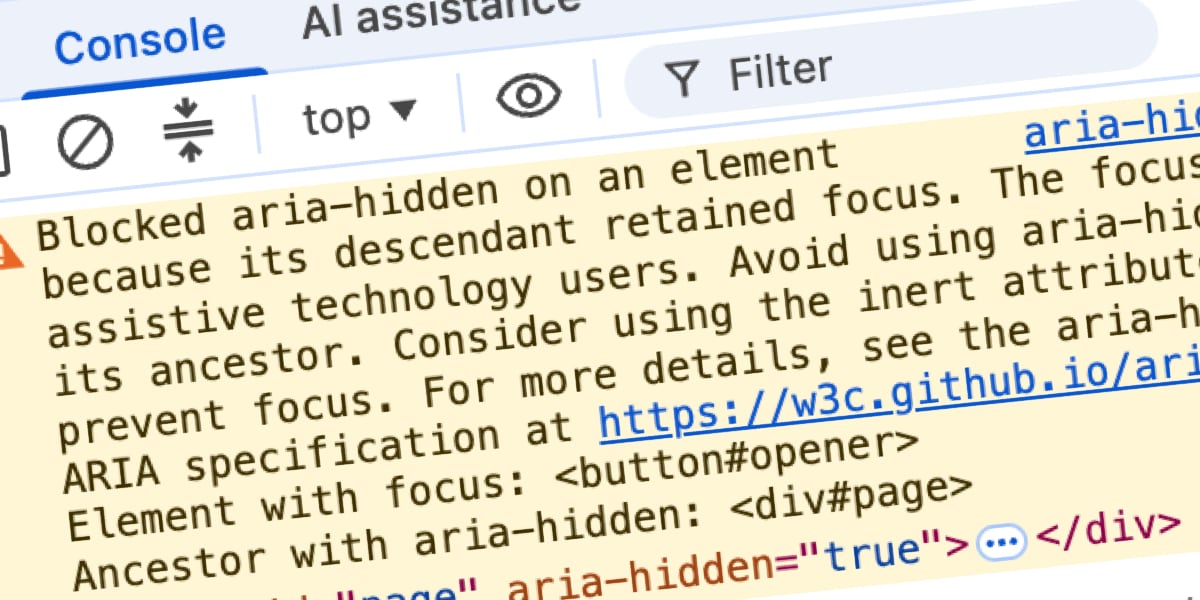
Every front-end developer knows the drill. You close a dialog box, and the browser console erupts in a shade of angry mustard. You highlight the error string, paste it into a search engine, and instantly join half the developer internet. Whether your stack is built on Angular, Bootstrap, Ionic, or running deep inside phpMyAdmin, this exact warning triggers universally.
Here is the inconvenient truth that top-ranking search results consistently bury: the warning is correct.
There is a real human being on the other side of that browser window—someone navigating via screen reader whose focus is about to drop into a profound structural hole in your page.
The most common community fixes—the blur() one-liner, the setTimeout wrapper, or stripping the aria-hidden attribute entirely—all share a fatal flaw. Each one quiets the console while quietly harming the user the browser was trying to protect. If you have already shipped one of these band-aids into production, you are in massive company. You were failed by your search results, not by your own carelessness. I know this because I shipped one, too.
Detailed Chronology: The Anatomy of a Browser Crackdown
To understand how our applications reached this state, we have to look closely at the timeline of how modern rendering engines handle focus and accessibility trees.
Chromium has been quietly patching accessibility defects involving focusable aria-hidden nodes for years. However, the developer-facing warnings arrived in two distinct waves:
- The Open-Time Inversion (Summer 2024): Around Chrome 127, developers noticed a sudden cluster of warnings complaining about elements that "just received focus" within hidden subtrees. Bug trackers lit up across Material-UI, Ant Design, and Flowbite.
- The Close-Time Race (Late 2024): Arriving with Chrome 131, the "retained focus" variant hit developers closing modals during transition fades. Bootstrap and Angular repositories flooded with identical issues.
Historically, Chromium began exposing focusable aria-hidden nodes as early as 2020. Engineers realized that completely hiding content from screen readers while a user’s cursor was actively parked inside it resulted in total silence. A user would press Tab, a control would visually light up, but the screen reader would output nothing. They were left stranded in a room the map insisted didn’t exist.
Firefox and Safari handle this differently, executing accessibility tree repairs silently without surfacing console warnings. But Chrome decided to make developers feel the pain. While the tone is jarring, the core motivation is sound: a silent fix lets broken code ship forever, because a browser papering over your mistake is indistinguishable from your code being correct. Loud is uncomfortable, but loud is honest.
Supporting Context & Metrics: The Four Trap Doors
Every instance of this bug ends in the same place: focus sitting inside a region that just went hidden. But they arrive via four distinct architectural vectors.
1. Hidden Mid-Goodbye (The Close-Time Race)
You click the close button. The dialog starts its fade-out animation. Somewhere within those 200 milliseconds of CSS transition, focus is still parked on the close button, which sits inside an overlay the library just marked hidden to trigger the fade. The transition hasn’t finished; focus hasn’t moved. Chrome flags the retained focus.
2. The Trigger Left Behind (Open-Time Inversion)
Run it in reverse. The overlay opens, and the library marks the background aria-hidden="true". However, the button the user just clicked lives in that background, holding focus for a brief moment before anything moves it into the dialog. Hidden region, focused node inside—warning triggered.
3. The Turf War (Nested Composition Conflicts)
You open a <dialog> and nest a <select> inside it. The user opens the select, picks an option, and it closes. Two components that each believe they are the "one true modal layer" begin fighting over who gets to hide the rest of the page. Under React 19, this morphs from an annoyance into a total page freeze as the inner select tears down and focus momentarily drops to <body>.
4. The User Walked Out
Nothing changed on your page; the user simply switched browser tabs (Alt + Tab) with an overlay open. The focus bookkeeping stranded an aria-hidden state with no live focus to reconcile against.
The Folk Remedies That Made It Worse
When developers encounter these warnings during a high-pressure release cycle, they inevitably reach for quick fixes. Every single one of them introduces a worse accessibility failure.
- The
blur()One-Liner: Callingdocument.activeElement.blur()clears the console warning because there is no longer a focused element inside your hidden subtree. But focus doesn’t go somewhere sensible—it drops straight to<body>. For a keyboard or screen reader user, this is a catastrophic break. The nextTabpress forces them to navigate from the very top of the entire page all over again. - The
setTimeoutShim: Wrapping focus restoration in an asynchronous timer bets that the paint finishes before the focus call runs. On a fast machine, it works. Under CPU load, on a cheap mobile device, or during React concurrent rendering, it fails intermittently, introducing unpredictable race conditions. - Stripping
aria-hidden: Removing the attribute or wiring up a mutation observer to yank it away keeps the console clean by making the entire background page accessible to screen readers while your modal is open, completely violating the modal contract.
The Teardown Contract: How to Fix It Properly
The underlying rule is remarkably simple: focus has to leave a region before that region becomes hidden or inert.
Furthermore, inert blocks focus. If your trigger sits inside a background you made inert, you must lift that inert state before attempting to focus the trigger, or your .focus() call becomes a silent no-op.
Here is the correct four-step imperative teardown contract for vanilla JavaScript:
class ModalController
  #trigger = null;
  #background = null;

  open(dialog)
    // 1. Capture the return target BEFORE moving focus in
    this.#trigger = document.activeElement;
    this.#background.setAttribute('inert', '');
    dialog.hidden = false;
    dialog.querySelector('[autofocus], button, [href], input')?.focus();


  close(dialog)
    // STEP 1: Hand the page back first (remove inert from background)
    this.#background.removeAttribute('inert');

    // STEP 2: Move focus OUT synchronously before anything hides
    this.#trigger?.focus();

    // STEP 3: Make the closing shell inert (NOT aria-hidden) for its fade-out
    dialog.setAttribute('inert', '');
    dialog.style.pointerEvents = 'none';
    dialog.classList.add('is-closing');

    // STEP 4: Unmount safely when the transition finishes
    const done = () =>
      dialog.hidden = true;
      dialog.classList.remove('is-closing');
      dialog.removeAttribute('inert');
      dialog.style.pointerEvents = '';
    ;

    const finish = (e) =>
      if (e && e.target !== dialog) return;
      dialog.removeEventListener('transitionend', finish);
      dialog.removeEventListener('transitioncancel', finish);
      done();
    ;

    const style = getComputedStyle(dialog);
    const dur = parseFloat(style.transitionDuration)
Future Outlook & Standardization
The good news is that the web platform is actively evolving to eliminate this class of bug entirely.
Standardization efforts within the W3C ARIA Working Group are addressing heuristic interpretations of accessibility attributes. More importantly, the native HTML <dialog> element and the browser’s top layer are steadily eating the custom-modal category whole. When you migrate to native <dialog> and call .showModal(), the browser runs the entire focus dance for you, rendering this class of bug completely obsolete.
For component libraries and design systems that cannot rip out their legacy architectures this quarter, the path forward is clear. Stop treating the console warning as an aesthetic nuisance to be silenced. A clean console was never the goal; a functional, accessible experience for every user is. The warning is simply your architecture telling on itself—and listening to it is the only way to build a truly resilient web.