Executive Overview
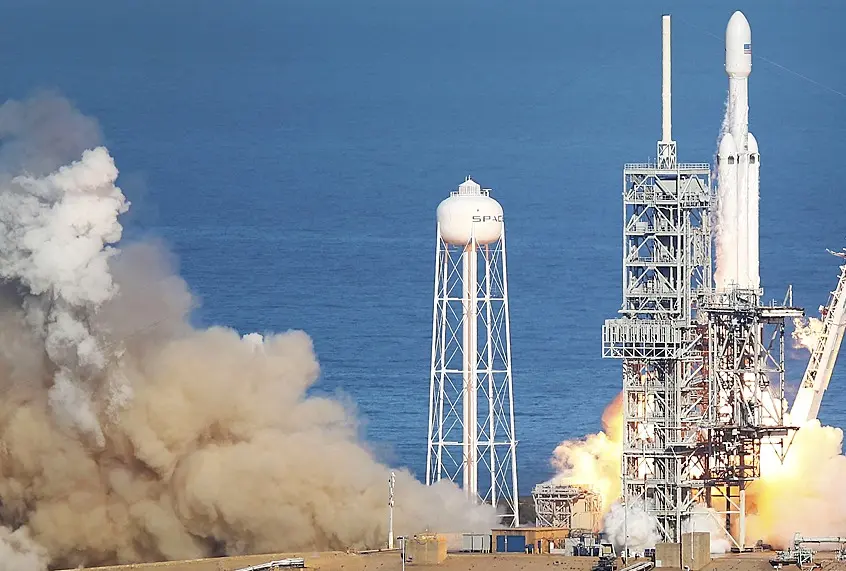
On February 6, 2018, the aerospace industry crossed a historic threshold. From historic Launch Pad 39A at the Kennedy Space Center in Florida—the very site that once launched humanity toward the moon—Elon Musk’s SpaceX successfully executed the maiden flight of the Falcon Heavy. As the most powerful operational rocket in the world at the time, the launch was a masterclass in modern aerospace engineering. To demonstrate the vehicle’s unprecedented payload capacity, SpaceX deployed an unconventional cargo into deep space: a cherry-red Tesla Roadster carrying a mannequin dubbed "Starman," outfitted in a next-generation spacesuit.
The launch captivated a global audience. Live video feeds streamed high-definition footage of the Earth’s breathtaking curvature from the edge of the cosmos, alongside the synchronized, propellant-powered descents of two reusable Falcon boosters back to Cape Canaveral. For the scientific community and the general public, the imagery provided yet another undeniable confirmation of our planet’s spherical geometry.
Yet, the unprecedented visual evidence immediately sparked a parallel cultural phenomenon across social media. Netizens and science advocates gleefully weaponized the footage against a persistent fringe demographic: flat-Earth theorists. For years, this subculture has rejected centuries of empirical science, claiming the world is a disc and that all imagery proving otherwise is the product of international governmental fabrication.
This report examines the monumental technical achievements of the February 6 Falcon Heavy launch, the viral cultural reaction regarding the shape of our planet, the psychological and sociological underpinnings of flat-Earth belief systems, and why overwhelming visual proof from the final frontier remains powerless against deeply entrenched conspiracy theories.
Detailed Chronology: Countdown to Liftoff and Beyond
T-Minus Zero and the Roar of 27 Merlins
The atmosphere at the Kennedy Space Center on Tuesday, February 6, 2018, was thick with anticipation. The Falcon Heavy was not merely a new rocket; it was an architectural gamble. By strapping three modified Falcon 9 first-stage cores together, SpaceX created a heavy-lift behemoth powered by a staggering 27 Merlin engines.
At 3:45 PM EST, the countdown clock reached zero. With a thunderous crescendo that rattled windows and chest cavities miles away, the Falcon Heavy tore away from Launch Pad 39A. Generating more than 5 million pounds of thrust at liftoff, the rocket pierced the Florida sky, accelerating through the maximum dynamic pressure zone (Max-Q) within minutes. Millions of viewers tuned into the live webcasts, watching telemetry data climb in real time as the vehicle left the troposphere behind.
The Twin Booster Landing: A Paradigm Shift
Roughly two and a half minutes into the flight, the two side boosters separated from the central core in a flawless execution. While the central core faced a harsher trajectory, the two side boosters flipped, reignited their engines, and began a synchronized retro-propulsive return to Earth.
Minutes later, the twin boosters touched down simultaneously at SpaceX’s Landing Zones 1 and 2 at Cape Canaveral Air Force Station. The twin sonic booms rolled across the Florida coastline, signaling a seismic shift in aerospace economics. Reusability was no longer a theoretical concept or a single-booster novelty; it had scaled into a synchronized ballet of precision engineering.
Into Deep Space: The Roadster’s Journey
While the boosters claimed headlines on Earth, the second stage continued its ascent, pushing deeper into the outer atmosphere. Hours after launch, following a successful second-engine burn designed to overcome Earth’s gravity well, the payload fairing separated to reveal the unusual cargo: a personal Tesla Roadster.
Cameras mounted on the vehicle beamed back live, crystal-clear footage of the electric sports car floating serenely against the vast, ink-black void of space, with the vibrant blue and white arc of the Earth curving dramatically in the background. David Bowie’s "Space Oddity" looped on the car’s audio system as Starman embarked on an elliptical orbit stretching out toward the Martian asteroid belt. It was an audacious blend of corporate marketing, technological triumph, and cosmic poetry.
Supporting Context & Metrics: The Engineering Feat and Cultural Ripple
To understand why the Falcon Heavy launch dominated global discourse in February 2018, one must evaluate the raw metrics of the vehicle and the economic disruption it represented.
Falcon Heavy Specifications
- Height: 70 meters (229.6 feet)
- Liftoff Thrust: 5.1 million pounds (derived from 27 Merlin 1D engines)
- Payload Capacity to Low Earth Orbit (LEO): 63,800 kilograms (140,660 lbs)
- Payload Capacity to Mars: 16,800 kilograms (37,040 lbs)
- Cost per Launch (Initial Estimate): ~$90 million, undercutting legacy heavy-lift competitors by a factor of three or four.
Before the Falcon Heavy, launching payloads of this magnitude required monumental financial expenditures, typically monopolized by government agencies and traditional defense contractors. By demonstrating that heavy-lift capability could be achieved at a fraction of the traditional cost—while simultaneously recovering expensive flight hardware—SpaceX altered the commercial space race permanently.
The Social Media Explosion
As the live stream broadcasted stunning visuals of the Earth’s curvature, platforms like Twitter, Reddit, and Facebook erupted. Within hours, hashtags such as #Starman, #FalconHeavy, and #FlatEarth trended globally.
Science communicators, casual observers, and internet meme creators seized the moment. The overarching narrative online was one of collective exhaustion with anti-science rhetoric. Users posted clips of the Earth’s horizon with captions challenging flat-Earthers to explain away the high-definition, unedited broadcast. Others utilized dry sarcasm, joking about how flat the globe looked from 250 miles up. Yet, underneath the internet humor lay a genuine disbelief that individuals in the 21st century could still cling to pre-enlightenment models of planetary physics.
Official Statements and Industry Reactions
The global scientific and aerospace community hailed the Falcon Heavy launch as a watershed moment.
NASA Administrator Robert Lightfoot released a formal statement congratulating SpaceX, noting:
"NASA congratulates SpaceX on the successful Falcon Heavy launch. The-collaborative spirit of innovation that drives our commercial partners will play a vital role in our future missions to return to the Moon and eventually journey on to Mars."
Aeronautical engineers across traditional institutions acknowledged that SpaceX had successfully solved one of rocketry’s most complex control problems: managing the aerodynamic stresses and thrust vectoring of three interconnected booster cores operating simultaneously.
Elon Musk himself took to social media to share the awe of the moment, posting:
"View from SpaceX Launch Control. Apparently, there is a car in orbit around Earth."
When questioned during post-launch press conferences about the theatrical nature of putting a sports car in space rather than a utilitarian satellite, Musk defended the decision with characteristic candor:
"Test flights of new rockets usually contain mass simulators in the form of concrete or steel blocks. That seemed extremely boring. Of course, anything boring is terrible, especially companies, so we decided to send something unusual, something that made us feel."
That feeling of wonder, however, collided directly with a subculture committed to rejecting the very optics that made the launch so visually striking.
The Resilient Psychology of Flat-Earth Beliefs
To expect a live video feed from a SpaceX rocket to dismantle the flat-Earth movement is to fundamentally misunderstand the psychological architecture of conspiracy theories.
Core Tenants of Flat-Earth Theory
Modern flat-Earthers reject the oblate spheroid model proven by Eratosthenes in ancient Greece, confirmed by circumnavigation, and documented by thousands of satellites. Instead, they assert:
- The Disc Model: The Earth is a flat disc centered around the North Pole, with Antarctica serving as a massive wall of ice at the perimeter holding the oceans in place.
- The "Ice Wall" Guard: Governments allegedly militarize Antarctica to prevent independent civilians from venturing over the edge.
- The Fake Space Illusion: All space agencies (NASA, ESA, SpaceX, Roscosmos) are part of a global conspiracy to fabricate space exploration, siphon taxpayer funds, and hide the "true" creationist or geometric nature of the universe.
Why Visual Evidence Fails
Psychologists and sociologists who study conspiracy theories note that empirical evidence—no matter how overwhelming—rarely penetrates a closed belief system. In fact, counter-evidence often hardens the resolve of believers through a mechanism known as belief perseverance or reactive confirmation bias.
When presented with high-definition footage of the Earth’s curvature from the Falcon Heavy, a flat-Earth truther does not update their mental model of reality. Instead, they integrate the new data into their existing conspiracy framework by claiming:
- The Fisheye Lens Defense: The cameras utilized on the rocket and the Roadster are equipped with wide-angle or fisheye lenses deliberately engineered to artificially curve a flat horizon.
- CGI Fabrication: The entire broadcast was rendered in real-time computer graphics by SpaceX technicians under the direction of shadow organizations.
- Corporate Complicity: Elon Musk and SpaceX are simply the new-age architects of the multi-billion-dollar space lie, continuing the work started during the Apollo era.
Because the core premise of the belief system requires that all institutional authorities be dishonest, any proof provided by those institutions is instantly categorized as further evidence of the deception.
Future Outlook: Science, Skepticism, and the Horizon
The February 2018 Falcon Heavy launch will be remembered in textbooks as the catalyst for a new era of heavy-lift commercial rocketry, paving the way for Starship, Artemis lunar missions, and eventual crewed flights to Mars. It proved that human ingenuity could build reusable systems capable of reshaping our relationship with the cosmos.
At the same time, the event served as a fascinating sociological case study on the digital age. It highlighted the widening chasm between empirical scientific consensus and decentralized, internet-fueled skepticism. While millions watched in awe as science validated itself in high definition, a vocal minority retreated further into alternative realities, demonstrating that no rocket—no matter how powerful—possesses enough thrust to break through the impenetrable armor of willful ignorance.
As humanity looks toward a future of interplanetary colonization, the challenge of the 21st century will not merely be developing the technology to reach the stars, but ensuring that a shared baseline of objective reality remains intact for the society left behind.