Executive Overview
For over a decade, the consumer data broker Radaris.com operated with impunity, routinely ignoring consumer removal requests and leveraging a web of international shell corporations to evade regulatory accountability. That era of unchecked operations has officially come to an end. In a milestone victory for digital privacy enforcement, a New Jersey court ordered the transfer of Radaris.com—along with more than a dozen associated people-search domains—to plaintiffs represented by Atlas Data Privacy Corp.
The court-ordered forfeiture stems from violations of Daniel’s Law, a stringent New Jersey statute that shields law enforcement personnel, judges, and government officials from having their private details published online. Faced with years of procedural stonewalling, jurisdictional shell games, and fictitious executive personas, the judiciary took the extraordinary step of stripping the operators of their core web assets.
Internal documents secured during discovery and shared exclusively with investigative journalists reveal the true architecture of the Radaris empire: a sprawling, highly profitable network of over 25 interconnected people-search websites managed by a tight-knit group of Boston-area operators. As state-level protections multiply and federal lawmakers grapple with the pervasive threats of the modern data broker ecosystem, the Radaris takedown serves as a watershed moment in the global fight for digital self-determination.
Detailed Chronology of an Investigation and Legal Showdown
The Catalyst: Daniel’s Law and Atlas Data Privacy Corp
Enacted following a horrific family tragedy involving a federal judge in New Jersey, Daniel’s Law was designed to protect public servants from targeted harassment and violence. The statute mandates the complete removal of personal information for judges, law enforcement officers, and government personnel from commercial people-search engines, imposing steep financial penalties of $1,000 per violation for non-compliance.
In February 2024, Atlas Data Privacy Corp initiated legal action against Radaris under this statute. Unlike individual consumers who often lack the legal resources to challenge multi-million-dollar tech operations, Atlas specialized in systematically holding non-compliant data brokers accountable. Less than a month after the lawsuit was filed, independent investigative reporting by KrebsOnSecurity unmasked the individuals pulling the strings behind the Radaris brand.
Unmasking the Operators: The Lubarsky Brothers and the "Gary Norden" Fiction
The investigation revealed that Radaris was operated by Igor and Dmitry Lubarsky (also known as Lybarsky), Russian-born brothers residing in Massachusetts. The brothers managed a dizzying array of people-search entities alongside Russian-language dating services and digital marketing affiliate programs.
When first confronted with these findings, legal representation for the Lubarsky brothers—led by Val Gurvits of the Boston Law Group—threatened defamation lawsuits and insisted that the true owners were Ukrainian nationals living in Ukraine. However, follow-up reporting dismantled these claims, demonstrating that Radaris utilized a fictitious CEO named Gary Norden. Gurvits later conceded in court documents that his clients had indeed invented the pseudonym "Gary Norden" and used it in press releases to secure venture funding and court credibility.
Procedural Stonewalling and the "Island-Hopping" Phase
As the litigation progressed, the defense deployed a revolving door of international entities to obscure ownership and frustrate plaintiffs. Matt Adkisson, CEO of Atlas Data Privacy Corp, described the defense strategy as an elaborate shell game.
"We refer to this period as their island-hopping phase," Adkisson explained. "Privacy policies changed constantly, and new entities kept appearing from places like the Marshall Islands, the British Virgin Islands, and Seychelles."
When Atlas attorneys tracked a corporate update pointing to a newly designated management entity in the Marshall Islands, private investigators discovered that the shell company did not even legally exist yet.
This mirrored tactics used in a prior 2017 class-action lawsuit (Huebner v. Radaris, LLC). In that case, Radaris defaulted, prompting a court to order Verisign to transfer the radaris.com domain. Gurvits successfully appealed that ruling by introducing a Cyprus-based entity called Bitseller Expert Limited, which claimed it was the true owner and that its due process rights had been violated. Shortly thereafter, control shifted to Andtop Company, a Marshall Islands entity formed in October 2020.
For a decade, this strategy of attrition worked brilliantly. Plaintiffs routinely abandoned lawsuits, exhausted by procedural delays and the daunting task of collecting judgments from foreign entities. However, recognizing the acute physical threat posed to New Jersey law enforcement officers, Atlas committed the necessary resources to pierce the corporate veil.
The Final Ruling and Domain Seizure
In June 2025, Atlas re-filed and expanded its lawsuit to encompass the full roster of Radaris-affiliated broker entities. On August 26, the presiding New Jersey judge ruled that the defendants had repeatedly squandered opportunities to present a substantive defense.
While Gurvits stepped aside, citing new counsel Victor Worms, the defense mounted a final procedural challenge. Worms argued that the default judgment was void because "Radaris.com" is not a legal entity capable of being sued, and labeled the domain transfer an unconstitutional forfeiture.
Despite these objections, the domain transfers proceeded. Today, visitors navigating to radaris.com are greeted not by consumer dossiers, but by an official notice from Atlas detailing the court-ordered forfeiture.
Supporting Context, Financial Metrics, and Corporate Networks
Uncovering the Inner Workings via Internal Records
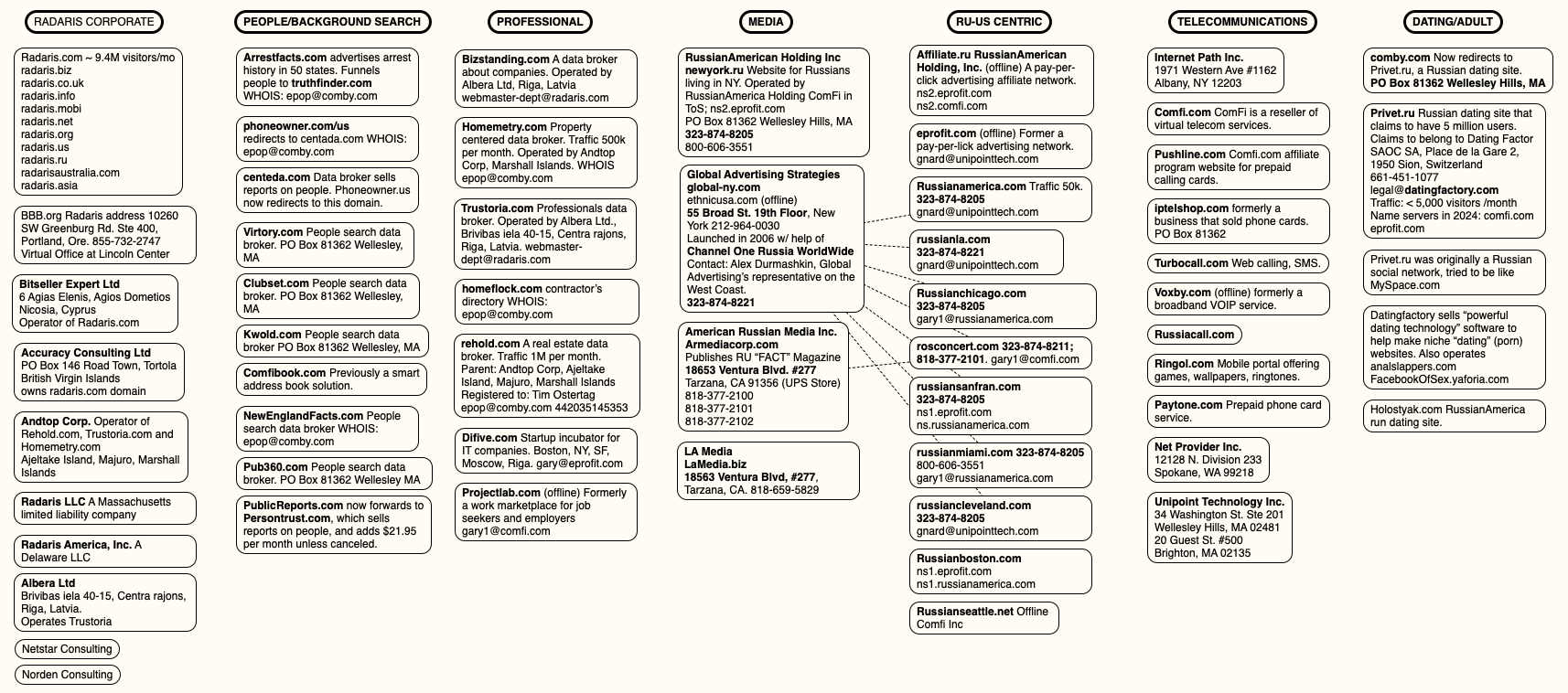
Through the course of discovery, Atlas secured more than 10,000 internal emails and corporate documents. These files validated prior investigative reporting, demonstrating that nominal legal vehicles—including Radaris America, Inc., Bitseller Expert Limited, Digital Orbit Corp, Core Solutions Group Inc, Lucky Solutions Inc, Virtura Corp, Veripages Inc., Nuform Solutions Inc., Growth Data Advisors Inc., and Property Experts, Inc.—were effectively paper tigers.
The documents proved that these disparate corporate fronts were:
- Administered by the exact same group of three or four individuals.
- Operated out of a single virtual office address.
- Tied to unified banking and payment processing channels.
- Managed centrally via infrastructure routed through the difive.com mail domain and its successor domains (centerex.com, scienteco.com, eprofit.com, realmo.com, and pub360.com).
Revenue Streams and Ecosystem Partnerships
The internal communications laid bare the lucrative nature of the people-search business model. According to financial data extracted during discovery:
- Radaris.com generated approximately $42,000 per month in direct revenue.
- Veripages.com pulled in roughly $45,000 monthly, heavily bolstered by data-sharing and marketing partnerships with the Lifetime Value Company (operator of consumer brands like PeopleLooker, PeopleSmart, NumberGuru, and the automotive history tracker Bumper).
- The Radaris network collected up to $25,000 monthly through syndication and service agreements with Onerep, a privacy-cleaning service founded by a Belarusian entrepreneur who simultaneously operated competing people-search sites like Nuwber.
In total, the New Jersey court successfully ordered the forfeiture and transfer of 14 distinct domain names associated with the Radaris ecosystem.
Official Statements and Industry Reactions
Legal representatives for both plaintiffs and defendants remain starkly divided on the constitutional validity and future implications of the case.
-
Raj Parikh (Partner at PEM Law, representing Atlas):
"In the past, they won by attrition. Plaintiffs’ attorneys tired of the procedural games and just gave up. That strategy worked for a decade, and it probably would have worked in this case too, since any financial recovery from foreign actors will be difficult. But we were acutely aware of the threat this website posed to law enforcement officers and other public officials in New Jersey, and decided early on to commit whatever time and resources were necessary to remove that threat."
-
Victor Worms (Defense Counsel for Radaris entities):
"We have made a motion to vacate that default judgment on the grounds that it is void since a non-entity has no legal capacity to sue or be sued. We also intend to pursue all appropriate appeals because we believe the transfer of Radaris.com amounts to a forfeiture in violation of various constitutional principles."
Future Outlook: The Constitutional Battleground and Legislative Horizons
The Legal Battle Moves Upward
While the immediate forfeiture of radaris.com represents a devastating blow to the Lubarsky network, the broader legal war is far from over. The Radaris family of companies still faces potential statutory fines amounting to $1,000 per violation under Daniel’s Law.
However, Daniel’s Law itself is facing an existential constitutional challenge. Roughly 150 data broker companies sued by Atlas have banded together to move at least 70 of these cases into federal court. The data broker industry argues that the New Jersey statute is overly broad and infringes upon First Amendment protections regarding the dissemination of public information. The U.S. Court of Appeals for the Third Circuit is expected to rule on the matter, with legal analysts predicting the dispute will ultimately reach the U.S. Supreme Court.
Parallel state-level efforts face similar hurdles. While at least 14 states have drafted legislation modeled after Daniel’s Law, West Virginia’s iteration was struck down as facially unconstitutional by a federal district court in August 2025.
The Broader Privacy Crisis
Privacy expert and author Justin Sherman notes that state-level carve-outs and intense industry lobbying continue to undermine meaningful consumer protections.
"These days at the federal level, add in the intense amount of lobbying against these laws from social media companies, big tech, cryptocurrency firms, and now AI proponents in the mix who claim that limiting their data scraping is somehow going to collapse the whole U.S. economy under Chinese rule," Sherman remarked.
Sherman emphasizes that people-search engines will continue to proliferate as long as state and federal laws exempt public government records—such as voter registries, property deeds, marriage licenses, motor vehicle data, and court filings—from privacy protections. Without comprehensive federal oversight governing how data scrapers and identity verification firms handle collected information (such as the vulnerabilities exposed in the massive IDScan.net breach that leaked 153 million driver’s licenses), ad-hoc state statutes will remain vulnerable to legal assault.
"The average person can look at Daniel’s Law and have a perfectly normal reaction, which is that everyone should be covered, not just police and judges," Sherman concluded. "Pero we don’t need more wake-up calls. We’ve had eight million wake-up calls already on the need for better privacy laws. The lack of comprehensive federal privacy law is not for a lack of knowledge, and anyone claiming otherwise is either not reading the news or kidding themselves."