Executive Overview
Throughout its legendary 49-year syndication run, Charles M. Schulz’s Peanuts established itself as a foundational pillar of modern comic art, offering deep philosophical musings, poignant melancholia, and incisive societal observations. While the strip’s cultural footprint is most frequently associated with existential ennui, baseball diamond defeats, psychiatric booths operating at five cents a session, and the timeless search for the Great Pumpkin, a quieter thematic undercurrent threads its way through the panels: food.
Culinary humor in Peanuts rarely took center stage compared to Charlie Brown’s chronic self-doubt or Snoopy’s elaborate Walter Mitty-esque flights of fancy. Instead, food and dietary preferences served as reliable comedic anchors, character shorthand, and occasional surrealist punchlines. From Snoopy’s idiosyncratic canine palate—heavily skewed toward root beer, chocolate chip cookies, and pizza—to Peppermint Patty’s legendary reliance on lunchbox-bound donuts, food acts as a mirror to the inner lives of the strip’s juvenile and canine inhabitants.
This comprehensive retrospective examines the evolution of food-related gags across the half-century lifespan of the comic strip. By analyzing specific historical strips—spanning from the foundational era of the early 1950s to the twilight years of the 1990s—we uncover how Charles Schulz utilized simple sustenance to illuminate psychological states, domestic realities, and the eccentricities of beloved characters.
Detailed Chronology: Five Defining Culinary Moments in Peanuts History
To understand the trajectory of food humor in the strip, one must trace its development across distinct chronological milestones. While Schulz’s artistic and conceptual approach to the strip matured dramatically between 1950 and 2000, his application of culinary tropes evolved from simple observational domesticity into outright surrealism and character-driven satire.
1. The Domestic Intrusion: October 13, 1950
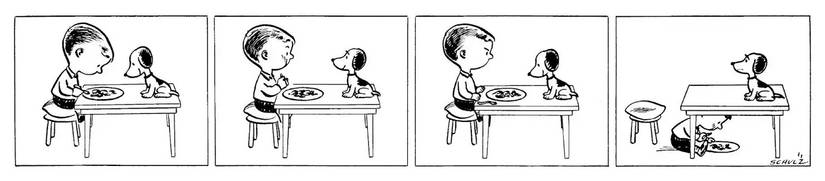
In the nascent days of Peanuts, the cast of characters operated much closer to conventional suburban reality, and Snoopy was, for all intents and purposes, a relatively ordinary dog. During this period, Snoopy lacked the complex interior monologue he would acquire in March 1952, the bipedal posture he adopted in 1956, and his high-flying aviation fantasies.
In the October 13, 1950 strip, Snoopy’s relationship with food is established through pure, unadorned animal pragmatism. Shermy, one of the strip’s early "lost characters" who eventually faded from rotation, attempts to enjoy a peaceful meal. Plagued by Snoopy’s intense, unblinking surveillance—the universal plight of pet owners everywhere—Shermy ultimately surrenders to defeat, abandoning the table to eat on the floor. This strip captures the primal, boundary-less nature of canine begging before Snoopy evolved into a sophisticated foodie capable of critiquing suppertime or ordering delivery.

2. The Pizza Imperative: February 12–13, 1960
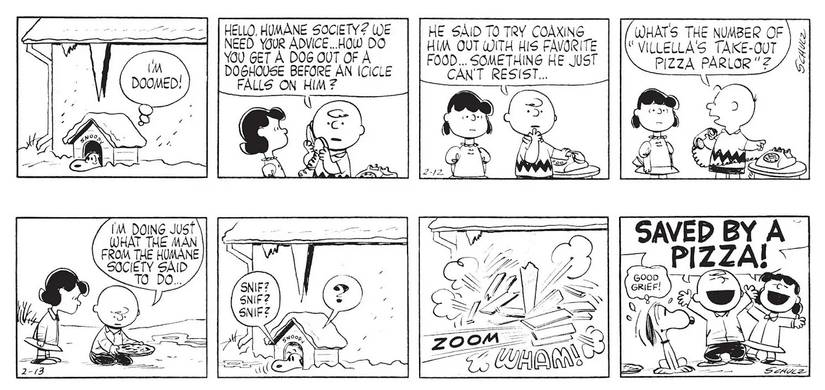
By 1960, the dynamic of the strip had shifted considerably, giving rise to some of its most enduring surrealist gags. In a memorable winter sequence, Snoopy finds himself trapped inside his doghouse, immobilized by a massive, precarious icicle hanging directly overhead. Paralyzed by the fear that the slightest movement will bring the frozen dagger crashing down upon him, he remains stranded.
In an act of problem-solving that defies conventional logic, Charlie Brown calls the Humane Society for advice and subsequently orders a pizza. The tactical genius of this maneuver lies in its psychological exploitation of the beagle’s deepest desires: the aromatic allure of freshly baked pizza instantaneously overpowers Snoopy’s fear of death. He bolts from the doghouse just fractions of a second before the icicle completely obliterates it. This sequence cements a recurring motif in the strip—that Snoopy’s love for human junk food transcends mortal peril.
3. The Culinary Abomination: April 15, 1978
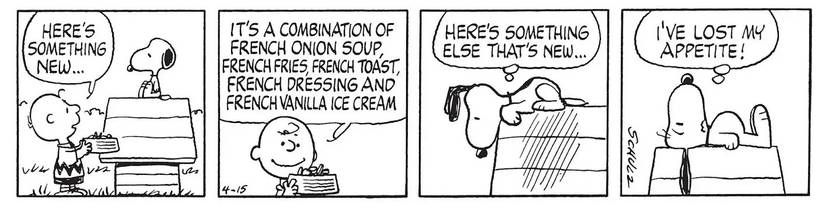
Gross-out humor was exceedingly rare in Peanuts, making the April 15, 1978 strip a notable anomaly in Schulz’s catalog. In an effort to break up the monotony of the beagle’s standard diet, Charlie Brown presents Snoopy with a specially prepared supper, listing its ingredients with genuine pride:
"It’s a combination of French onion soup, French fries, French toast, French dressing, and French vanilla ice cream."
Faced with this staggering, multi-layered culinary disaster—a bizarre pan-French pastiche—Snoopy exhibits a reaction entirely out of character: he loses his appetite altogether. The joke serves as a rare moment where Charlie Brown’s well-intentioned caregiving crosses the line into outright psychological warfare, leaving even an animal known for eating almost anything completely defeated.
4. The Latchkey Lunchbox Reality: September 18, 1986
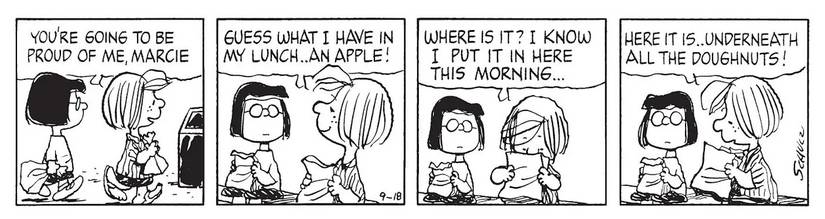
By the mid-1980s, the supporting cast had established deep, highly specific behavioral patterns. Peppermint Patty, known for her academic struggles, athletic prowess, and status as a latchkey kid, provides the setup for a deceptively simple visual and verbal gag on September 18, 1986.
Proudly announcing to Marcie that she has brought a healthy snack—an apple—to school, Peppermint Patty discovers the harsh truth upon opening her container: the apple is completely buried underneath an avalanche of donuts. Beyond the immediate situational comedy of a child failing at dietary discipline, the strip offers a subtle nod to Peppermint Patty’s domestic independence. As a child who packs her own lunches without direct parental supervision, her nutritional choices reflect both personal preference and a humorous lack of oversight.
5. Avian Gastronomy: April 14, 1991
As Peanuts entered its final decade of publication, Schulz occasionally experimented with the bizarre and unexpected. Woodstock, whose avian sidekicks occasionally made appearances outside of his immediate bond with Snoopy, takes center stage in the April 14, 1991 Sunday strip.
While Snoopy is attempting to focus on a golf game, Woodstock’s nomadic crew of yellow bird companions creates an audible distraction. When the exasperated beagle demands to know what warrants such urgent chatter, Harriet—distinguished by her red hair bow—begins reciting the ingredients to a frosting recipe. While the recipe is intentionally incomplete and impossible to replicate for real-world baking, the strip stands as a surreal, delightful curio from the twilight years of the comic’s run, proving that even minor background characters possessed hidden domestic agendas.
Supporting Context & Metrics: The Anatomy of a Daily Strip
To fully appreciate how food functioned within Peanuts, it is helpful to examine the structural ecosystem of Charles Schulz’s creative output:
- Syndication Span: October 2, 1950 – February 13, 2000 (nearly 49 years).
- Total Strips Produced: 17,897 published strips.
- Primary Food Archetypes:
- Snoopy: Root beer, chocolate chip cookies, pizza, and pizza-flavored snacks.
- Peppermint Patty & Marcie: Donuts, cafeteria food, and poorly managed lunchboxes.
- Charlie Brown: Existential dread, occasional butter mishaps, and ill-fated culinary experiments.
- Lucy Van Pelt & Woodstock: A shared, highly specific affinity for grape jelly.
While sports (baseball, football) and philosophical musings (the psychiatry booth, the Great Pumpkin) dominated the statistical frequency of punchlines, food gags served as essential grounding mechanisms. They allowed the characters to engage in universal, highly relatable human behaviors—such as begging pets, sneaking sweets, and failing at meal preparation—which balanced out the strip’s more abstract philosophical flights.
Official Statements & Creator Insights
Charles M. Schulz was famously protective of his creative process and maintained absolute control over every aspect of Peanuts throughout its multi-decade run. Operating out of his studio in California, Schulz rarely relied on gag writers or assistants for the writing process, preferring to draw and write every single strip by hand.
In various historical interviews compiled across retrospectives like The Complete Peanuts (published by Fantagraphics), Schulz noted that the humor in his strip derived naturally from the personalities of the characters rather than forced topicality. When discussing Snoopy’s bizarre culinary preferences—such as his taste for root beer and chocolate chip cookies—Schulz often emphasized that animals in comic strips function best when they retain animal limitations while simultaneously possessing human emotional depth.
Animation historians and archivists at WildBrain Studios and the Schulz Studio have frequently highlighted how food in television specials—such as the iconic Thanksgiving special where Charlie Brown serves toast, popcorn, pretzel sticks, and jelly beans—mirrored the strip’s underlying philosophy: that the emotional weight of a gathering matters far more than the culinary execution.
Future Outlook: The Enduring Legacy of Peanuts Dining Culture
Decades after the final original strip was published in February 2000 following Charles Schulz’s passing, the cultural footprint of Peanuts remains remarkably robust. Through continuous syndication, collected volumes, and modern animated revivals on platforms like Apple TV+ (such as Welcome Home, Franklin), new generations continue to discover the world of Charlie Brown and Snoopy.
The food motifs of Peanuts have transitioned successfully from newspaper print into pop-culture iconography. The spread from the animated Thanksgiving special—featuring popcorn and buttered toast—has inspired generations of fans to recreate the meal annually. Meanwhile, themed cafes, merchandise collaborations, and museum exhibitions regularly celebrate the distinctive culinary quirks of the strip’s characters.
Ultimately, food in Peanuts was never really about haute cuisine or nutritional science. It was about connection, comfort, and the occasional absurdity of daily life. Whether Snoopy is sprinting away from an icicle for a slice of pepperoni, or Peppermint Patty is excavating a lonely apple from beneath a mountain of pastries, Charles Schulz used the universal language of food to remind readers that even the most depressed blockheads and philosophical beagles deserve a good snack at the end of the day.