Executive Overview
In modern cybersecurity architecture, the file upload portal is frequently treated as a heavily fortified gatehouse. Systems employ multi-layered defenses: signature verification engines inspect incoming byte streams, MIME-type inspectors cross-reference client-supplied headers, and format validation libraries parse incoming files to ensure they conform to strict structural expectations.
Yet, a subtle and deeply structural vulnerability continues to confound even sophisticated web applications: the phenomenon of the polyglot file.
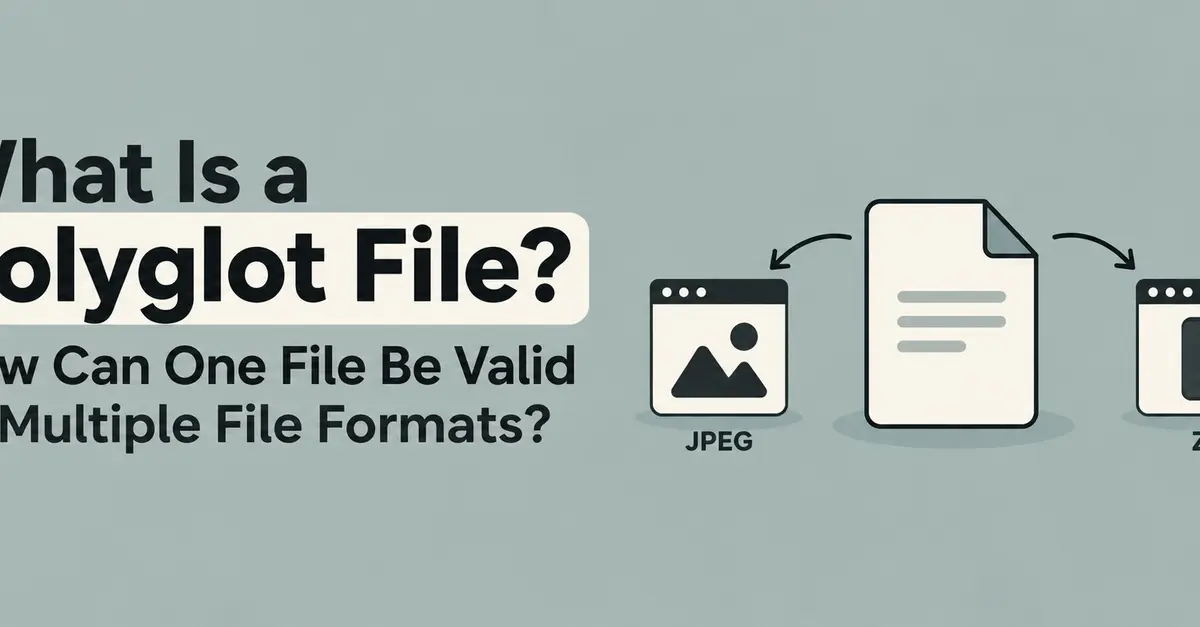
Imagine a scenario executed daily across thousands of enterprise networks: A user uploads a file. The upload validator inspects the raw bytes and concludes, "That is a pristine JPEG image. Safe to accept." The file is cataloged, marked as benign, and written to disk. Later, a secondary component in the same application stack—perhaps an unpacking utility or a downstream processing daemon—opens those exact same bytes and interprets them through an entirely different lens: "That is a ZIP archive."
Neither component is broken. Neither system is guessing or operating on corrupted logic. Both are applying rigorous, standard-compliant parsing rules to the exact same byte sequence, and both are successfully discovering a valid grammatical structure.
This article investigates the mechanics of file polyglots, examining how a single sequence of bytes can legitimately satisfy the syntax rules of two completely different file formats. We will explore why traditional validation strategies routinely fail, the mechanics of parser differentials, the severe security implications when systems fall victim to content-type confusion, and the engineering paradigms required to permanently close these architectural gaps.
Detailed Chronology: The Evolution of File Validation and the Rise of the Polyglot
To understand how polyglot files became a prominent vector for bypassing security controls, we must trace the evolution of how operating systems, web applications, and security parsers interpret data streams.
Phase One: The Era of Extension Trust (1980s–1990s)
In the early days of personal computing and local area networks, files were identified almost exclusively by their filename extensions—the suffix appended following a period (e.g., .txt, .exe, .bat). Operating systems maintained registry mappings or internal lookup tables associating these extensions with specific applications.
Security was largely perimeter-based or non-existent at the file level. If a malicious executable was renamed from payload.exe to vacation.jpg, many early systems would willingly execute it if invoked by an unsuspecting user. This approach relied entirely on the user’s perception and the file system’s superficial labeling.
Phase Two: The Introduction of Magic Bytes and MIME Types (Late 1990s–2000s)
As the web expanded and file-sharing via HTTP became ubiquitous, relying on user-controlled extensions and client-supplied MIME types (Content-Type headers in HTTP requests) proved catastrophically insecure. Attackers routinely spoofed these values to smuggle scripts and executables past primitive web filters.
In response, developers and security engineers introduced content-based inspection, commonly referred to as "magic byte" validation. Instead of trusting what a file called itself, systems began reading the first few bytes of a file stream to check for known signatures:
- JPEG files typically start with
FF D8 FF. - PDF documents begin with
%PDF. - ZIP archives open with
50 4B 03 04.
While this represented a significant security upgrade, it fundamentally anchored file validation to a fraction of the total data stream. It answered a very narrow question: "Does this file begin like format X?" It rarely evaluated whether the entirety of the file conformed strictly to format X, leaving vast tracts of the file body open to alternative interpretations.
Phase Three: The Sophistication of Polyglots and Parser Differentials (2010s–Present)
As automated security scanners and strict validation pipelines became standard industry practice, attackers and researchers began exploring the mathematical and structural intersections of file grammars. By exploiting the architectural design choices of various parsers—some of which ignore trailing data, others of which read from the end of the file backward (such as ZIP’s central directory), and others that evaluate specific structural offsets—crafty engineers constructed true polyglots.
A polyglot is not a corrupted file, nor is it merely a renamed file using extension spoofing. It is a meticulously crafted byte sequence where Parser A reads the beginning, identifies a valid header, skips over application-defined padding or metadata blocks, and reaches a successful termination, while Parser B—ignoring the initial header or interpreting it as comment data—parses the identical byte stream as an executable script, an archive, or a database dump.
Supporting Context & Metrics: The Anatomy of File Grammars
To comprehend how a polyglot is constructed, one must first define what a file format actually is from a computer science perspective: a grammar for bytes.
A File Format Is a Grammar for Bytes
A file format is a rigid specification describing how a sequence of bytes must be structured, ordered, and interpreted. It defines:
- Magic Numbers / Headers: Unique byte sequences at predetermined offsets indicating the start of a format.
- Length Fields and Chunks: Declarations within the byte stream specifying how many bytes follow, allowing parsers to jump through the file.
- Terminators: Specific byte patterns indicating the end of a valid data block or file.
A filename extension is merely a human-readable label. A raw parser reading a byte stream does not care about the .jpg or .pdf extension; it evaluates the data against programmatic parsing rules.
Why File Formats Can Coexist
Different file formats make profoundly different structural assumptions about how data should be read. These divergent assumptions create structural "whitespace" where multiple formats can peacefully coexist:
- Header-Centric Parsers: Some formats (like JPEG) evaluate headers at the very beginning of the file, process image data chunk-by-chunk, and stop when an End of Image (EOI) marker (
FF D9) is encountered. What happens to the bytes after the EOI marker? Many standard image libraries simply ignore them as trailing garbage or metadata padding. - Offset-Centric Parsers: Other formats search for markers at specific byte offsets or scan backward from the end of the file. ZIP archives, for instance, locate their End of Central Directory (EOCD) record by reading backward from the final bytes of the file. To a ZIP parser, the data sitting at byte offset 0 is completely irrelevant until the archive traversal begins.
- Comment and Metadata Injection: Many container formats allow arbitrary comment fields, EXIF data, or user-defined segments. By injecting valid secondary file structures into these permitted metadata regions, an attacker can embed a secondary payload that remains entirely invisible to the primary parser.
Byte offset 0
├── Format A header (magic bytes, required header)
├── Region ignored by Format A / Metadata block
│    └── Format B-compatible structures live here
├── Shared data / Padding
└── Format A/B terminal structures (e.g., EOI / EOCD)
Official Statements & Industry Guidance
Cybersecurity agencies and standards bodies have increasingly highlighted parser discrepancies and improper input validation as critical vectors for remote code execution (RCE) and local file inclusion (LFI) vulnerabilities.
The OWASP Foundation (Open Worldwide Application Security Project) explicitly warns against relying on single-stage validation mechanisms in its File Upload Security Cheat Sheet:
"Never rely solely on the verification of the file extension or the Content-Type header supplied in the HTTP request. Furthermore, checking only ‘magic bytes’ at the header of a file is insufficient to prevent advanced file upload attacks. If downstream systems consume the file using a different parsing engine than the upload validator, parser differentials can lead to severe security bypasses."
Similarly, security engineering advisories from major cloud providers and enterprise software vendors emphasize that the processing pipeline is the real security boundary. An application is only as secure as its weakest parsing component. If an upload gateway uses a lightweight image-checking library, but the application’s rendering engine or administrative dashboard utilizes a heavier, multi-format parser or an unmanaged decoding library, the discrepancy introduces systemic risk.
Future Outlook: Architectural Defenses and the Path Forward
As file formats grow increasingly complex and applications demand richer media processing capabilities, the threat landscape surrounding polyglot files will continue to evolve. Mitigating this risk requires a fundamental shift away from passive validation toward proactive data sanitization.
1. Re-Encoding and Transcoding (The Gold Standard)
The most robust defense against polyglot-based attacks is transcoding. Instead of attempting to validate whether an uploaded file is "clean" by inspecting its bytes, the system decodes the file into a standardized, raw intermediate format and immediately re-encodes it from scratch.
For example, if a user uploads an image:
- The server ingests the raw byte stream.
- A strict image decoding library reads the pixel data into memory (e.g., an uncompressed bitmap buffer).
- Any metadata, comment fields, embedded archives, or alternative format structures present in the original file are discarded during the decoding process.
- The server writes a brand-new image file to disk generated entirely from the decoded pixel buffer.
Any hidden payload embedded within the original file’s structural whitespace is obliterated in transit because the output file is synthesized entirely by the server’s encoding library.
2. Unified Parsing Pipelines
Organizations must ensure that the parser used during the initial upload validation phase is identical to the parser used by any downstream consuming component. If Validation Component A and Processing Component B operate on different libraries or varying versions of the same specification, parser differentials will inevitably emerge.
3. Strict Boundary Isolation and Storage Hygiene
- Store Uploads Externally: User-uploaded files should never be stored within web-accessible directories or executable paths. Utilizing isolated object storage (such as dedicated cloud buckets with public access blocked) ensures that even if a polyglot file bypasses ingestion checks, the server will not inadvertently execute or serve it as an active script.
- Disable Execution Privileges: Web servers must be configured to treat uploaded directories strictly as non-executable.
4. Zero Trust in Content Interpretation
Modern software engineering must adopt a Zero Trust philosophy regarding data structures. A file does not carry its own authoritative interpretation; meaning is assigned entirely by the parser that reads it. By recognizing that different grammars applied to the same byte sequence will inevitably yield different conclusions, developers can build resilient applications that assume every incoming byte stream is potentially ambiguous until neutralized through active re-encoding.
Conclusion
The polyglot file serves as a fascinating reminder of the complexity inherent in digital data processing. It exposes the fragile illusion that a file is a monolithic entity with a single, unambiguous identity. In reality, a file is merely a sequence of numbers interpreted through the subjective rules of whatever software happens to be reading it.
As long as validation gateways and downstream execution pipelines rely on divergent parsing logic, attackers and researchers will find creative ways to speak two languages at once. Defending modern applications requires abandoning the naive assumption that checking the first four bytes of a file is enough; instead, systems must enforce absolute structural purity through rigorous transcoding, unified parsing pipelines, and uncompromising defense-in-depth architecture.