Executive Overview
Twenty years ago, a solitary blog post penned by Jeff Barr permanently altered the trajectory of human technology. When the Amazon Elastic Compute Cloud (EC2) Beta quietly debuted, it offered a proposition that sounded almost radical to enterprise IT leaders accustomed to racking physical servers: resizable Linux virtual servers in the cloud, billed strictly by the hour, hosted within a single region (US East) using just one instance type (m1.small).
What began as a minimal-yet-useful utility has evolved into the bedrock of the modern internet. Over the past two decades, Amazon Web Services (AWS) has methodically transformed a simple virtual machine rental service into an expansive, globally distributed, and silicon-driven compute engine. Today, Amazon EC2 underpins everything from foundational web apps to massive, trillion-parameter artificial intelligence (AI) training clusters.
To appreciate the scale of this milestone is to understand how enterprise architecture has shifted. In 2006, provisioning infrastructure meant months of procurement, capital expenditure, and hardware maintenance. Today, developers can deploy thousands of cores across multiple continents in seconds. As EC2 celebrates its 20th anniversary, this retrospective examines the trajectory of cloud computing’s foundational engine, chronicling its technological evolution, its foundational architecture, and its expanding horizon in an era defined by artificial intelligence and edge computing.
Detailed Chronology: The Evolution of a Computing Giant
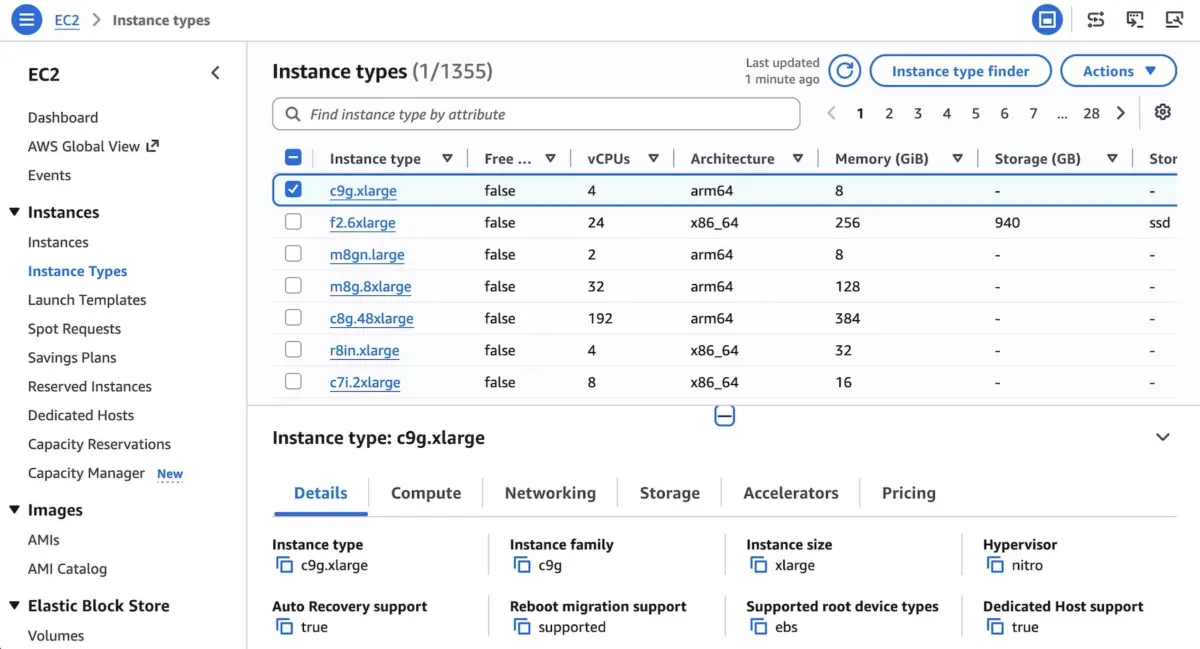
The journey from a single instance type (m1.small) to an ecosystem of more than 1,200 specialized configurations did not happen overnight. It was forged through a continuous sequence of architectural breakthroughs, customer-driven feature launches, and bold engineering bets.
The Formative Years: Establishing the Building Blocks (2006–2009)
In its earliest days, EC2 gave developers raw compute power, but managing state and application reliability remained a manual chore. AWS quickly realized that compute alone was insufficient for production-grade enterprise workloads.
- 2008: Persistent Storage Arrives. The introduction of Amazon Elastic Block Store (EBS) solved one of the cloud’s early Achilles’ heels—ephemeral storage. EBS provided persistent, high-performance block storage volumes tailored for EC2 instances, making database deployments and stateful applications viable in the cloud for the first time.
- 2009: Scaling and Visibility. Recognizing that static virtual machines could not automatically handle web traffic spikes, AWS launched Elastic Load Balancing (ELB), Auto Scaling, and Amazon CloudWatch. These three services democratized high availability, allowing applications to breathe—expanding and contracting dynamically based on real-time demand.
- 2009: Network Isolation. Enterprise adoption accelerated dramatically with the introduction of Amazon Virtual Private Cloud (VPC). VPC gave customers logically isolated networks within the AWS cloud, bringing the security parameters of a traditional corporate datacenter to multi-tenant cloud infrastructure.
The Hardware Revolution and Custom Silicon (2017–2018)
As virtualization matured, traditional hypervisors began consuming measurable CPU cycles and memory overhead. AWS responded with a paradigm-shifting engineering effort.
- 2017: The AWS Nitro System. AWS introduced the Nitro System, a combination of dedicated hardware and lightweight hypervisors that offloaded virtualization, storage, and networking functions from the host CPU. Nitro delivered near bare-metal performance, enhanced security isolation, and faster feature velocity for new instance types.
- 2018: Custom Silicon with Graviton. Challenging decades of x86 dominance, AWS launched its first ARM-based processors—AWS Graviton—via the A1 instance family. Designed specifically for cost-sensitive scale-out workloads, Graviton processors proved that custom silicon could yield massive price-performance advantages.
Expanding Beyond the Region Boundary (2018–2019)
For the first 12 years of its existence, EC2 lived strictly inside centralized AWS Regions. As enterprise and low-latency requirements evolved, AWS pushed the boundaries of where cloud infrastructure could physically reside.
- 2018: AWS Outposts. Bringing native AWS infrastructure and services directly to customer on-premises data centers and edge locations.
- 2019: AWS Local Zones. Placing compute, storage, and database services closer to large population and industry centers to deliver single-digit millisecond latencies for end-users.
- 2019: AWS Wavelength. Embedding AWS compute and storage directly inside 5G telecommunications carrier networks, unlocking ultra-low-latency mobile applications.
Supporting Context & Metrics: The Scale of Modern EC2
Numbers tell the story of EC2’s explosive growth better than prose. From a single region and a single instance type, the numbers have scaled to astronomical proportions.
+-----------------------------------+--------------------+--------------------+
| Metric Dimension                  | 2006 (Beta Launch) | Present Day        |
+-----------------------------------+--------------------+--------------------+
| Global Regions                    | 1 (US East)        | 39 Regions         |
| Instance Types                    | 1 (m1.small)       | > 1,200 types      |
| Compute Families                  | General Purpose    | Gen, Compute, Mem, |
|                                   |                    | Storage, HPC, & AI |
| Hardware Innovation               | Commodity CPU      | Custom Nitro &     |
|                                   |                    | Graviton Processors|
+-----------------------------------+--------------------+--------------------+
The Unseen Foundation of the Modern AWS Portfolio
While customers interact with thousands of distinct product offerings across the AWS console, almost all of them trace their lineage directly back to EC2.
- Container Orchestration: Both Amazon ECS and Amazon EKS rely on underlying EC2 capacity to run containerized workloads.
- Serverless and Functions: Even serverless services like AWS Lambda and AWS Fargate execute on foundational EC2 architecture managed behind the scenes by AWS.
- Big Data and Artificial Intelligence: Heavy analytical engines like Amazon EMR, machine learning pipelines on Amazon SageMaker AI, and foundation model training and inference on Amazon Bedrock ultimately draw their compute power from specialized EC2 accelerated computing instances (such as GPU- and Trainium/Inference-backed configurations).
Every architectural pattern conceived over the last twenty years—from a monolithic web application hosting static pages to trillion-parameter generative AI training workloads—begins with a single API call to launch an instance.

Official Statements & Industry Perspectives
Reflecting on two decades of cloud evolution, internal leaders and industry observers alike emphasize that EC2’s early design philosophy laid the groundwork for its longevity.
In historical reflections, long-time AWS evangelist and corporate blogger Jeff Barr—whose original 2006 post announced the beta—noted that the service succeeded by remaining true to its core tenets: being minimal yet useful, launching quickly, and iterating rapidly in response to real-world customer feedback.
"We made strong foundational decisions in 2006, and we left room for the service to grow," notes Channy Yun, principal developer advocate at AWS. "Twenty years later, that strategy of creating services that are minimal-yet-useful, launching quickly, and iterating rapidly in response to your feedback continues to guide how we build."
Industry analysts point out that EC2’s true genius was never just about renting virtual machines; it was about transforming IT infrastructure from a capital-intensive fixed asset into an elastic, utility-billed operational variable. By decoupling software from physical hardware, EC2 made experimentation cheap, rapid, and universally accessible to startups and multinational enterprises alike.
Future Outlook: The Next Twenty Years of Compute
As Amazon EC2 enters its third decade, the computing landscape looks vastly different from the Linux-centric virtual server environment of 2006. The primary drivers of cloud infrastructure are no longer just web applications and relational databases—they are compute-intensive generative AI models, real-time edge processing, autonomous systems, and highly distributed microservices.
Despite these seismic shifts in workload types, the fundamental value proposition of Amazon EC2 remains unaltered:
- Immediate Agility: Providing secure, resizable compute capacity in minutes.
- Granular Economics: Paying only for exact consumption without long-term hardware commitments.
- Elastic Scale: Scaling infrastructure dynamically to meet unpredictable spikes in user demand.
The integration of custom silicon—such as the evolution of AWS Graviton processors, Trainium, and Inferencia chips—signals that AWS will continue tightly coupling hardware design with software optimization. As artificial intelligence demands unprecedented parallel processing capabilities and energy efficiency, EC2 is poised to absorb these requirements through custom-built accelerators.
The next twenty years of cloud computing will undoubtedly demand capabilities that engineers in 2006 could not have conceptualized. Yet, as enterprises prepare for the next wave of technological disruption, Amazon EC2 stands ready as the resilient, adaptable foundation upon which the future of digital infrastructure will be built.