Executive Overview
If you have stepped outside into a sudden downpour after checking a weather app that promised clear skies, or melted in a heat wave that your smartphone claimed would be a mild afternoon, you are far from alone. Across the United States, users have grown increasingly exasperated by what feels like a systemic decline in the reliability of everyday weather forecasts.
This friction comes at a paradoxical time. Scientifically and computationally, meteorological modeling has never been more advanced. Leveraging massive supercomputers, physics-based simulations, and increasingly, machine learning and artificial intelligence algorithms, forecasters are capable of mapping atmospheric conditions with unprecedented granularity.
Yet, the user experience tells a completely different story. Popular consumer applications—from built-in smartphone widgets to major commercial platforms like Apple Weather, AccuWeather, and The Weather Channel—routinely bungle localized forecasts. The result is a pervasive national phenomenon: the weather-app blues.
This in-depth investigation explores why our pocket forecasts feel so chronically untrustworthy. By examining the mechanics of global weather modeling, the constraints of commercial app curation, the impact of recent institutional budget cuts, and the fundamental mismatch between raw data and human expectations, we uncover why your weather app so often lets you down—and what you can do about it.
Detailed Chronology: A Season of Meteorological Misdirection
The widespread disillusionment with consumer weather platforms is not just a collection of isolated complaints; it forms a documented pattern of high-profile forecasting failures that have punctuated daily life across the country.
Spring and Summer 2026: A Timeline of Discrepancies
- March 2026 (San Francisco, CA): A severe heat wave gripped the Bay Coast, pushing downtown temperatures toward record-breaking 90-degree marks. Meanwhile, residents checking Google Weather were met with charts displaying comfortable low-70s temperatures—a dramatic and deeply uncomfortable disconnect for those stepping outdoors.
- April 22, 2026 (Philadelphia, PA): Local spring-shower alerts turned into a masterclass in confusion when The Weather Channel notified users that storm activity would officially taper off at 7:15 a.m. The hitch? It hadn’t rained at all that morning, leaving commuters baffled by alerts for a disappearing tempest.
- Late Spring 2026 (National Disruption): Throughout the country, small businesses reported tangible economic impacts. Foot traffic dropped precipitously whenever generic thunderstorm icons dominated local app forecasts, even on days featuring bright, uninterrupted sunshine.
- December 2026 (North Carolina): Frustration reached a boiling point among professionals as well. A North Carolina meteorologist posted a viral public critique on social media after Apple’s weather app missed a regional forecast entirely. The meteorologist’s blunt conclusion echoed a growing sentiment: "Human-made forecasting is still the best way to go, and even that is still wrong."
These incidents have driven a surge of digital anxiety. Social media feeds, community boards, and online forums are flooded with users desperately seeking reliable weather apps, only to find that even tech-savvy consumers—such as Massachusetts philosophy instructor Vincenza Berardo, who rotates between EverythingWeather, MyRadar, WTForecast, and Weather Underground—remain trapped in a cycle of false alarms and unheralded storms.
Supporting Context & Metrics: The Anatomy of a Forecast
To understand why weather apps fail the average user, one must first look at where the data originates and how it is processed.
The Heavy Machinery of Global Modeling
Global weather forecasting is an immense computational feat. It relies on predictive models—vast mathematical frameworks comprising thousands of lines of code executed on elite supercomputers.
- Grid Mapping: The Earth’s surface and atmosphere are divided into a complex three-dimensional grid.
- Data Assimilation: Billions of data points gathered from satellites, weather balloons, radar stations, and ocean buoys are fed into these grids.
- Model Runs: Supercomputers simulate the physics of the atmosphere to generate baseline predictive scenarios.
Because the infrastructure required to run these models is astronomically expensive, almost all consumer-facing apps trace their data back to a handful of premier, government-funded institutions. Chief among these are:
- The Global Forecast System (GFS): Operated by the U.S. National Weather Service (NWS), updated four times a day, and projecting conditions up to 16 days out.
- The European Centre for Medium-Range Weather Forecasting (ECMWF): Frequently cited by data scientists for its more frequent update cycles and superior modeling architecture.
"It all tends to be the same data," explains Steve Gifford, co-founder and CEO of data-processing startup Wet Dog Weather. "If some app tries to tell you it has a fancier forecast, you roll your eyes a bit, because it all mostly comes from governments."
The Curation Trap: How Raw Science Becomes Consumer Fiction
If the underlying data comes from the same world-class supercomputers, why do different apps tell radically different stories? The answer lies in app curation and data presentation.
As climate scientist Daniel Swain notes, most consumer apps are intentionally "opaque" about what informs their displays. While models generate a spectrum of probabilities, an app developer must simplify this complex statistical spread into a single, digestible user interface element.
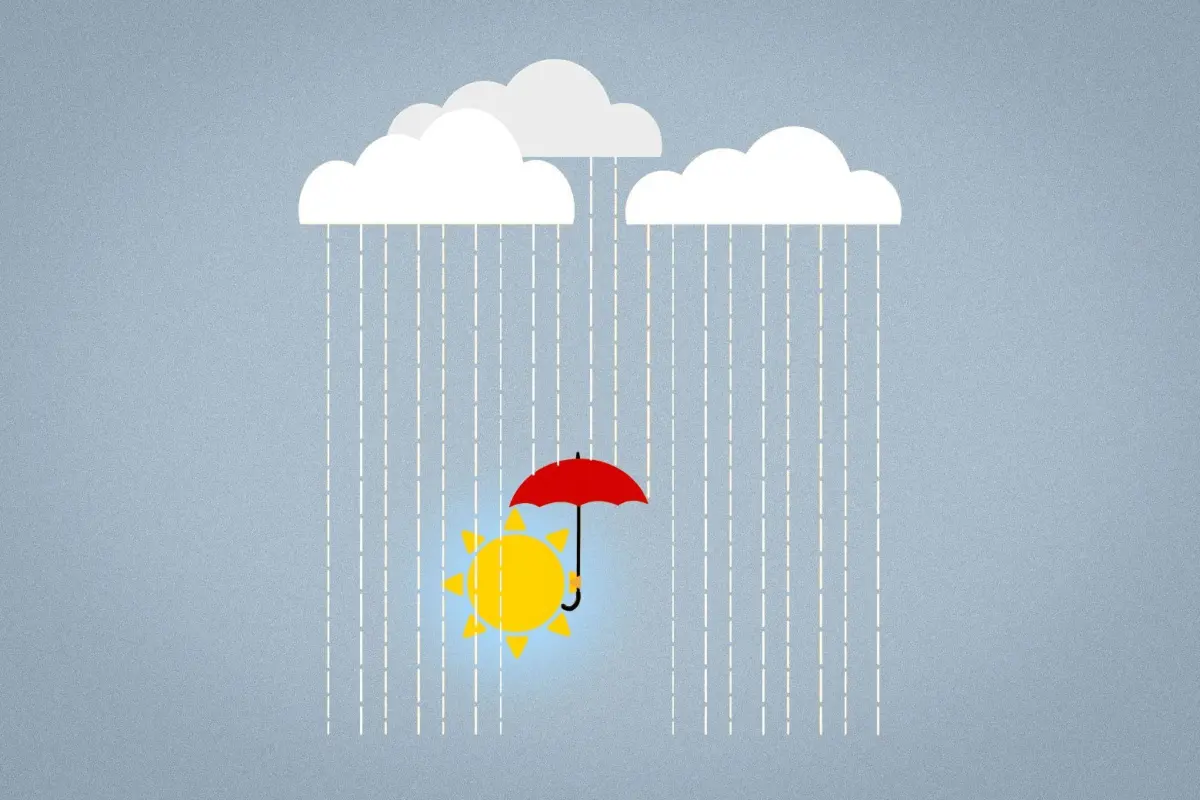
"If the NWS says a 30 percent chance of ‘scattered afternoon thunderstorms,’ that means there’s high confidence of storms, but they won’t be widespread within your area," Swain explains. "The app may display that forecast with a partly cloudy icon for the region, which will be correct for 70 percent of the area, but not for the 30 percent that actually gets pouring rain."
To maximize simplicity, apps often choose the single most likely binary outcome—a sunny icon or a rain cloud—erasing the nuance of probabilistic forecasting. When a localized downpour strikes the exact block you are walking down, the app’s binary "sunshine" icon feels like a personal betrayal, even if it was statistically accurate for the broader zip code.
Official Statements and Institutional Pressures
The fragility of our weather infrastructure has been compounded by recent policy shifts and budgetary contractions.
The U.S. weather-monitoring apparatus has faced significant headwinds following budget-slashing directives directed by the Department of Government Efficiency (DOGE), which targeted the National Oceanic and Atmospheric Administration (NOAA). These federal funding cuts have forced meteorological offices to scale back regional operations, reduce staffing, and cut back on critical satellite and weather balloon launches.
With public agencies stretched thin, private actors have stepped in to bridge the monitoring gaps. However, private companies often prioritize user retention, sleek design, and ad engagement over rigorous statistical transparency.
Industry experts emphasize that human psychology also plays a major role in the friction. "Users have always thought that weather apps are inaccurate, but they’re also incredibly untrustworthy about their experiences," says Gifford. Human memory naturally anchors onto dramatic failures—getting soaked in an unpredicted rainstorm—while completely overlooking the hundreds of times the app correctly predicted a clear commute.
Future Outlook: Niche Solutions vs. Mass-Market Design
Is there hope for the humble weather forecast? Industry insiders suggest that the solution depends entirely on your specific needs as a consumer.
The Rise of Specialized Apps
For the general public, major tech platforms will likely continue prioritizing ultra-simplified, glanceable interfaces over deep meteorological context. Consumers want instant answers—a quick look at their phone screen before running out the door—without parsing complex ensembles of data.
However, for those willing to look past the default smartphone widgets, robust alternatives exist:
- Niche & Marine Apps: Platforms like Windy, FishWeather, and CARROT Weather provide access to near-term radar feeds, localized wind dynamics, and high-frequency updates tailored to boaters, windsurfers, and outdoor professionals.
- The Human Element: Both Swain and Gifford emphasize that automated apps cannot fully replace human meteorologists. Local TV and digital broadcast meteorologists synthesize raw model data with regional intuition, providing crucial context, nuance, and narrative depth that a static cloud icon simply cannot match.
Conclusion
Your weather app doesn’t necessarily "suck" because the science of meteorology is failing; it struggles because of the inherent difficulty of translating chaotic, fluid atmospheric physics into a tidy, three-second smartphone animation. Until consumer tech companies embrace probabilistic transparency over deceptive simplicity, the best way to know which way the wind blows may still require looking out the window—or checking in with a human expert.