Executive Overview
For over a decade, Pinterest has functioned as the internet’s digital corkboard—a repository for aesthetic aspirations, dream homes, and curated lifestyles. Yet, the platform has historically grappled with a persistent structural challenge: the "conversion chasm." While hundreds of millions of users routinely "pin" home decor and interior design concepts, translating those static, idealized images into real-world transactions has remained a friction-filled process.
In a decisive bid to bridge this gap, Pinterest has unveiled "Restyle," a sophisticated, consumer-facing generative artificial intelligence tool. Currently launching in beta for users in the United States and Canada, Restyle represents a fundamental evolution in how consumers interact with spatial design. Powered by "Pinterest Intelligence"—a state-of-the-art computational framework built in partnership with Nvidia—the feature allows users to photograph their physical living spaces and deploy generative AI to instantly redesign, modify, and purchase items within those spaces.
This launch is not merely an incremental feature update; it is a calculated, infrastructure-heavy play to dominate the emerging spatial and social commerce sectors. By integrating cutting-edge computer vision, generative inpainting, and high-performance computing pipelines, Pinterest is attempting to transform itself from a passive discovery engine into an interactive, high-fidelity visualization platform. If successful, Restyle could fundamentally redefine the retail funnel, converting casual inspiration into direct-to-consumer commerce at an unprecedented scale.
Detailed Chronology
The rollout of Restyle and the underlying Pinterest Intelligence architecture represents a coordinated, multi-stage product strategy designed to signal both consumer utility and technological dominance to Wall Street and Silicon Valley alike.
[Monday] -------------------------> [Annual Event] -------------------> [Thursday]
Nvidia Partnership Announced        "Pinterest Presents" Showcase      "Restyle" Beta Launch
- Blackwell GPU Integration        - Visual Search Ads introduced     - US & Canada Rollout
- Dynamo Optimization Pipeline      - App Promotion Tools unveiled     - Interactive Spatial AI
Phase 1: The Infrastructure Foundation (Monday)
The technological groundwork was laid bare on Monday when Pinterest publicly disclosed a deep, multi-faceted engineering partnership with Nvidia. The company revealed that the foundation of Pinterest Intelligence is built upon Nvidia’s next-generation Blackwell GPU architecture and Nvidia Dynamo—an advanced software compilation and optimization framework designed to accelerate deep learning model training and inference. By combining these hardware and software pipelines with select open-source foundation models and Pinterest’s proprietary spatial algorithms, the company established the computational horsepower necessary to run real-time, high-fidelity image manipulation for millions of concurrent users.
Phase 2: The Advertiser Showcase (The "Pinterest Presents" Event)
With the infrastructure validated, Pinterest transitioned to its annual flagship advertiser event, "Pinterest Presents." Here, the company teased the capabilities of Restyle within a broader suite of commercial tools. To reassure brands of its monetization potential, Pinterest introduced advanced visual search advertisements and specialized app promotion features. The strategic messaging was clear: Pinterest was building a unified ecosystem where consumer-facing generative AI tools would directly feed into highly targeted, high-conversion advertising inventories.
Phase 3: The Beta Deployment (Thursday)
On Thursday, the consumer-facing iteration of this technological push went live. Pinterest officially launched the "Restyle" feature in beta, limiting initial access to an early preview cohort in the United States and Canada. This phased rollout allows Pinterest’s engineering teams to stress-test the real-time inference capabilities of the Nvidia Blackwell clusters, gather user interaction data, and refine the generative output of the spatial model ahead of a broader public launch.
Supporting Context & Metrics
The Mechanics of "Restyle"
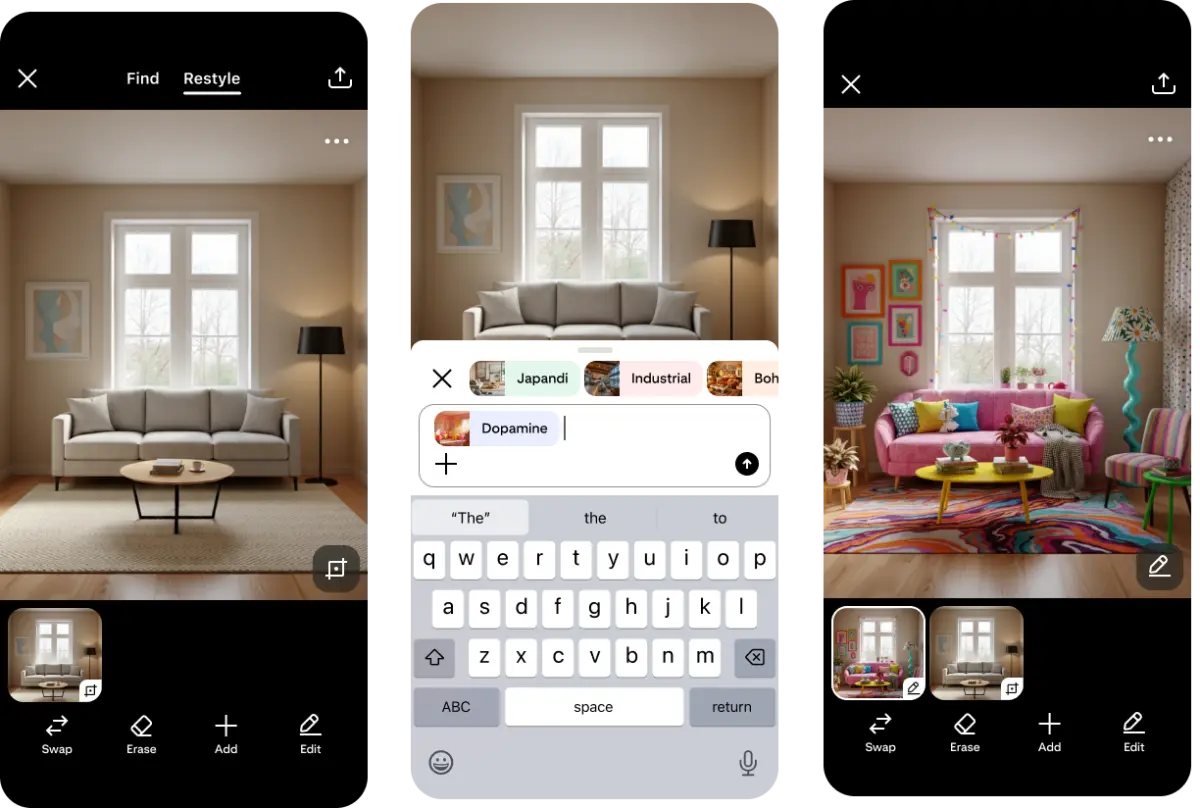
At its core, Restyle is a spatial editing engine designed to lower the barrier of entry for interior design. The user journey begins with a simple action: capturing a photograph of a room within their home. From there, the Pinterest Intelligence engine processes the spatial depth, lighting conditions, and existing architectural boundaries of the image.
Users can interact with the environment in three distinct ways:
- Targeted Object Manipulation: By tapping on individual elements within their photo—such as an outdated armchair or an empty coffee table—users can leverage generative inpainting to swap the item out, erase it entirely, or replace it with a product discovered on Pinterest.
- Aesthetic Style Overhauls: Users can issue natural language prompts to completely transform the stylistic DNA of the room. The system supports a wide range of design vernaculars, ranging from classic "bohemian" and "industrial" aesthetics to highly contemporary, algorithmically driven trends like "dopamine decor" and "whimsical modernism."
- Environmental Adjustments: Beyond object placement, the AI can manipulate global parameters within the photo, such as altering wall paint colors, adjusting ambient lighting schemes, or dynamically rendering indoor plants and decorative accessories.
| Feature Capability | Technical Method | Consumer Value Proposition |
|---|---|---|
| Generative Inpainting | Latent Diffusion / Proprietary Masking | Seamlessly swap or erase specific furniture items |
| Style Transfer | Natural Language Text-to-Image Prompts | Instantaneously visualize room themes (e.g., Industrial, Boho) |
| Spatial Lighting Alignment | Photometric Stereo / Depth Estimation | Ensures inserted products match the room’s natural shadows |
| Catalog Mapping | Computer Vision / Vector Embedding | Directly links visual designs to purchasable merchant inventory |
The Spatial Commerce Landscape
Pinterest is entering a competitive arena where retail giants have long experimented with augmented reality (AR) and spatial computing. Ikea’s Kreativ application, Wayfair’s Decorify, and Amazon’s AR View have all attempted to solve the visualization problem. However, many of these legacy solutions rely on rigid AR overlays—often resulting in cartoonish, poorly lit 3D models floating awkwardly in a physical space.

Pinterest’s approach differs by utilizing generative AI rather than traditional 3D asset rendering. By leveraging diffusion models optimized by Nvidia Dynamo, Restyle does not just overlay a product; it re-renders the entire image, ensuring that the shadows, reflections, and perspective of the new furniture item perfectly match the ambient environment of the user’s home.
Furthermore, Pinterest holds a massive data advantage: a vast, highly structured catalog of billions of user-curated "Pins." By pairing this rich semantic dataset with generative AI, Pinterest can offer highly personalized, contextual product recommendations that feel organic rather than forced.
Official Statements & Strategic Implications
The strategic implications of the Nvidia partnership and the Restyle launch point to a broader shift in Pinterest’s corporate identity. The company is aggressively moving away from being viewed as a legacy social network, positioning itself instead as a high-performance AI utility.
According to technical briefs released by Pinterest, the collaboration with Nvidia is designed to radically optimize the "Pinterest Assistant"—the platform’s conversational and visual search agent. By leveraging Nvidia Blackwell GPUs, the platform can process complex visual search requests with significantly reduced latency. This allows the system to instantaneously translate a user’s visual searches into highly accurate "signals" for AI-driven discovery and commerce.
From an advertising perspective, the implications are profound. Traditionally, home decor brands have struggled with high return rates due to "buyer’s remorse"—a phenomenon often caused by consumers misjudging how an item will look or fit in their actual home. By allowing consumers to virtually trial products in their own living spaces prior to purchase, Pinterest is directly addressing this pain point. Advertisers can now transition from buying simple impression-based banner ads to sponsoring high-intent, interactive visualization sessions where their products are directly integrated into the consumer’s personal spatial canvas.
Future Outlook
As Restyle moves from its initial beta phase in the United States and Canada toward a broader global rollout slated for next month, Pinterest faces both massive opportunities and formidable technical hurdles.
[Beta Phase] -----------------------> [Optimization] ------------------> [Global Launch]
- US & Canada Cohorts                 - Reduce GPU Latency               - Scaled Merchant Integration
- Feedback on AI Accuracy             - Refine Depth Mapping             - International Rollout
The Challenge of Scale and Compute Costs
While the integration of Nvidia Blackwell GPUs represents the gold standard of AI infrastructure, running real-time diffusion models at scale is incredibly compute-intensive. Pinterest must find a way to balance the massive operational costs of running these high-performance GPU clusters with the monetization generated through sponsored products and visual search ads. If the conversion rate does not offset the high cost of generative inference, the feature could become a financial drag on the company’s margins.
Algorithmic Accuracy and Trust
For Restyle to succeed as a commerce engine, the AI’s rendering must be highly accurate. If a user purchases a couch visualized through Restyle, only to find that the real-world color, texture, or dimensions differ significantly from the AI-generated preview, consumer trust will erode. Pinterest will need to continuously refine its spatial depth mapping and color-matching algorithms to ensure that "what you see is truly what you get."
The Evolution of Generative Commerce
Despite these challenges, the launch of Restyle marks a watershed moment for social commerce. By successfully merging generative AI with a highly intent-driven user base, Pinterest is establishing a blueprint for the future of retail. In this future, shopping is no longer about scrolling through flat grids of products; it is an interactive, creative process where the consumer’s own home becomes the ultimate storefront. As the technology matures, expect Pinterest to expand this generative visualization capability beyond home decor, potentially moving into virtual fashion try-ons, beauty, and beyond.