Executive Overview
In a major development for cloud architects and serverless developers globally, Amazon Web Services (AWS) has officially announced the launch of an enhanced custom event bus for Amazon EventBridge. Purpose-built to address the mounting architectural friction of enterprise-scale serverless deployments, this new capability fundamentally reshapes how multi-account organizations handle asynchronous event routing, governance, and scaling.
For years, organizations building event-driven applications on Amazon EventBridge have begun their journeys with a single custom event bus housed within a single AWS account. While this minimalist approach serves early-stage architectures effectively, it quickly breaks down as adoption scales. Driven by security and organizational best practices, modern enterprises adopt multi-account strategies where distinct teams operate inside isolated AWS environments.
To bridge the communication gap between these segregated accounts, developers historically had to construct web-like networks of multiple event buses connected via cross-account rules or complex bus-to-bus configurations. Ironically, this workaround reintroduced the very operational complexity that serverless computing was designed to eradicate. Platform engineering teams lost holistic visibility over who was subscribing to what. Furthermore, compounding cross-account routing charges escalated cloud overhead, while teams requiring strict event ordering were forced to build intricate, brittle workarounds or pivot to alternative messaging technologies entirely.
The new enhanced custom event bus directly targets these operational bottlenecks. By permitting the deployment of a single, centralized event bus shared across all AWS accounts within an entire organization, AWS has successfully eliminated the need for fragmented routing topologies. Bolstered by native event ordering guarantees, a simplified unified "Subscriber" resource model, and an innovative ingress-and-egress pricing tier, this release represents one of the most substantial architectural updates to Amazon EventBridge since its inception. Existing "classic" event buses will remain fully supported, allowing enterprises to adopt the new model at their own pace without operational disruption.
Detailed Chronology: Solving the Multi-Account Scaling Dilemma
The evolution of event-driven architectures (EDA) inside large enterprises followed a predictable trajectory prior to this announcement. As the industry embraced microservices, Amazon EventBridge emerged as the serverless backbone for decoupled systems. However, the path to a mature, multi-account setup exposed critical friction points.
The Rise of Multi-Account Complexity
As cloud estates expanded, security mandates dictated that disparate development teams—such as billing, inventory, user management, and logistics—operate within separate AWS accounts. To allow these teams to communicate, platform engineers had to implement intricate cross-account permissions policies. Every time a new team wanted to consume events from another account, engineers configured explicit resource-based policies on the event bus, established target rules, and sometimes chained multiple event buses together.
This decentralized routing mechanism triggered a cascade of operational issues:

- Loss of Observability: Central platform teams could no longer easily track event schemas, lineage, or dependency graphs across account boundaries.
- Cost Amplification: Multi-bus routing structures frequently incurred compounding data-transfer and invocation charges.
- Architectural Fragmentation: Strict subscriber limits on traditional buses forced organizations to spin up additional, redundant buses, further muddying the data flow.
The Path to the Enhanced Custom Event Bus
Recognizing these pain points, AWS product engineering designed the enhanced custom event bus to restore simplicity to enterprise topologies. The workflow to provision and govern this new architecture has been streamlined directly into the AWS Management Console and infrastructure-as-code tooling.
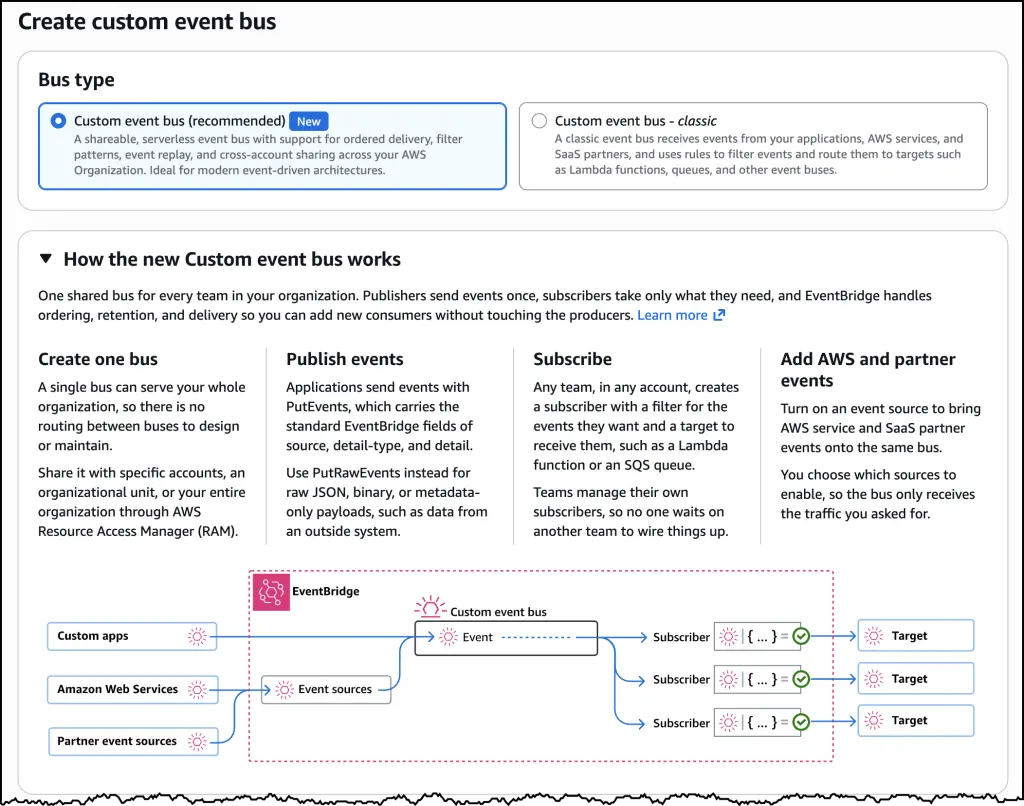
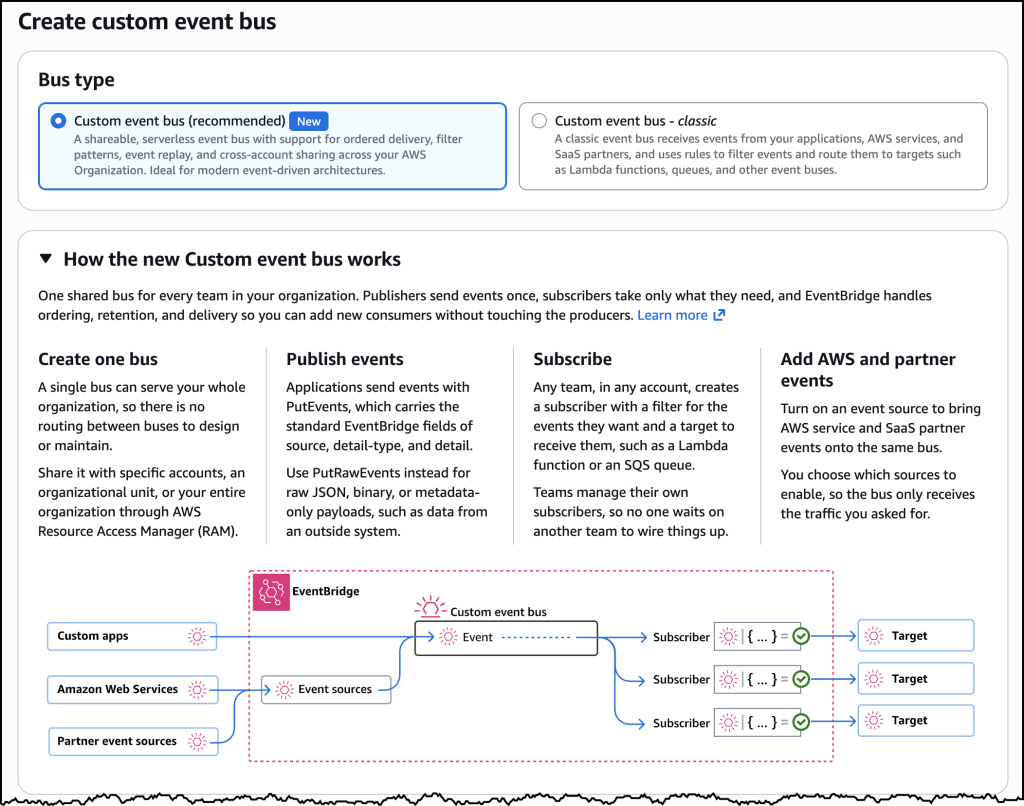
When initiating the creation of a new custom event bus via the AWS Management Console, administrators are now presented with a clear distinction between the Custom event bus (recommended new option) and the Custom event bus – classic option. Choosing the new option initiates a paradigm where a single shared bus serves every corner of the organization. Publishers emit events freely, subscribers ingest precisely what they need based on advanced filtering patterns, and the underlying EventBridge service manages ordering, retention, routing, and delivery natively.
[Publisher AWS Account] ---> (Emits Event) ---> [Central Enhanced Event Bus]
                                                          |
                 +----------------------------------------+----------------------------------------+
                 | (Shared via AWS RAM across Org)                                                 |
                 v                                                                                 v
     [Subscriber: Account B]                                                           [Subscriber: Account C]
     - Filter Pattern: Orders.EU                                                       - Filter Pattern: Orders.US
     - EventGroupId: Driver-123 (Ordered)                                              - Standard Async (Unordered)
     - Target: AWS Lambda (Sync Mode)                                                  - Target: Amazon SQS
Seamless Resource Sharing via AWS RAM
Configuring organization-wide accessibility no longer requires manual cross-account policy scripting. By leveraging integration with AWS Resource Access Manager (AWS RAM), administrators can toggle Enable event bus sharing and restrict access exclusively to their AWS organization.
Granular access can be scoped down to specific organizational units (OUs), individual AWS account IDs, or designated AWS Identity and Access Management (IAM) roles and users. This integration ensures that teams can immediately begin publishing and consuming events across account lines without waiting for manual infrastructure provisioning cycles from central platform teams.
Supporting Context & Metrics: Technical Deep Dive
The architectural enhancements baked into the new event bus go far beyond simple account sharing. AWS has introduced targeted solutions for some of the most persistent challenges in distributed systems: event ordering, ingestion deduplication, payload transformation, and cost governance.
1. Balancing Asynchronicity with Event Ordering
Asynchronous event-driven patterns are inherently non-deterministic; consumers generally process messages as they arrive, assuming order is irrelevant. However, certain business domains—such as financial transaction ledgers, inventory updates, and real-time fleet logistics—strictly depend on sequential execution. For instance, in a logistics and GPS-tracking application, vehicle location updates must be processed in exact chronological order. If out-of-sequence updates reach a routing algorithm, dispatchers risk making critical navigational decisions based on stale positioning data.
The enhanced custom event bus solves this dichotomy by supporting both ordered and unordered workflows concurrently on the same bus:

- Event Grouping: Publishers attach an optional
EventGroupIdpayload attribute when dispatching events. - Ordered Delivery: EventBridge guarantees that events sharing the same
EventGroupIdare delivered sequentially to subscribers that have opted into ordered delivery. - Asynchronous Coexistence: Other consumers on the exact same bus can consume those identical events asynchronously without being bottlenecked by ordering constraints.
To underpin this deterministic processing, the enhanced bus introduces synchronous invocation modes for targets such as AWS Lambda. Synchronous invocation confirms successful downstream execution before acknowledging the event. This effectively eliminates the historical requirement of interposing an Amazon Simple Queue Service (Amazon SQS) FIFO queue between an event bus and a Lambda function merely to guarantee linear processing order.
2. The Unified "Subscriber" Resource
Previously, configuring a consumer to read from an event bus required creating disparate rules, target bindings, retry policies, and dead-letter queue (DLQ) configurations spread across multiple cloud resources.
The enhanced event bus introduces the Subscriber resource, a unified abstraction that encapsulates:
- Event filtering logic
- Target configuration
- Granular retry policies
- Dead-letter destinations
Furthermore, Subscribers feature variable start-time options, simplifying the onboarding of newly deployed microservices and enabling rapid event replay workflows for disaster recovery or database rehydration. Default quotas have been established at 10,000 Subscribers per bus, with provisions to request higher limits, all but eliminating the arbitrary fragmentation previously caused by low subscriber ceilings.
3. Advanced Event Evaluation: Deduplication and Transformation
Distributed networks frequently suffer from network timeouts, duplicate packet transmissions, and retry storms. The new event bus introduces content-based deduplication to combat this at the infrastructure layer:
- EventBridge computes cryptographic hashes of meaningful payload fields, automatically identifying and dropping duplicate events arriving within a strict five-minute window.
- This delivers exactly-once delivery semantics for retries originating from sources that lack native idempotency tokens, lifting the operational burden off application developers.
Additionally, subscribers can harness JSONata expressions to transform event payloads dynamically before they reach downstream targets. Fields can be extracted, renamed, or computed on the fly when a receiving API expects a specific schema. For organizations utilizing standardized serialization protocols like Apache Avro or Protocol Buffers, EventBridge can seamlessly deserialize payloads into JSON, empowering subscribers to filter and route based on rich data structures without writing custom consumer-side parsing logic.
4. A Scalable Ingress-Egress Pricing Model
Monetary structures for cloud services often dictate architectural design. Under traditional multi-bus topologies, cumulative per-event pricing models meant that cross-account and bus-to-bus routing charges escalated exponentially at scale.
The enhanced custom event bus introduces an optimized ingress and egress throughput pricing model:
- Publishers pay solely for events ingested into the bus.
- Subscribers pay strictly for events delivered out of the bus.
This transparent model aligns infrastructure expenses directly with actual data consumption, neutralizing the financial penalty of multi-account event distribution.
Future Outlook
The introduction of the enhanced custom event bus signals a maturation phase for serverless and event-driven computing. As enterprises increasingly migrate complex, mission-critical workloads to cloud-native paradigms, the infrastructure supporting these systems must evolve from simple utility pipelines into governed, intelligent data backbones.
Industry analysts predict that this release will accelerate the adoption of enterprise-wide event meshes. By removing the administrative overhead of cross-account permissions management and dissolving historical limits on subscriber counts, AWS has lowered the barrier to entry for holistic domain-driven design (DDD). Platform engineering teams can now confidently establish centralized event fabrics that act as the single source of organizational truth, secure in the knowledge that governance, ordering, and cost controls are handled natively at the platform layer.
Moving forward, we can expect to see deeper integrations between this centralized bus architecture and AWS governance tools, enhanced AI-driven schema discovery, and even more granular compliance reporting. For organizations seeking to build resilient, scalable microservices without drowning in operational complexity, the enhanced Amazon EventBridge custom event bus establishes a robust new standard for the serverless era.
Availability and Getting Started
The enhanced custom event bus is generally available today across a broad footprint of global AWS Regions, including:
- US Regions: US East (N. Virginia, Ohio), US West (Oregon)
- European Regions: Europe (Ireland, Frankfurt, Stockholm, Spain)
- Asia Pacific Regions: Asia Pacific (Hong Kong, Malaysia, Mumbai, Singapore, Sydney, Thailand, Tokyo)
Developers and platform engineers can provision their first enhanced custom event bus immediately via the AWS Management Console, the AWS Command Line Interface (AWS CLI), or programmatically through EventBridge APIs. For comprehensive implementation tutorials and schema references, consult the official Amazon EventBridge Documentation.