In the rapidly evolving landscape of cloud-native architecture, enterprise engineering teams have increasingly gravitated toward event-driven paradigms. This approach decoupling producers and consumers offers scalability, responsiveness, and resilience.
For years, Amazon Web Services (AWS) has anchored much of this serverless ecosystem on Amazon EventBridge, a serverless event router that makes it easy to build scalable event-driven applications.
However, as organizations scale these architectures beyond a single proof-of-concept or isolated team into sprawling, multi-account enterprise environments, operational friction has historically crept in.
To combat this complexity, AWS has announced a landmark release: the enhanced custom event bus for Amazon EventBridge. Purpose-built for modern enterprises scaling event-driven applications across disparate teams and AWS accounts, this new offering fundamentally rethinks how events flow through an organization.
Instead of forcing platform teams to construct complex webs of cross-account rules, bus-to-bus configurations, and fragmented subscriptions, the enhanced custom event bus introduces a single, centralized, organization-wide event backbone.
By integrating native event ordering, simplified subscriber resource models, automated AWS Resource Access Manager (RAM) sharing, and a revamped ingress-egress pricing structure, AWS is directly addressing the operational debt that has plagued large-scale serverless implementations.
This deep-dive technical news report explores the architecture, implications, and operational realities of the enhanced custom event bus, charting its evolution from classic multi-bus anti-patterns to a streamlined, enterprise-grade event mesh.
Detailed Chronology: The Evolution of Multi-Account Routing
To truly understand the weight of the new enhanced custom event bus, one must trace the architectural trajectory of Amazon EventBridge and its precursor, Amazon CloudWatch Events.
The Single-Account Era
When organizations first adopt serverless and event-driven patterns, the deployment topology is typically straightforward. A single development team operates within a single AWS account, deploying a solitary custom event bus.
Microservices within that account publish domain events—such as OrderCreated or PaymentProcessed—which are evaluated against rules and routed to targets like AWS Lambda functions, Amazon Simple Notification Service (SNS) topics, or downstream APIs.
In this nascent stage, latency is low, visibility is absolute, and administrative overhead is negligible.
The Multi-Account Explosion
As organizational adoption accelerates, enterprise governance models take over. AWS security best practices mandate a multi-account structure, typically orchestrated via AWS Organizations.
Under this model, each business unit, product team, or domain microservice operates in its own isolated AWS account to achieve blast radius containment, distinct billing boundaries, and granular access control.
While secure, this architectural isolation creates a profound friction point: how do applications in Account A securely and reliably communicate with consumers in Account B, C, and D?
Historically, bridging this gap required engineering workarounds. Teams were forced to create multiple custom event buses across accounts, wiring them together via complex cross-account resource policies, bus-to-bus routing rules, and rigid IAM trust relationships.
The consequences of this multi-bus sprawl were severe:
- Operational Blind Spots: Platform and central cloud-ops teams lost holistic visibility into event lineage. It became increasingly difficult to audit who was subscribing to what events across organizational boundaries.
- Cost Compound Effects: Routing events across multiple buses incurred cumulative charges, inflating the total cost of ownership (TCO) for simple publish-subscribe operations.
- Feature Gaps: Teams requiring strict sequencing, such as order-dependent financial transactions or logistics telemetry, could not natively rely on basic event routing. They were forced to introduce intermediary message queues like Amazon SQS, write custom deduplication logic, or abandon event-driven designs altogether for critical paths.
The Paradigm Shift
Recognizing these pain points, AWS product engineering initiated a complete re-architecting of the custom event bus. Rather than iterating marginally on the classic bus model, AWS developed a greenfield resource designed explicitly for organizational scale.
The resulting enhanced custom event bus—running alongside the legacy "classic" bus for backward compatibility—marks a generational leap forward. It unifies multi-account publishing and subscribing into a single managed construct, effectively eliminating the infrastructural scaffolding that platform engineers previously had to build by hand.
Architectural Deep Dive: Core Capabilities
The enhanced custom event bus introduces several foundational engineering breakthroughs that transform how events are managed, routed, and consumed at scale.
1. Organization-Wide Sharing via AWS RAM
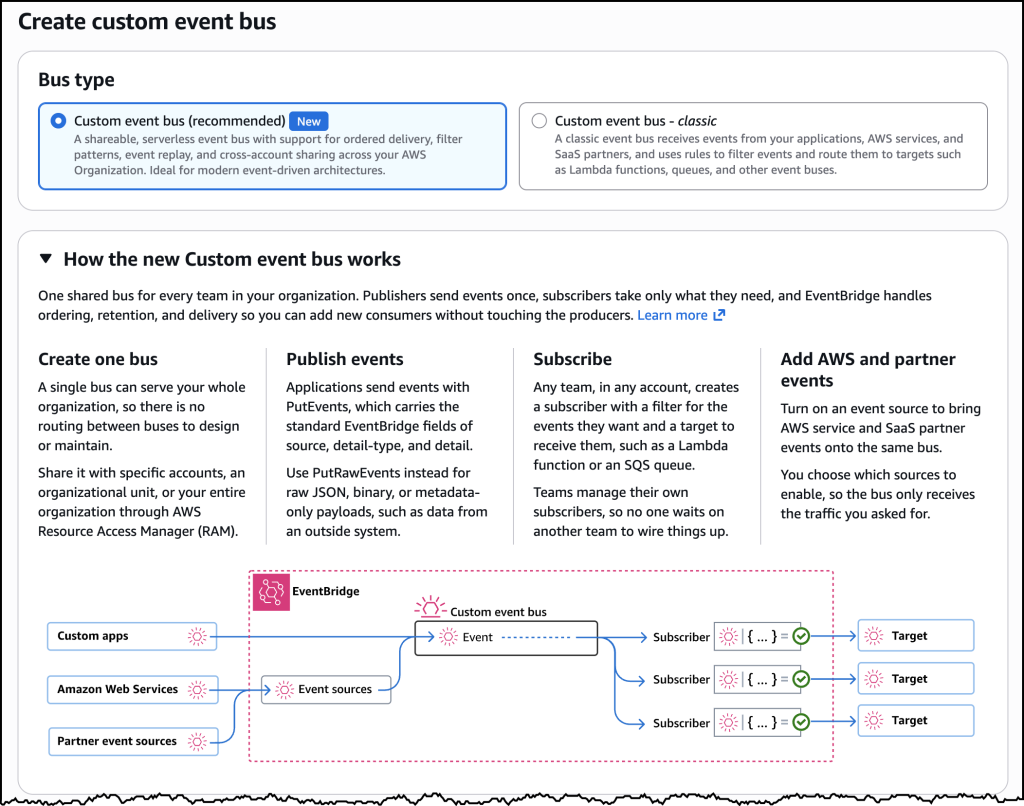
At the heart of the new architecture is native integration with AWS Resource Access Manager (AWS RAM). Platform teams can now deploy a single enhanced custom event bus in a central account and configure it to be shared instantly across an entire AWS Organization, specific Organizational Units (OUs), or granular IAM principals.
[Publisher Account (Team A)]
        │
        ▼
[ Central Enhanced Custom Event Bus ] ──(AWS RAM / Org-Wide Sharing)
        │
        ├──► [Subscriber Account 1 (Team B)]
        ├──► [Subscriber Account 2 (Team C)]
        └──► [Subscriber Account 3 (Team D)]
When a platform administrator enables event bus sharing, publishers and subscribers can immediately interact with the bus without requiring manual cross-account policy management or complex routing rules. Publishers broadcast events without needing prior knowledge of who—or how many teams—will consume them.
Concurrently, application teams independently provision their own consumption mechanisms, maintaining agility while remaining tethered to a centrally governed event backbone.
Furthermore, the default quota has been dramatically expanded to support 10,000 Subscribers per bus, vastly reducing the artificial fragmentation that previously forced teams to spin up auxiliary buses simply to bypass subscriber limits.
2. Native Event Ordering and Synchronous Processing
Event-driven design principles traditionally dictate that consumers must be idempotent and asynchronous, operating under the assumption that event arrival order is non-deterministic. However, real-world enterprise workloads frequently violate this assumption.

Consider a logistics and fleet management platform: if a vehicle’s GPS coordinates and status updates arrive out of sequence, routing algorithms will evaluate stale data, resulting in catastrophic path-planning errors.
The enhanced custom event bus solves this by introducing native Event Grouping. Publishers attach an EventGroupId attribute to their payloads.
EventBridge guarantees strict, in-sequence delivery of events sharing the same EventGroupId to any subscriber configured for ordered delivery. Crucially, this occurs on the same bus, allowing teams to mix unordered, highly concurrent asynchronous consumers with strict, sequenced processors without architectural compromises.
To support this deterministic execution model without race conditions, EventBridge now supports synchronous invocation for targets like AWS Lambda.
By confirming successful processing before acknowledging receipt of the event, this capability eliminates the legacy anti-pattern of inserting Amazon SQS queues between an event bus and a Lambda function purely to enforce reliable processing order.
3. The Unified Subscriber Resource Model
In classic EventBridge architectures, achieving granular delivery required piecing together disparate components: individual rules, target configurations, retry policies, and dead-letter queue (DLQ) destinations scattered across multiple resource definitions.
The enhanced event bus streamlines this via the Subscriber resource. A Subscriber is a cohesive, single-manageable unit that encapsulates:
- Event Filtering Patterns: Precise specifications dictating exactly which events the consumer wishes to ingest.
- Target Mapping: The destination endpoint (such as Lambda, SQS, or APIs) configured to receive the filtered events.
- Retry Policies & Dead-Letter Destinations: Robust error handling parameters configured in one centralized location.
- Variable Start Times: Flexible onboarding parameters allowing new consumers to initialize without disrupting historical event streams, or facilitating historical event replays for debugging and state hydration.
4. Advanced Event Evaluation, Deduplication, and Transformation
Data ingestion at enterprise scale is rarely pristine. Producers frequently experience network timeouts, transient retries, or partial failures that result in duplicate message delivery.
The enhanced custom event bus introduces content-based deduplication.
Instead of forcing publishers to generate and track complex idempotency tokens, EventBridge hashes the meaningful elements of the event payload. If identical payloads arrive within a five-minute window, the engine automatically collapses them, delivering true exactly-once semantics to consumers.
For payload transformations, subscribers can leverage native JSONata expressions. Downstream microservices often require payloads structured in specific formats that differ from the publisher’s output. JSONata allows consumers to dynamically reshape, extract, rename, or compute new values on-the-fly before the event ever hits the target.
Additionally, for organizations utilizing binary serialization formats like Apache Avro or Protocol Buffers (Protobuf), EventBridge can natively deserialize these payloads into JSON. This enables subscribers to execute fine-grained filtering and routing over rich binary data streams without writing custom consumer-side parsing middleware.
Supporting Context & Metrics: Economic and Operational Impact
The transition from classic multi-bus architectures to the enhanced custom event bus yields profound operational and financial dividends.
| Architectural Metric / Dimension | Classic EventBridge Multi-Bus Model | Enhanced Custom Event Bus (AWS Org-Wide) |
|---|---|---|
| Cross-Account Setup | Manual IAM policies, resource-based policies per bus, complex bus-to-bus rules. | Automated via AWS RAM; instant organization or OU-level sharing. |
| Subscriber Limits | Restricted per bus, driving unnecessary bus proliferation and fragmentation. | Default quota of 10,000 Subscribers per bus (extensible). |
| Event Ordering | Requires auxiliary queues (e.g., SQS) or custom sequencing logic. | Native support via EventGroupId and synchronous target invocation. |
| Deduplication | Manual idempotency token generation and producer tracking. | Content-based automatic hashing and 5-minute deduplication window. |
| Pricing Model | Per-event pricing with compounding cross-account/routing multipliers. | Ingress and egress throughput pricing model optimized for scale. |
The New Economic Model
Perhaps one of the most compelling aspects of the release is its pricing structure. Multi-bus architectures historically imposed compounding cost penalties: publishing an event across multiple accounts and intermediate buses triggered cumulative per-event routing fees.
The enhanced custom event bus pivots to an ingress and egress throughput pricing model. Publishers pay strictly for events ingested into the bus, while subscribers pay for events delivered.
This decouples the financial overhead from the topological complexity of the network, ensuring that scaling out consumer teams within an organization does not result in exponential cost curves.
Official Statements & Industry Reception
The release has drawn significant attention from enterprise architects and cloud infrastructure leaders who have long struggled with the friction of multi-account serverless coordination.
"For years, our enterprise customers building serverless applications at scale faced a difficult compromise," noted a senior AWS serverless product leader during the launch announcement. "They could embrace multi-account isolation for security and governance, but doing so meant wrestling with the operational gravity of multi-bus routing, cross-account policies, and fragmented event visibility. The enhanced custom event bus eliminates that friction entirely. By bringing organization-wide sharing, native ordering, and unified subscribers under one roof, we are delivering an enterprise event mesh that scales effortlessly with the business."
Early adopters participating in private previews have echoed these sentiments, highlighting the drastic reduction in Infrastructure-as-Code (IaC) boilerplate. Engineering leads report that deploying a centralized event backbone no longer requires hundreds of lines of complex CloudFormation or Terraform templates to wire cross-account permissions. Instead, a few clicks in the AWS Management Console or an AWS RAM invitation establishes a secure, governed event flow across dozens of isolated AWS accounts.
Future Outlook: The Next Wave of Event-Driven Engineering
The introduction of the enhanced custom event bus signals a maturation point in the serverless ecosystem. As enterprises move beyond simple microservices toward complex, event-driven mesh architectures encompassing real-time analytics, machine learning pipelines, and distributed operational workflows, the underlying infrastructure must keep pace.
Looking forward, several trajectory lines emerge:
- Deeper Governance and Lineage Tracking: With centralized buses shared via AWS RAM, platform engineering teams are well-positioned to build comprehensive data cataloging and event lineage dashboards, mapping out exactly how business domains interconnect in real-time.
- Advanced Stream Processing Integration: The convergence of native event ordering, JSONata transformations, and Protobuf/Avro deserialization suggests that EventBridge is increasingly stepping into territory previously dominated by heavier stream-processing engines like Apache Kafka, while retaining the zero-administration benefits of serverless.
- Phased Migration of Legacy Workloads: While the "classic" custom event bus remains fully supported for backward compatibility, enterprises are expected to gradually migrate mission-critical, high-scale workloads to the enhanced bus to capitalize on the superior economics of the ingress-egress pricing model and simplified subscriber governance.
Availability and Getting Started
The enhanced custom event bus is generally available today across a broad footprint of global AWS Regions, including US East (N. Virginia, Ohio), US West (Oregon), Europe (Ireland, Frankfurt, Stockholm, Spain), and Asia Pacific (Hong Kong, Malaysia, Mumbai, Singapore, Sydney, Thailand, Tokyo).
Engineers and platform administrators can provision their first enhanced custom event bus immediately using the AWS Management Console, the AWS Command Line Interface (AWS CLI), or infrastructure automation via EventBridge APIs.
As serverless architectures continue to eat the software world, innovations like the enhanced custom event bus ensure that infrastructure complexity scales sub-linearly with organizational growth—allowing engineering teams to focus on writing business logic rather than wiring plumbing.