Executive Overview
The intersection of artificial intelligence and video game development continues to be a contentious battleground. As studios search for ways to combat soaring production costs, inflated development cycles, and ballooning team sizes, generative AI has emerged as both a miraculous efficiency booster and a lightning rod for community backlash.
No studio currently embodies this tension quite like Pearl Abyss. The South Korean developer and publisher, best known for the massive MMORPG Black Desert Online, recently doubled down on its commitment to integrating artificial intelligence deeper into its production pipeline. This strategic shift was formally outlined in the company’s Q3 financial earnings report, signaling that despite earlier public controversies regarding AI-generated assets in its upcoming flagship action-RPG, Crimson Desert, the studio views automated tools as essential to its long-term commercial survival and operational scalability.
While Pearl Abyss continues to insist that human developers remain the creative anchor of its games—framing AI strictly as a utilitarian support framework for design validation, task automation, and testing—the industry at large remains skeptical. The studio’s trajectory offers a fascinating case study in how major players in the AAA games sector are navigating the treacherous waters of technological adoption, transparency, and player sentiment.
Detailed Chronology of Events
To understand the weight of Pearl Abyss’s recent statements regarding its AI pipeline, it is necessary to examine how the studio’s relationship with generative technology has evolved over the past year.
Early 2024: The Crimson Desert Asset Discovery
The friction between Pearl Abyss and its player base came to a head earlier this year when eagle-eyed players dissecting promotional media and early builds of Crimson Desert discovered visual anomalies. Specifically, a series of 2D visual props and textures scattered throughout the game environment bore the distinct hallmarks of generative AI art—artifacts, distorted line work, and nonsensical background patterns typical of early-generation image synthesis models.
The discovery sparked an immediate outcry across social media and gaming forums. Gamers and digital artists alike criticized the studio for utilizing generative tools, arguing that doing so devalues human labor, undercuts traditional artistic integrity, and introduces low-quality, derivative assets into a multi-million-dollar production.
The Apology and Clarification
Responding swiftly to the controversy, Pearl Abyss issued a public apology. However, the studio’s statement drew a fine, yet significant, distinction: the apology was not for using generative AI per se, but rather because the AI-generated placeholders had been left visible to players prematurely.
According to the studio, some 2D visual elements were drafted using AI during the preliminary stages of development to quickly populate asset lists and establish rough visual blocks. The original intention, Pearl Abyss maintained, was always to replace these placeholder assets with bespoke, high-quality artwork created entirely by human artists before the game reached its final polish phase.
Crucially, Pearl Abyss admitted to a lapse in communication, conceding that it had failed to clearly disclose its internal use of AI tools to the public. The studio pledged greater transparency moving forward—a promise that brings us directly to its Q3 financial disclosures.
Q3 Financials: Accelerating AI Integration
Rather than scaling back its reliance on artificial intelligence in the wake of the Crimson Desert incident, Pearl Abyss’s Q3 earnings letter reveals an aggressive expansion of the technology. The studio outlined that AI is no longer confined to experimental design phases or isolated concept art generation; instead, it is being woven directly into the core development pipeline to streamline production workflows, optimize code testing, and automate repetitive administrative and technical chores.
Supporting Context & Metrics: The Economics of Modern Game Development
The aggressive pivot toward AI by Pearl Abyss does not happen in a vacuum. It is a direct response to the unsustainable economic realities of modern AAA game development.
Spiraling Budgets and Extended Timelines
Over the past decade, the cost of developing a major console or PC game has skyrocketed. Budgets routinely cross the hundreds of millions of dollars, and production cycles that once lasted three to four years now frequently stretch past six or seven years. For publicly traded companies like Pearl Abyss, satisfying shareholders while managing these enormous capital expenditures requires drastic improvements in operational efficiency.
Industry analysts point out several key pressure points driving studios toward automation:
- Man-Hours on Prototyping: Validating game loops, balancing mechanics, and testing conceptual designs historically required months of manual implementation by engineering teams. AI-driven simulation and concept validation can reportedly compress these timelines significantly.
- Repetitive Task Offloading: Rigging models, generating environmental filler assets, and running baseline Quality Assurance (QA) regression tests consume thousands of developer hours. Automating these chores allows senior talent to focus on high-level creative direction.
- Risk Mitigation: By testing multiple design permutations via machine learning algorithms before writing physical code, studios hope to minimize costly design pivots late in production.
The Pipeline Shift: From Art to Architecture
While the initial public backlash focused heavily on 2D art assets, Pearl Abyss’s disclosures reveal that its current and future use of AI extends far beyond graphics. The technology is increasingly being deployed as a structural backbone across multiple departments:

- Design Validation: Rapidly running through algorithmic simulations to test whether a combat system, traversal mechanic, or open-world economy functions as intended before manual programming begins.
- Test Optimization: Utilizing machine learning to isolate bugs, predict structural bottlenecks in game code, and optimize frame-rate performance across diverse hardware configurations.
- Content Creation Support: Assisting developers in generating localized text, staging background environmental layouts, and handling non-critical world-building variables.
Official Statements and Corporate Stance
To mitigate potential public backlash, Pearl Abyss has carefully crafted its corporate narrative regarding artificial intelligence. The studio walks a tightrope between embracing efficiency and reassuring its audience that human creativity remains paramount.
In its Q3 earnings letter, the company explicitly addressed the boundaries of its AI implementation:
"While we previously validated game systems only after implementing them manually, we now utilize AI to rapidly validate diverse design concepts prior to actual implementation. This enables a more efficient allocation of development resources and enhances overall production speed."
However, the studio immediately sought to calm fears regarding job displacement and the erosion of artistic integrity:
"AI serves strictly as a tool to support concept validation and pipeline productivity. Gameplay and content development remain fully driven by our development team."
Reiterating its long-term vision, Pearl Abyss added:
"We view AI not as a substitute for human developers, but as a tool to elevate development efficiency and quality. We will continue to expand our application of AI to deliver higher-fidelity games to the market more expeditiously."
These statements mirror the broader sentiment across the global game industry. Major publishers ranging from Electronic Arts and Ubisoft to Square Enix have increasingly championed AI as an augmentation tool rather than a replacement for human imagination. Yet, the gap between corporate messaging and player perception remains wide.
Future Outlook: Crimson Desert, DokeV, and Beyond
As Pearl Abyss pushes forward with its AI-integrated development pipeline, all eyes are locked on its upcoming release slate.
Crimson Desert: The Ultimate Test
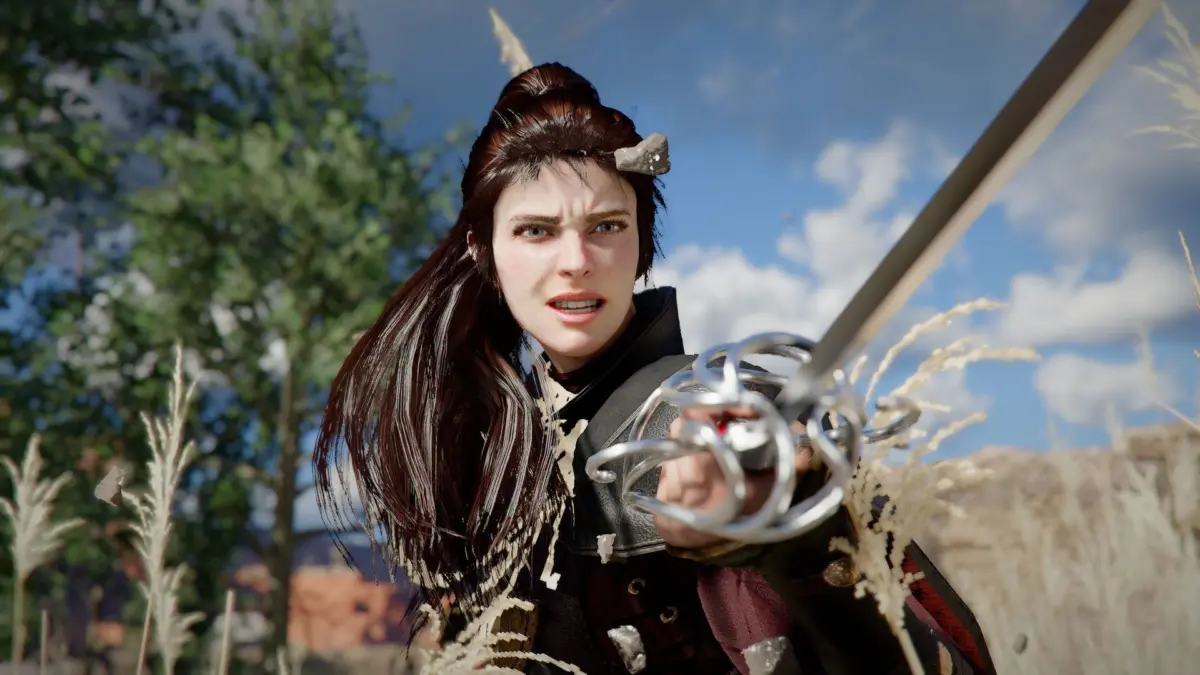
Crimson Desert, originally conceived as a prequel to Black Desert Online before evolving into a massive, single-player open-world action-adventure, represents the immediate proving ground for the studio’s new workflows. Following the controversy over AI-generated concept art placeholders, the pressure on Pearl Abyss to deliver a polished, artistically cohesive product is immense. Players and critics will undoubtedly scrutinize every texture, environmental asset, and narrative beat to determine where machine assistance ends and human artistry begins.
DokeV and the Horizon of 2028
Beyond Crimson Desert, Pearl Abyss provided a long-term update on DokeV, the vibrant, creature-collecting open-world game first unveiled back in 2021. Often playfully described by gaming communities as a hybrid of open-world exploration and stylized creature companions, the title has experienced a protracted development cycle.
In its latest communications, Pearl Abyss confirmed that it is currently targeting a release window in the second half of 2028 for DokeV. The extended timeline highlights the immense complexity involved in bringing the studio’s ambitious IP portfolio to life—and underscores why leadership views AI integration as a non-negotiable strategy for meeting future deadlines.
The Broader Industry Implications
Pearl Abyss’s transparent embrace of AI in its financial reporting signals a broader cultural shift within the gaming industry. As generative tools mature, the debate is no longer about whether studios will use AI, but how they will disclose it, regulate it, and balance it against the irreplaceable value of human craftsmanship.
For Pearl Abyss, the gamble is clear: leverage cutting-edge automation to streamline production, cut spiraling costs, and deliver massive worlds like those found in Crimson Desert and DokeV on time—all while hoping that transparent communication and a commitment to human-led design will be enough to keep player trust intact.