Executive Overview
In the sprawling, hyper-connected landscape of internet culture, viral images often emerge not from high-production Hollywood trailers or meticulously coordinated public relations campaigns, but from the mundane, unscripted corners of everyday life. Among the most culturally resonant and enduring meme formats of the late 2010s is a candid photograph captured on a Tuesday night inside a crowded dance venue in Scotland.
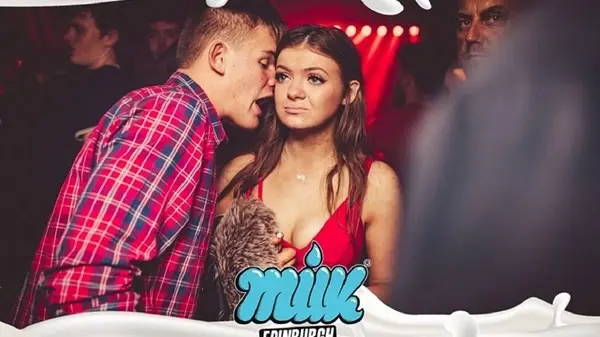
Widely known across social media platforms as "Milk Edinburgh" or "Guy Explaining," the image depicts a young man shouting passionately into the ear of a visibly unamused young woman. With the venue’s glowing watermark stamped proudly across the composition, the photograph quickly transcended its local origins to become a universal symbol of social exhaustion, unwanted exposition, and the comedic asymmetry of intense conversations held in loud environments.
What began as a standard promotional nightclub photograph published on Facebook in September 2018 swiftly evolved into a masterclass in internet user-generated content. Within days, the image was decoupled from its Scottish origins, weaponized by Twitter and Facebook users worldwide, and transformed into a versatile macro template. By overlaying absurd, hyper-specific captions—ranging from unsolicited sports commentary and geopolitical breakdowns to bizarre hypothetical scenarios—netizens turned the subjects into archetypes of modern social friction.
This retrospective investigation examines the genesis, viral expansion, and cultural legacy of the "Milk Edinburgh" phenomenon. Furthermore, it explores the broader lineage of "explaining" reaction formats that it helped popularize, examining how a single flash photograph managed to strike a chord with millions of internet users globally.
Detailed Chronology: From a Tuesday Night in Scotland to Global Virality
The Genesis: September 19th, 2018
The story of the "Milk Edinburgh" meme begins on a routine weekday evening at Milk, a popular student-centric club night held at the Bourbon nightclub in Edinburgh, Scotland. Nightclub photography is a well-established marketing tool designed to project an atmosphere of unbridled joy, social connection, and high energy. On September 19th, 2018, the official Facebook page for Milk Tuesdays uploaded a batch of gallery images capturing the evening’s attendees.
Buried within the digital album was a single frame that captured a moment of awkward human interaction. In the foreground, a young man leans in close, his face twisted in intense concentration as he bellows directly into the ear of his female companion. In stark contrast, the young woman stares blankly ahead into the strobe lights, her posture rigid, her eyes glazed with a mixture of polite endurance and profound boredom. The frame was stamped with the distinct "Milk Edinburgh" event logo, an unintentional brand signature that would soon be seen by millions.
The Spark of Recognition: September 21st–22nd, 2018
For the first 48 hours, the photograph existed primarily as a local curiosity. However, its universal relatability soon caught the attention of sharp-witted social media users who recognized its potential as a reaction image.
On September 21st, Twitter user @RFBorthwick shared the image paired with a satirical caption imagining the man yelling, "AM NOT A WEIRDO AH ACTUAL PLAY FOR MOTHERWELL," playfully invoking a Scottish professional football club. The post resonated immediately, accumulating thousands of retweets and likes.

Simultaneously, fellow Twitter user @MattCleland96 posted the image with the bewildered observation, "How’d they let ye in wae a hedgehog?"—a joke drawing attention to an indistinct object near the woman’s hands that bore a passing resemblance to an animal. This tweet exploded, eventually pulling in over 79,000 likes.
The tipping point arrived on September 22nd, when Facebook user Alex Hall shared the photograph with the bold declaration: "Congratulations to Milk in Edinburgh on taking what I suspect may be the most relatable nightclub photo in the history of the art." This endorsement triggered an avalanche of shares, pushing the image out of localized British meme circles and into mainstream international visibility. Within a week, major digital publications, including the BBC, The Sun, and The Irish Times, were reporting on the sudden internet sensation.
Identification of the Subjects
As the image circulated globally, internet sleuths and local media quickly identified the unwitting protagonists: Patrick Richie and Lucia Gorman, two university students who had simply been catching up over drinks. In subsequent interviews with the press, the pair revealed that neither of them could remember the exact topic of conversation that provoked the dramatic expressions.
Gorman, however, candidly admitted that she vividly remembered feeling ready to leave the venue—a sentiment perfectly encapsulated by her immortalized facial expression. Rather than recoiling from the sudden internet fame, the pair embraced the absurdity of their unexpected global prominence, cementing the image’s status as a wholesome, accidental piece of modern folklore.
Supporting Context & Metrics: The Mechanics of Relatability
To understand why "Milk Edinburgh" achieved such profound penetration across digital platforms, one must analyze the structural elements that make a reaction meme successful.
The Psychology of the "Unwanted Explanation"
At its core, the meme taps into a universally experienced social anxiety: being trapped in a conversation about a hyper-niche, intensely boring, or socially inappropriate topic while lacking a polite exit strategy. Whether it is an acquaintance passionately breaking down cryptocurrency market fluctuations, recounting the intricate lore of a sci-fi franchise, or offering unsolicited political theories in a setting designed for dancing and escapism, the dynamic is universally understood.
Quantitative Impact and Platform Spread
While comprehensive analytics tools for individual organic images are rarely published in full, qualitative metrics from top-performing iterations paint a clear picture of user engagement:
- Facebook Amplification: Initial viral posts regularly crossed the threshold of 20,000 reactions and over 14,000 shares, proving the image’s potency among older millennial and Gen X demographics on the platform.
- Twitter/X Virality: Humor-driven text overlays on Twitter consistently generated high engagement loops, with tweets mocking indie music gatekeeping, political peerage systems ("actually 90% of the peers in the Lords are elected"), and historical deep-dives (such as the collapse of the USSR) pulling in tens of thousands of aggregate interactions.
- Cross-Cultural Adaptation: The template proved entirely language-agnostic. Because the facial expressions transcended linguistic barriers, the image was easily translated and adapted into Spanish, French, and East Asian meme economies within weeks of its emergence.
The Broader Ecosystem: Lineage of the "Explaining" Meme Format
"Milk Edinburgh" did not exist in a vacuum. It arrived as a spiritual successor to, and catalyst for, an entire lineage of internet meme formats centered around asymmetrical social interactions. Its success paved the way for subsequent iterations that captured similar interpersonal dynamics.

1. Bro Explaining
Originating as a photograph from 2011 featuring a man in sunglasses and a Houston Astros jersey leaning aggressively toward a blonde woman, Bro Explaining surged into a prominent meme format in March 2020. Much like Milk Edinburgh, this template was heavily deployed to mock individuals—predominantly young men—who corner acquaintances at parties to lecture them on video game lore, comic book timelines, or tech startups.
2. Girl Explaining (Bro Girl)
Emerging from Spanish-speaking meme communities in early 2019, Girl Explaining inverted the gender dynamics of the traditional "explaining" format. Featuring a woman at a concert gesturing wildly and shouting into the ear of a stoic, blank-faced man, this template allowed internet users to circulate female-centric versions of obsessive enthusiasm, ranging from pop culture obsession to intricate reality television breakdowns.
3. John Silver Explaining to Anna Jay
Adding a pop-culture and professional wrestling layer to the genre, this 2022 viral format featured All Elite Wrestling (AEW) star John Silver intensely talking to fellow wrestler Anna Jay. Jay’s wide-eyed, horrified, and intensely searching gaze mirror the exact brand of trapped social energy first popularized by the Milk Edinburgh photograph.
Official Statements and Media Reception
The rapid transition of two ordinary students into global meme celebrities prompted a flurry of mainstream media coverage. Outlets eager to understand the inner workings of internet culture reached out to analyze the phenomenon.
In interviews with the BBC and The Irish Times, Lucia Gorman reflected on the surreal nature of seeing her night out analyzed by millions. She noted that friends from around the world—ranging from distant acquaintances to people living on entirely different continents—began sending her screenshots of the meme appearing organically in their feeds.
Media analysts praised the "Milk Edinburgh" phenomenon as a rare example of viral internet culture that remained fundamentally harmless. Unlike instances of viral shaming or malicious cyberbullying, the meme celebrated the universal awkwardness of youth culture, transforming a fleeting moment of social friction into a shared piece of global comedy. Patrick Richie and Lucia Gorman emerged not as targets of ridicule, but as relatable everyman figures standing in for anyone who has ever wished they were anywhere else.
Future Outlook: The Enduring Legacy of "Guy Explaining"
Years after the strobe lights faded at Bourbon nightclub in Edinburgh, the "Milk Edinburgh" template remains a gold standard for situational reaction macros. As social media platforms continue to evolve—shifting toward short-form video and algorithmic feeds—static image macros face stiffer competition than ever before. Yet, formats rooted in raw, authentic human emotion retain a unique staying power.
The cultural footprint of the image extends far beyond its initial 2018 lifespan. It fundamentally shaped the visual language used by internet users to communicate boredom, social entrapment, and the comedy of mismatched enthusiasm. As long as social gatherings exist—and as long as overly passionate individuals insist on shouting niche trivia into the ears of uninterested companions—the ghost of Milk Edinburgh will continue to haunt digital discourse, reminding us all of the quiet agony of the nightclub conversation.