EXECUTIVE OVERVIEW
In the high-stakes ecosystem of venture capital and high-growth technology startups, the autopsy of a failed executive hire often points to a familiar set of culprits. Boards and founders frequently blame misaligned cultural fit, an inability to scale, shifting market conditions, or flawed go-to-market strategies. However, after tracking more than 30 direct investments, guiding over 10 unicorn companies to maturity, and sitting through hundreds of portfolio company board meetings, a far more insidious and reliable predictor of executive failure emerges.
It has very little to do with resume pedigree, prestigious past employers, Ivy League degrees, or even a polished, charismatic interview performance.
The single greatest indicator of whether a Vice President or C-level executive will flame out comes down to one fundamental question: Do they still do the actual work themselves?
Conventional corporate wisdom has long dictated that as companies scale past $10 million, $50 million, or $100 million in Annual Recurring Revenue (ARR), executives must graduate from being "doers" to being pure managers and macro-strategists. They are told to "work on the business, not in the business."
This article argues that this conventional wisdom is dangerously flawed. In modern tech companies—particularly those scaling toward a $250 million ARR threshold and beyond—the "manager-only" executive is a ticking time bomb. This investigative look breaks down why hands-on execution remains the ultimate superpower for CROs, CTOs, CMOs, and CCOs, and how the advent of the Artificial Intelligence era has made staying close to the craft more critical than ever.
DETAILED CHRONOLOGY: THE EVOLUTION OF THE "PURE STRATEGIST" FALLACY
To understand how modern leadership lost its way, we must examine the historical trajectory of corporate management structures. For decades, traditional enterprise playbooks—largely inherited from industrial-era manufacturing and legacy Fortune 500 conglomerates—advocated for strict layers of hierarchy. In these massive entities, an executive’s sole function is capital allocation, high-level governance, and delegating tactical execution down through multiple tiers of middle management.
As the software-as-a-service (SaaS) boom accelerated over the past twenty years, tech startups blindly imported these traditional enterprise management playbooks. Founders raising Series B and Series C rounds were told by recruiters and traditional venture capitalists that hiring "seasoned executives" meant hiring people who were "too senior" to touch the keyboard, write a line of code, run a cold discovery call, or draft a marketing campaign.
This philosophy created a dangerous evolutionary fork in the road for startup leadership:
- Phase One (The Early Days): Founders and early team members do everything. They sell, code, market, and support customers directly. Feedback loops are instantaneous, and institutional empathy for the product and the customer is absolute.
- Phase Two (The "Professionalization" Trap): As fresh capital floods the balance sheet, the board pressures the CEO to bring in "adult supervision." VPs are hired based on their polished slide decks and their ability to talk about "systems, processes, and scale."
- Phase Three (The Great Disconnection): The newly hired executives retreat to 30,000 feet. They build organizational charts, demand weekly status reports, and stop engaging with the foundational mechanics of the business.
- Phase Four (The Decline): Performance metrics begin to mysteriously slip. Conversion rates drop, engineering velocity slows down, customer churn ticks upward, and pipeline generation stalls. Because the executives are isolated from the tactile reality of the daily work, they diagnose these systemic failures incorrectly—usually by blaming the junior staff or demanding more process rather than fixing the root cause.
This chronological drift from doer to pure manager is the exact pipeline through which promising scale-ups stall out, miss their numbers, and eventually implode.
SUPPORTING CONTEXT & METRICS: FUNCTION-BY-FUNCTION BREAKDOWN
The pattern of executive detachment holds true across every major C-suite and VP discipline. When leaders stop doing the work, they lose the precise situational awareness required to lead effectively.
1. The Chief Revenue Officer (CRO) Who Doesn’t Sell
Every time a CRO is hired who refuses to carry a bag, run discovery calls, or negotiate enterprise contracts themselves, failure follows.
- The Reality: The best CROs—those who scale companies from $5M to $50M+ ARR—never stop selling. They remain active in the CRM, join critical enterprise calls, and negotiate the largest pipeline deals.
- The Cost of Detachment: When a CRO is "too senior" to sell, they lose the ability to diagnose declining conversion rates. Quota-carrying counterparts can pinpoint exact market objections because they heard them three times that very week. At $50M ARR, a minor two-point drop in win rates translates directly to millions of dollars in lost revenue annually.
2. The Chief Technology Officer (CTO) Who Doesn’t Code
A CTO who restricts their technical involvement to reviewing high-level pull requests from a distance or writing trivial scripts is fundamentally compromised.
- The Reality: Elite CTOs are inside the codebase multiple times per week. They don’t do this out of micromanagement or distrust; they do it to maintain a deep, visceral understanding of architectural debt and product velocity.
- The Cost of Detachment: A CTO who codes understands precisely why a complex feature took three weeks instead of three days. A detached CTO merely observes that "engineering is slow" and resorts to unhelpful pressure rather than solving structural bottlenecks.
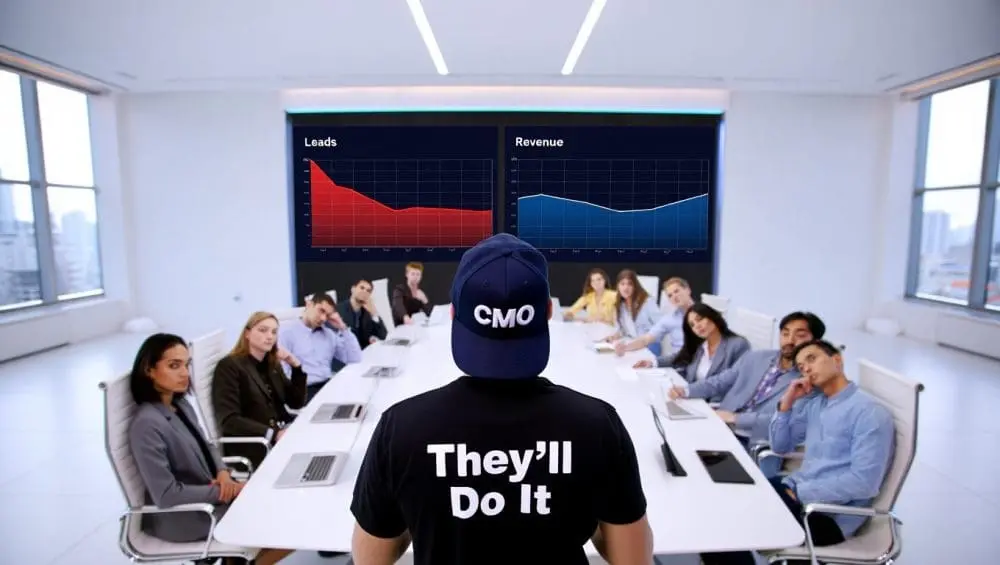
3. The Chief Marketing Officer (CMO) Who Doesn’t Generate Pipeline
Modern marketing has become hyper-nuanced and deeply tactical. CMOs who retreat entirely into "brand positioning" and delegate tactical execution for months lose their edge.
- The Reality: Great CMOs write copy, run live ad experiments, build campaigns, and get their hands dirty with actual marketing tooling.
- The Cost of Detachment: Marketing dynamics change week by week. A leader who has not personally tested a campaign or built a piece of content in over a year cannot accurately evaluate the quality of output coming from their team or agency partners.
4. The Chief Customer Officer (CCO) Who Avoids Customers
Customer success is won and lost in the micro-details of live customer interactions, not on polished dashboard slides.
- The Reality: Exceptional CCOs are constantly meeting with customers in person and on calls, absorbing the earliest indicators of customer friction.
- The Cost of Detachment: When a CCO introduces heavy administrative "process" while abandoning direct customer interaction, silent churn begins to accumulate. By the time rising churn registers on an executive dashboard, it is already too late to salvage the relationship.
OFFICIAL PERSPECTIVES & THE SCALING PARADOX
Many executive recruiters and traditional management theorists continue to push back against this hands-on philosophy, arguing that founders must let go to scale. However, operational data from high-growth unicorns suggests the opposite.
As companies scale, the financial impact of operational errors multiplies exponentially:
"At $50M ARR, a minor miscalculation in product-market fit or a 2-point decrease in sales efficiency costs you over $1 million a year. At $100M ARR, that figure doubles. You simply cannot afford to be an executive who is disconnected from what is actually happening in the deals, the code, the campaigns, and the customer conversations," notes a leading venture capital partner with over a decade of unicorn board experience.
Furthermore, hands-on executives generate outsized organizational leverage not by delegating work away, but by setting the standard through execution. When a top-tier CRO closes a massive account, they aren’t just hitting a revenue target—they are stress-testing the messaging, proving the viability of the pricing model, and training the junior sales reps by example.
Manager-only executives, by contrast, inevitably become organizational bottlenecks. If an executive cannot perform the foundational tasks themselves, they lose the authority to coach talent, evaluate technical or creative output, or realistically scope project timelines.
THE AI ERA: AMPLIFYING THE DIVIDE BETWEEN DOERS AND NON-DOERS
The necessity of hands-on leadership has received an explosive accelerator through the rapid maturation of Artificial Intelligence tools such as Cursor, Claude, ChatGPT, and advanced automation frameworks.
We are currently witnessing the widening of an exponential productivity gap:
- For the Technical Leader: A CTO who actively codes alongside an AI pairing tool like Cursor is easily 5x to 10x more productive than they were just a few years ago. Conversely, a CTO who abandoned coding has fallen off a productivity cliff; their team’s output has accelerated massively through AI, while the leader’s comprehension has deteriorated.
- For the Marketing Leader: A CMO who leverages AI to draft, iterate, and test content variations can produce sophisticated campaigns at a scale that previously required an entire department. A CMO who cannot write or prompt effectively can no longer evaluate what high-quality creative work looks like.
In the AI era, executive tools have transformed dramatically. Leaders who remain hands-on possess operational superpowers, while executives who rely purely on management theater are becoming obsolete faster than at any point in corporate history.
FUTURE OUTLOOK: WHAT THIS MEANS FOR HIRING AND RETENTION
For founders, CEOs, and hiring committees navigating the hyper-competitive talent market, this paradigm shift requires a radical overhaul of the interview and vetting process. Traditional resume scrutiny is no longer enough.
To avoid catastrophic executive misfires, organizations must implement rigorous testing protocols:
- In Interviews: Do not merely ask candidates about their past management philosophies. Ask them to walk through specific tactical challenges, dissect recent metrics down to the foundational level, and describe the last time they personally executed a core task within their domain.
- In References: Probe deeply into the candidate’s daily habits. Did their former team members view them as an active mentor who rolled up their sleeves, or as an administrative layer who pushed paper and demanded status updates?
- In the First 90 Days: Set explicit expectations that the new executive will spend their onboarding period embedded in the actual operational work—talking to buyers, building prototypes, writing copy, or analyzing user behavior directly.
Conclusion
The definitive rule for building an enduring, high-performing executive team is refreshingly straightforward: Stay hands-on or fail.
It matters not whether the title is CRO, CTO, CMO, or CCO. The underlying pattern across dozens of investments and multiple unicorns is uniform. Leaders who stay close to the craft win; executives who graduate into pure managers and strategists eventually lose touch, miss the signals, and lead their organizations into stagnation.
Before hitting $250 million in ARR—and arguably well beyond that milestone—the companies that dominate their respective markets are those whose leadership teams can still execute at the absolute highest level. If an executive candidate has "graduated" beyond doing the actual work, or if you find yourself sitting across from a leader who has abandoned the craft, do not make the hire. Stay close to the work, or prepare for the consequences.