In the modern digital economy, the demand for high-velocity, high-quality content has completely outpaced traditional human capacity. Businesses, digital marketers, entrepreneurs, and solo creators face relentless pressure to maintain an active footprint across multiple channels—ranging from search-optimized blogs and social media campaigns to targeted email sequences and e-commerce product listings. Maintaining this cadence manually often leads to burnout, inconsistent publishing schedules, and inflated overhead costs.
Enter Artificial Intelligence (AI) content generation. Powered by advanced Large Language Models (LLMs) and sophisticated Natural Language Processing (NLP) architectures, modern AI writing assistants have transformed from experimental novelties into indispensable enterprise assets. These systems analyze vast datasets to predict, structure, and synthesize human-like prose tailored to specific tones, formats, and commercial objectives.
However, the rapid commercialization of generative AI has created a crowded and complex marketplace. Choosing the correct platform requires balancing capability against constraints such as pricing models, output quality, native SEO integrations, and intended use cases. This comprehensive report investigates the top 10 AI content generator tools available today, breaking down their operational mechanics, feature sets, pricing tiers, and ideal deployment scenarios to help organizations make data-driven investment decisions.
Detailed Chronology: The Evolution of AI Writing Assistants
The journey toward mainstream AI content creation did not happen overnight; it is the culmination of decades of research in computational linguistics, machine learning, and transformer architecture.
The Rule-Based Era (Early 2000s – 2010s): Early attempts at automated writing relied heavily on template matching, synonym substitution, and basic rule-based spinning. These systems produced rigid, unnatural, and often unreadable text that was easily flagged by search engine algorithms as low quality.
The Rise of Deep Learning (2018–2020): The introduction of transformer-based neural networks marked a paradigm shift. OpenAI’s release of early GPT models demonstrated that machines could generate contextual, coherent paragraphs by predicting subsequent tokens based on massive textual corpora.
The Commercialization Wave (2020–2022): Startups capitalized on foundational models by wrapping them in intuitive user interfaces, specialized templates, and workflow optimizations tailored to marketers and copywriters. Companies like Jarvis (later rebranded as Jasper), Copy.ai, and Writesonic democratized access to advanced copywriting engines.
The Modern Ecosystem (Present): Today, AI writers are deeply integrated into broader digital marketing ecosystems. Modern platforms offer real-time SEO scoring, grammar checking, plagiarism detection, automated multi-channel repurposing, and advanced long-form content generation pipelines that match the editorial standards of professional human writers.
Supporting Context & Metrics: The State of Automated Copywriting
The transition toward AI-assisted workflows is underpinned by sweeping shifts in digital marketing efficiency. According to recent industry benchmarks, content creators utilizing AI tools report a reduction of up to 60% in draft production time. Furthermore, businesses scaling their content operations through automation have observed notable improvements in search engine indexing speed and inbound organic traffic generation.
Unlike human copywriters who are bound by biological limits—such as fatigue, writer’s block, and context-switching overhead—AI engines operate continuously. They process complex instructions, adjust to dynamic brand voices, and scale output instantly. Yet, the consensus among digital strategists remains clear: AI functions best not as a total replacement for human oversight, but as an advanced force multiplier that handles ideation, structuring, and rough drafting, leaving final strategic polish and editorial integrity to human experts.
Comprehensive Evaluation of the Top 10 AI Content Generators
1. Jasper AI (Formerly Jarvis)
Jasper stands as a pioneer in the AI content generation space, engineered specifically to translate complex brand guidelines and short user prompts into polished, high-converting prose.
Operational Mechanics: Jasper utilizes sophisticated underlying language models fine-tuned with specialized copywriting frameworks (such as AIDA and PAS). It excels at understanding context, tone, and pacing across a wide variety of formats.
Standard tier options available for individual creators.
Boss Mode / Pro Tier: Priced at approximately $99/month, unlocking advanced workflow execution and maximum token limits for high-volume agencies.
Pros & Cons:
Pros: Exceptional narrative flow, highly customizable tone of voice, robust template library.
Cons: Higher price point compared to entry-level competitors; learning curve for advanced document orchestration.
2. Copy.ai
Designed with a heavy emphasis on marketing copy and rapid social media execution, Copy.ai removes friction from short-form content creation.
Operational Mechanics: Offers over 90 specialized templates—ranging from bullet-point-to-blog converters to high-impact Facebook ad hooks—enabling users to generate targeted copy in seconds.
Free Trial: 7 days with full feature exploration and 100 runs per day.
Pro Plan: $49/month (or discounted to $35/month when billed annually).
Pros & Cons:
Pros: Incredibly user-friendly interface; exceptional for ad copy, email subject lines, and social captions.
Cons: Less suited for unassisted, in-depth long-form whitepapers without extensive human steering.
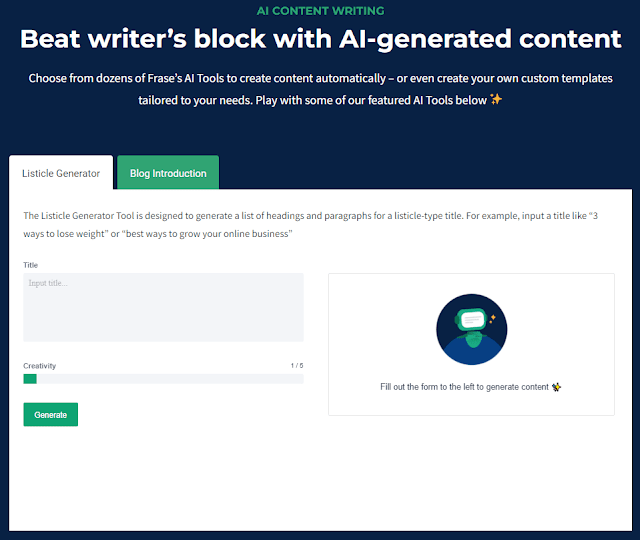
3. Frase AI
Frase approaches content generation through the lens of search engine optimization (SEO) and topical authority, bridging the gap between writing and research.
Operational Mechanics: Frase analyzes top-ranking Google search results for a given keyword, extracts common subheadings, questions, and semantic entities, and uses AI to generate research briefs and optimized content sections.
Key Features: Automated content briefs, SEO metrics integration, topic clustering, and real-time content scoring.
Pricing & Tiers:
Solo Plan: $14.99/month ($12/month billed annually).
Team Plan: $114.99/month ($99.99/month billed annually) with unlimited document credits.
Pros & Cons:
Pros: Unmatched research and outlining capabilities; keeps content laser-focused on search intent.
Cons: Requires a steeper learning curve for users solely looking for creative writing.
4. Article Forge
For bloggers and site owners prioritizing scale and hands-off execution, Article Forge provides a uniquely streamlined approach.
Operational Mechanics: Unlike platforms that require detailed multi-step prompting, Article Forge requires only a target keyword and minor context, autonomously executing research, structuring headings, and writing an entire article from scratch.
Key Features: One-click automated article generation, integrated image and video insertion, automatic Copyscape-passing verification.
Pricing & Tiers:
Basic Plan: $27/month (up to 25k words).
Standard Plan: $57/month.
Unlimited Plan: $117/month.
Pros & Cons:
Pros: True set-and-forget automation; excellent for programmatic SEO strategies.
Cons: Output often requires heavier human editing to ensure nuance and factual precision.
5. Rytr
Rytr.me has earned a reputation as a lean, highly accessible AI writing assistant designed for budget-conscious students, small business owners, and solo bloggers.
Operational Mechanics: Powered by state-of-the-art language models, Rytr focuses on speed, simplicity, and clean markdown formatting across dozens of use cases.
Key Features: Built-in plagiarism checker, tone selector (over 20 tones), rich text editing extensions, and persistent history logs.
Pricing & Tiers:
Free Plan: Limited to 5,000 characters per month.
Saver Plan: $9/month ($90/year).
Pros & Cons:
Pros: Highly affordable; clean and distraction-free user interface.
Cons: Monthly character limits on lower tiers can restrict high-volume publishing operations.
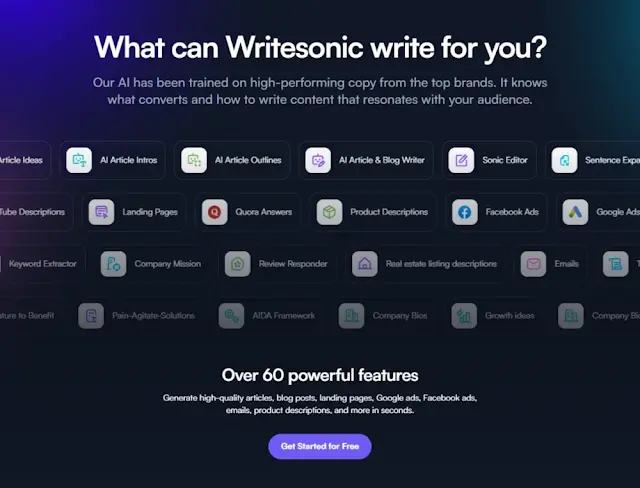
6. Writesonic
Writesonic positions itself as an all-in-one AI writing powerhouse equipped with advanced grammatical polish and plagiarism protection.
Operational Mechanics: Combines high-speed generation templates with dedicated article rewriting modules, landing page copy generators, and long-form article builders.
Pros: Balanced feature set for both short marketing copy and long articles; competitive pricing.
Cons: Credit structures can occasionally be confusing depending on the generation mode selected.
7. CopySmith
Engineered specifically for enterprise workflows, e-commerce managers, and agile marketing teams, CopySmith delivers rapid, bulk content creation solutions.
Operational Mechanics: Utilizes collaborative workspace features and bulk upload pipelines to generate thousands of product descriptions, ad variations, and blog outlines simultaneously.
Key Features: Shopify and WooCommerce integrations, bulk generation spreadsheets, team collaboration workspaces, and API access.
Pricing & Tiers:
Starter Plan: $19/month.
Enterprise: Custom-tailored pricing based on organizational scale.
Pros & Cons:
Pros: Exceptional integrations for e-commerce stores; built for team collaboration.
Cons: Interface can feel overly complex for solo creators looking for simple blog tools.
8. Hypotenuse.ai
Hypotenuse.ai carves out a distinct niche as the premier AI writing software optimized explicitly for e-commerce catalogues and rich product descriptions.
Operational Mechanics: Analyzes basic product specifications, SKU data, and bullet points to generate compelling, SEO-friendly e-commerce copy across thousands of items at once.
Pros: Industry leader for online store copywriting; saves hundreds of hours in manual cataloging.
Cons: Lacks a permanent free tier beyond introductory trial runs.
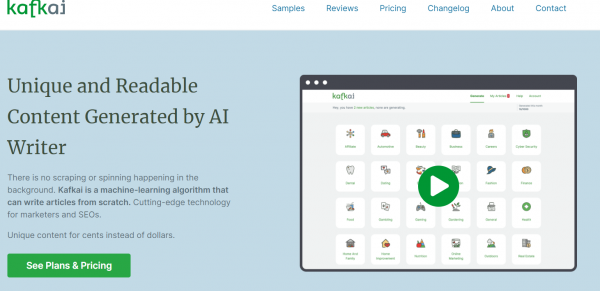
9. Kafkai
Tailored specifically for SEO professionals, niche site builders, and affiliate marketers, Kafkai focuses on generating niche-specific articles at scale.
Operational Mechanics: Relies on unsupervised machine learning models trained on specific niches to generate niche-relevant articles without generic filler.
Pros: Ultra-low per-article cost at higher tiers; great for PBNs and niche affiliate sites.
Cons: Generative quality can occasionally vary depending on the chosen niche specificity.
10. Peppertype.ai
Peppertype.ai acts as a virtual copywriting assistant designed to accelerate the ideation and drafting phases for digital marketers and bloggers.
Operational Mechanics: Employs a clean, dashboard-driven layout that groups generation modules by marketing function, enabling rapid creation of social hooks, blog intros, and essays.
Key Features: Interactive content idea generator, paragraph expansion tools, and team management dashboards.
Pricing & Tiers:
Personal Plan: $35/month.
Team Plan: $199/month.
Pros & Cons:
Pros: Extremely fast generation speed; highly intuitive UI.
Cons: Limited advanced SEO optimization features compared to dedicated tools like Frase.
Official Statements & Industry Expert Perspectives
Industry analysts maintain a pragmatic outlook on the integration of generative AI within professional publishing workflows. According to enterprise software researchers, the primary value proposition of AI writing assistants lies in eliminating the cognitive friction of the blank page.
"Artificial intelligence does not replace human creativity; rather, it amplifies it. By automating structural drafting, keyword integration, and baseline research, tools like Jasper, Frase, and Writesonic allow human creators to redirect their focus toward strategy, emotional resonance, and editorial oversight."
— Digital Marketing Technology Review
Corporate adoption metrics further validate this shift. Enterprises across retail, technology, and publishing sectors increasingly view AI integration not as an optional experiment, but as a core competency required to remain competitive in high-velocity information ecosystems.
Future Outlook: The Next Horizon of AI Content Generation
As foundational models continue to evolve, the capabilities of AI content generators will expand beyond text-based drafting. Looking ahead, industry watchers anticipate several transformative developments:
Multimodal Integration: Seamless blending of text generation with automated graphic design, video synthesis, and audio voiceover generation within a single unified workspace.
Hyper-Personalization at Scale: Real-time content generation tailored dynamically to individual user behavior, browsing history, and real-time intent signals.
Enhanced Fact-Checking Protocols: Integration of live web-scraping verification layers to mitigate hallucination rates and ensure strict factual accuracy in automated journalistic and academic writing.
Deeper Semantic SEO Optimization: Advanced predictive algorithms capable of aligning generated content with shifting search engine ranking factors before publication.
Ultimately, the market will continue to reward platforms that balance raw processing power with user-centric workflow design, editorial control, and verifiable content integrity. Creators and businesses that master these tools today will define the standards of digital communication tomorrow.