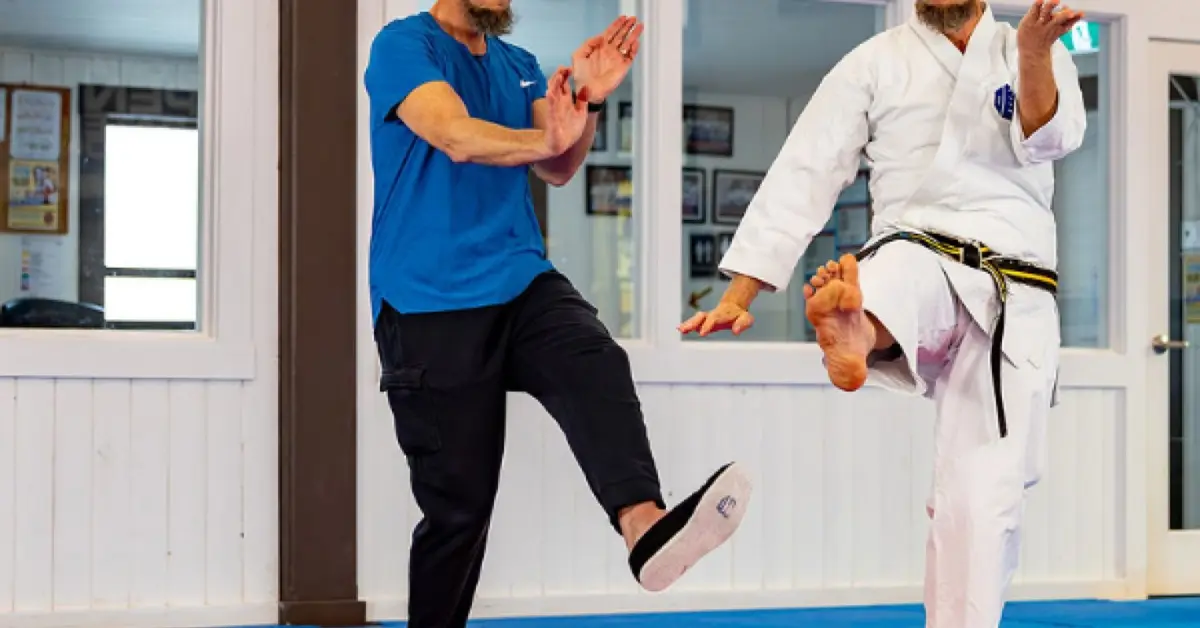
Executive Overview
For decades, popular culture has presented two diametrically opposed philosophies of physical conflict through the lens of cinematic martial arts. On one side stands Mr. Miyagi from The Karate Kid, advising Daniel-san that "Karate is for defense only"—an ideology rooted in the classical Okinawan maxim karate ni sente nashi ("there is no first attack in karate"). On the other side stands the aggressive, unapologetic dojo ethos of Cobra Kai: "Strike first, strike hard, show no mercy."
To the casual observer, these two approaches represent an irreconcilable chasm between pacifist restraint and preemptive brutality. However, a deeper examination of martial arts science, biomechanics, and physiological psychology reveals a more nuanced reality. The traditional dichotomy between "defense" and "offense" collapses when scrutinized through the lens of modern tactical self-protection.
True martial mastery transcends the reactionary passivity often associated with self-defense. It reframes safety not as waiting to absorb a blow, but as a dynamic, proactive engagement with space, timing, and intent. By dissecting the physiological states of combat—ranging from counterattacking to preemptive interception—experts argue that self-protection requires an offensive mindset executed with defensive geometry. Ultimately, the integration of tactical readiness with compassionate execution reshapes how we understand safety, conflict resolution, and the ancient adage that "the fist comes from the heart."
Detailed Chronology: The Evolution of Martial Philosophy
To understand how modern combat theory views the concepts of offense and defense, one must trace the historical evolution of martial arts from ancient battlefield applications to contemporary self-protection frameworks.
Ancient Roots and Classical Okinawan Maxims
Centuries ago, the indigenous fighting systems of Okinawa—influenced by Chinese Kempo and shaped by various weapons bans—prioritized survival against armed adversaries. The core philosophy was never about sporting combat or structured dueling; it was about absolute preservation of life.
Despite the lethality of these techniques, Okinawan masters emphasized moral restraint. The phrase karate ni sente nashi emerged not as a tactical rule forbidding proactive safety measures, but as a philosophical safeguard against arrogance and unprovoked aggression. The system was designed so that a practitioner would never initiate violence out of ego. However, once an adversary’s hostile intent became manifest, the line between offense and defense blurred out of necessity.
The Cinematic Split: Miyagi vs. Cobra Kai
The modern public consciousness regarding these philosophies was largely forged in the mid-1980s. The Karate Kid (1984) popularized the Goju-ryu-inspired wisdom of Mr. Miyagi (modeled historically after masters like Miyagi Chojun, who famously stated, "When anger rises the fists must lower, when you raise your fists you must lower your anger"). Miyagi-Do positioned defense as an art of evasion, redirection, and emotional detachment.
Conversely, the fictional Cobra Kai dojo popularized a hyper-aggressive paradigm. By prioritizing the first strike, the show tapped into a primal tactical truth that military and law enforcement trainers have long understood: waiting to be attacked places an individual at a severe biomechanical and psychological disadvantage. Yet, taken literally, the original Cobra Kai mantra lacks the moral and proportional restraint required in civil society.
Modern Synthesis: The Science of Self-Protection
In contemporary martial arts science, the conversation has shifted away from the simplistic "defense versus offense" binary. Researchers and high-level practitioners now categorize physical encounters through precise psychological and physiological states:
- Counterattacking: Responding after absorbing or blocking an incoming strike.
- Attacking While Being Attacked: Intercepting the threat simultaneously as it unfolds.
- Preemptive Attack: Neutralizing the threat based on subtle behavioral cues (weight shifts, gaze, breathing) before the strike is launched.
This evolutionary timeline demonstrates that martial philosophy has continually swung between the poles of moral restraint and tactical pragmatism. Today, the synthesis of these ideas suggests that an effective practitioner must combine the chilling efficiency of proactive timing with the profound ethical restraint articulated by the ancient masters.
Supporting Context & Metrics: The Biomechanics and Psychology of Threat Assessment
To move beyond cinematic tropes, one must examine the hard mechanics of how human bodies interact during high-stress violent encounters. The distinction between "self-defense" and "self-protection" provides the foundation for this analysis.
Self-Defense vs. Self-Protection: A Semantic and Tactical Distinction
Semantics matter profoundly in tactical training. Self-defense implies a reactive posture: you wait to be attacked, absorb the shock of the assault, and then mount a response. This paradigm forces the defender onto their heels, encouraging backward movement while attempting to mitigate damage. In essence, traditional self-defense functions as a shield—heavy, cumbersome, and inherently vulnerable to being overwhelmed by sustained pressure.
Self-protection, on the other hand, employs a proactive framework. It involves recognizing a deteriorating situation, getting off the direct line of attack, and positioning oneself advantageously. Crucially, self-protection acts as a spear. It utilizes forward momentum, decisive spacing, and tactical positioning to seize the initiative. As martial arts researchers note, it is mathematically and physically harder for an adversary to attack someone who is already moving proactively off the center line than it is for someone waiting statically to block an incoming fist.
The Three States of Combat Timing
A granular breakdown of physical confrontations reveals that all effective martial responses utilize variations of timing rather than a fundamental difference in violence. These states represent increasing levels of technical sophistication:
- Counterattacking (The Slowest Response):
- Mechanism: Action occurs after receiving, blocking, or intercepting the opponent’s strike.
- Timing Ratio: Attack (1) $rightarrow$ Block (1) $rightarrow$ Counterattack (0.5).
- Drawback: The defender absorbs the psychological and physical toll of the initial assault.
- Attacking While Being Attacked (Simultaneous Interception):
- Mechanism: The practitioner detects the unfolding threat and launches an immediate counter-offensive that overlaps with the opponent’s attack.
- Timing Ratio: Attack (1) $rightarrow$ Counterattack/Interception (1).
- Advantage: Disrupts the opponent’s rhythm and fractions their focus between offense and defense.
- Preemptive Attack (The Highest Technical Tier):
- Mechanism: Action is taken the moment an imminent threat is perceived—signaled by micro-expressions, visual fixation, postural tension, or weight shifts—just milliseconds before the strike is fully launched.
- Timing Ratio: Preemptive Counterattack (-1) vs. Opponent Attack (0).
- Advantage: Total disruption of the adversary’s OODA loop (Observe, Orient, Decide, Act).
The Spectrum of Force: From Lethal Targets to Total Evasion
Not every physical confrontation requires catastrophic violence. Indeed, advanced self-protection systems categorize responses into graduated tiers of application:
- Emergency Level: Striking lethal targets (e.g., a direct throat strike) when skill levels are low and life safety is immediately compromised.
- Incapacitation Level: Striking specific structural targets (e.g., a lateral kick to the knee joint to compromise ligament integrity) to create an immediate opening for escape.
- Evasion Level: The apex of martial capability—recognizing the threat early enough to "not be there," utilizing spatial awareness and geometry to bypass the physical exchange entirely.
Furthermore, advanced self-protection acknowledges that physical interaction is sometimes required with individuals who cannot control their actions—such as loved ones experiencing acute trauma, dementia, or severe intoxication. In these delicate scenarios, highly skilled practitioners utilize tactical body movement and redirection to maintain safety and prevent harm without striking the individual at all. You do not have to hit, but tactical positioning ensures you are never forced to accept being hit.
Official Statements and Expert Perspectives
Prominent martial arts scientists, kinesiologists, and master instructors have increasingly weighed in on the harmonization of moral philosophy and tactical reality.
Dr. E. Paul Zehr, a noted neuroscientist, martial artist, and author specializing in the neural control of movement, has extensively explored the intersection of brain function and martial arts practice. In contemporary analyses of the Miyagi versus Cobra Kai debate, Zehr champions a reimagined operational framework:
"I prefer the concept of self-protection rather than self-defense. Self-protection involves proactive attack, while self-defense implies waiting to be attacked and then responding… If we are truly under threat, only defending permits constant repeated attacks. Self-defense becomes a shield, whereas self-protection based on attack gives you a spear."
Addressing the emotional and structural core of martial engagement, Zehr bridges the gap between aggressive efficiency and deep-seated compassion by revisiting classic axioms:
"So I revise the Cobra Kai mantra as ‘strike first, strike fast, show mercy’ to align with the Wing Chun expression that ‘the fist comes from the heart’… This saying means two things: 1) occupy the centre line and attack the opponent directly; and, 2) your attack is meant to stop the aggression and allow safety. We hurt with compassion and only harm if needed."
This sentiment is echoed by historical lineage holders of traditional Okinawan and Chinese systems. Master instructors emphasize that the emotional state of the practitioner must remain entirely detached from the physical mechanics of the technique. True martial power requires mushin (no-mind)—an unperturbed state of calm execution. When anger corrupts technique, precision fails, escalation accelerates, and the core purpose of self-protection is lost.
Future Outlook: The Evolution of Personal Safety and Tactical Education
As society evolves through technological integration, shifting urban landscapes, and changing paradigms of personal security, the training of physical self-protection is undergoing a profound transformation.
The Shift from Sport to Functional Realism
For decades, the commercialization of martial arts led to a heavy emphasis on point-fighting, aesthetic forms (kata), and structured tournament rules. While these practices offer tremendous physical and mental benefits, they often inculcate a dangerous habit of waiting for a referee’s whistle or expecting a formalized exchange of techniques.
The future of martial arts education lies in functional realism. Instructors are increasingly incorporating scenario-based training, stress-inoculation drills, and biomechanical threat recognition into their curricula. Students are taught to read pre-violence indicators—such as the "social-vandal" posture or predatory target glancing—long before a physical punch is thrown. This operationalizes the concept of the preemptive counterattack, making situational awareness the ultimate form of self-protection.
De-Escalation and Compassionate Mechanics
Paradoxically, as tactical systems become more efficient at delivering decisive force when required, they are simultaneously placing greater emphasis on verbal judo, conflict de-escalation, and non-violent control. The modern martial artist understands that the ultimate victory is the neutralization of hostility without structural trauma.
By integrating the Wing Chun philosophy of the "fist coming from the heart," future self-protection paradigms will teach students to deploy structural mechanics with absolute emotional neutrality. Compassion does not mean passivity; rather, it dictates that when violence is unavoidable, it must be applied swiftly, clinically, and mercifully to end the threat and restore peace.
Conclusion: The Ultimate Synthesis
Ultimately, the debate between Mr. Miyagi’s pacifist defense and Cobra Kai’s aggressive initiative is resolved through a synthesis of mind and method. As history, science, and martial philosophy confirm, the best defense is not a passive shield that invites endless punishment. When the only way out of a crisis is directly through it, the modern martial artist embraces the ultimate tactical truth: the best defense is a proactive, compassionate, and uncompromising offense.