While foundational science fiction franchises like Star Wars, Star Trek, and the Alien universe thrive on endless momentum—expanding into multi-decade tapestries of sequels, prequels, and spin-offs—there is a distinct, understated power in narrative economy. The sci-fi genre is inherently built on the grand luxury of world-building, offering creators the canvas to sketch infinite galaxies, alternate realities, and speculative futures. Yet, audiences are increasingly looking for a different kind of satisfaction: the tight, self-contained narrative arc that can be fully digested, digested, and reflected upon over the course of a single weekend.
Enter the miniseries. Distinct from the sprawling, multi-season commitments required by modern epics like The Expanse or Westworld, the sci-fi miniseries operates on high-yield efficiency. These eight television landmarks prove that you do not need five seasons to fundamentally alter a viewer’s perspective on time, space, and human nature. Ranging from post-apocalyptic poetry and high-concept time-travel puzzles to chilling political allegories and mind-bending philosophical thrillers, these selections offer near-perfect viewing experiences designed to wrap up neatly in just a few days.
Detailed Chronology & Curated Selections
To understand the evolution of the limited-run science fiction format, one must trace its trajectory from 1980s network television risk-taking to modern prestige streaming platforms. Here are eight essential miniseries that master the craft of the weekend binge.
1. Station Eleven (HBO Max)
Format: 10-Episode Miniseries
The Premise: Set twenty years after a devastating flu pandemic collapses human civilization, Station Eleven defies the standard post-apocalyptic playbook. Instead of wallowing in nihilism or endless survivalist violence, the narrative follows a troupe of actors and musicians—the Travelling Symphony—who keep art, Shakespeare, and music alive across the Great Lakes region.
Why It Binge-Wears Well: The series uses a non-linear timeline to weave together the final days of the old world with the fragile, beautiful communities of the new. It frames grief not as a terminal wound, but as a shared language connecting survivors. Its emotional resolutions are hard-fought, deeply earned, and entirely self-contained.
2. Watchmen (HBO)
Format: 9-Episode Limited Series
The Premise: Conceived by Damon Lindelof as a direct continuation of Alan Moore and Dave Gibbons’ legendary 1986 graphic novel, Watchmen shifts the geopolitical landscape decades into an alternate present. Masked vigilantism has been outlawed, and a white supremacist terrorist group known as the Seventh Kavalry—inspired by Rorschach—wages a silent war against a Tulsa Police Department forced to conceal their identities behind yellow masks. Detective Angela Abar (Regina King), operating under the moniker Sister Knight, stumbles upon a sprawling conspiracy reaching the highest echelons of power.
Why It Binge-Wears Well: Lindelof’s puzzle-box plotting is masterclass television. By anchoring real-world historical trauma (such as the 1921 Tulsa Race Massacre) to superhero mythos, Watchmen delivers an airtight narrative that burns bright, makes its point, and closes the book definitively.
3. Bodies (Netflix)
Format: 8-Episode Limited Series
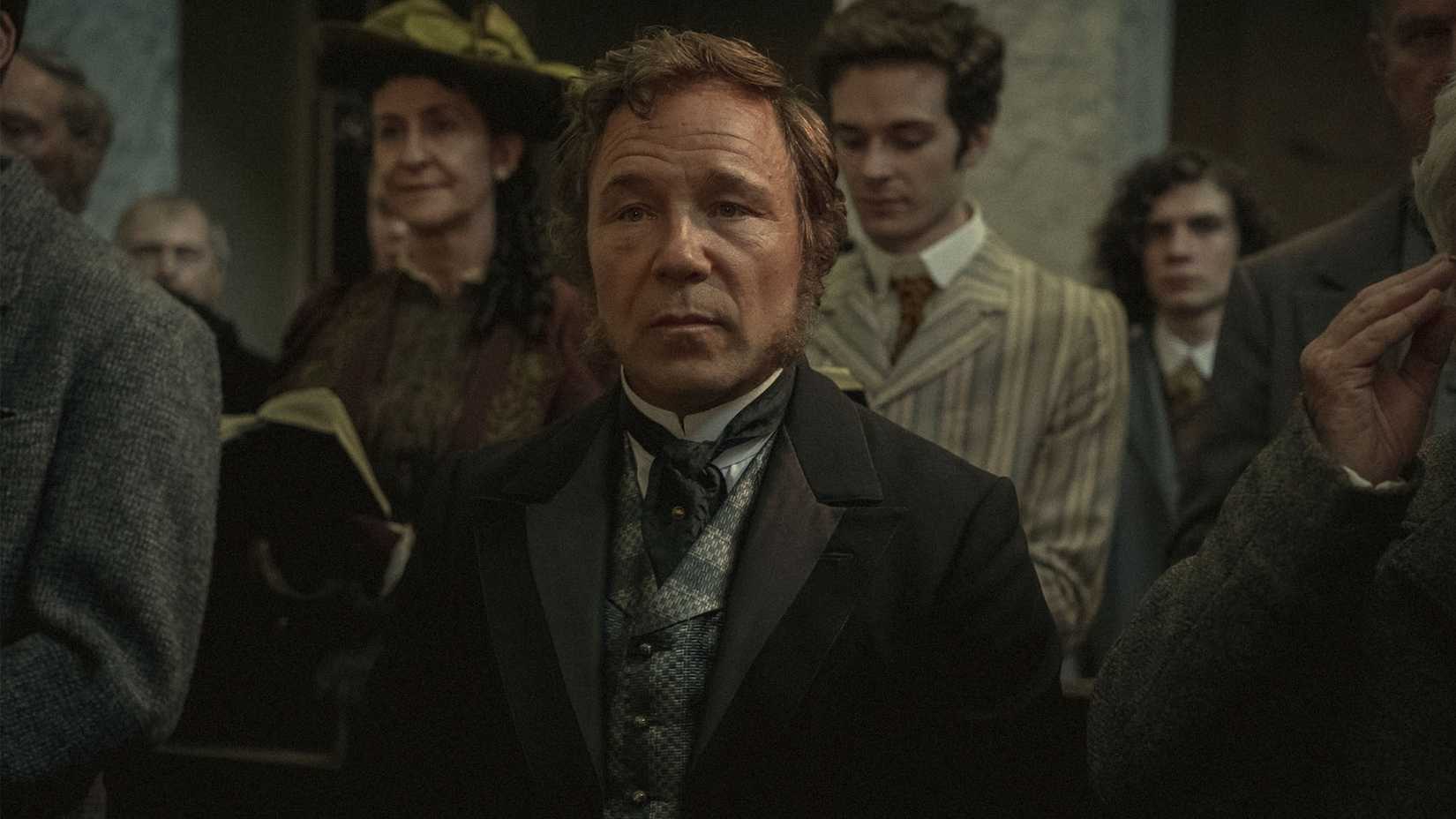
The Premise: Based on the genre-bending graphic novel by Si Spencer and Dean Ormston, Bodies asks an impossible question: What happens when the exact same corpse turns up in Whitechapel, London, across four completely different eras—1890, 1941, 2023, and 2053? Four distinct detectives across these timelines take on the case, each influenced by the cultural anxieties, politics, and technology of their respective decades.
Why It Binge-Wears Well: Time-travel narratives often collapse under the weight of their own paradoxes. Bodies, however, maintains a razor-sharp focus across its eight episodes. The ensemble cast elevates the material, ensuring that the historical texture of Victorian London feels just as vital as the dystopian atmosphere of 2053.
4. Years and Years (HBO / BBC)
Format: 6-Episode Miniseries
The Premise: Written by Russell T Davies—renowned for spearheading the modern Doctor Who revival—Years and Years is a brutally realistic dystopian family drama. Following the Manchester-based Lyon family over a turbulent 15-year period from 2019 to 2034, the series charts how rapidly accelerating political instability, economic collapse, and technological shifts reshape everyday existence. At the center of this storm is Vivienne Rook (Emma Thompson), a charismatic, populist politician whose disruptive rise mirrors troubling real-world political trends.
Why It Binge-Wears Well: The terror of Years and Years lies in its proximity to reality. It bypasses futuristic laser guns and space travel in favor of terrifyingly plausible near-future tech and geopolitical shifts. It is emotionally devastating, hyper-paced, and impossible to turn off.
5. FLCL (Production I.G. / Gainax)
Format: 6-Episode Original Anime
The Premise: Twelve-year-old Naota Nandaba lives a stagnant, bored suburban life in Japan until Haruko Haruhara—an eccentric, Vespa-riding, bass-guitar-wielding extraterrestrial—literally runs him over. The impact turns Naota’s skull into a portal for intergalactic weapons and giant combat robots, dragging him headfirst into a bizarre alien conspiracy.
Why It Binge-Wears Well: At just six episodes, FLCL is the ultimate afternoon watch. It marries traditional cel animation with cutting-edge 3D CGI, backed by an iconic alternative rock score by The Pillows. Beneath its chaotic, hyper-kinetic surface lies a poignant, chaotic coming-of-age metaphor about the agonizing awkwardness of adolescence.
6. Scavengers Reign (Max)
Format: 1-Season Complete Narrative / Miniseries-Style Run
The Premise: Stranded on a breathtakingly alien, hostile planet after a cargo ship malfunction, the surviving crew members are scattered across surreal ecosystems. As they attempt to trek across the uncharted wilderness to find a rescue beacon, they must navigate a world where flora and fauna exist in bizarre, hyper-complex symbiosis—and where the environment itself acts as an unpredictable character.
Why It Binge-Wears Well: Though prematurely caught in corporate cancellations, Scavengers Reign functions as a self-contained masterpiece of speculative biology. Drawing inspiration from 1990s speculative animation, it induces environmental dread and visual awe in equal measure, making it a mesmerizing visual feast for a single weekend.
7. Devs (FX on Hulu)
Format: 8-Episode Limited Series
The Premise: Created by Alex Garland (Ex Machina, Annihilation), Devs follows Lily Chan (Sonoya Mizuno), a software engineer working at Amaya, an ultra-secretive quantum computing corporation in Silicon Valley. When her boyfriend, newly recruited to the secretive "Devs" division, dies under deeply suspicious circumstances, Lily launches an investigation that pulls back the curtain on a deterministic universe built to see both backward and forward through time.
Why It Binge-Wears Well: Garland’s signature clinical aesthetic and philosophical rigor are on full display here. Devs takes its time unpacking complex theories of quantum mechanics, free will, and pre-destination, rewarding the viewer with an airtight narrative loop that satisfies intellectually and emotionally.
8. V (NBC)
Format: 2-Part Network Miniseries
The Premise: Written and directed by Kenneth Johnson, this 1983 landmark miniseries opens with the arrival of massive flying saucers over Earth’s major cities. The extraterrestrial "Visitors" claim to come in peace, offering miraculous medical and technological advancements in exchange for Earth’s rare minerals. However, a small band of human resistance fighters—led by journalist Mike Donovan—discovers a chilling truth: the visitors are carnivorous reptilians using human beings as livestock.
Why It Binge-Wears Well: Serving as a thinly veiled historical allegory for fascism, collaboration, and the erosion of democratic institutions during wartime, original V is a masterclass in sci-fi tension. It discarded campy space-opera tropes for documentary-style realism, cementing its place as a foundational text in invasion thrillers.
Supporting Context & Production Metrics
The resurgence of the high-concept limited series is no accident. Industry metrics over the past half-decade reveal a shifting viewer psychology:
Completion Rates: Streaming analytics across platforms like Netflix, Max, and Hulu consistently indicate that limited series boasting 6 to 10 episodes achieve completion rates up to 40% higher than multi-season ongoing dramas.
Creative Risk Management: A finite episode order allows showrunners and networks to secure high-profile cinematic talent—such as Emma Thompson (Years and Years), Regina King (Watchmen), and Alex Garland (Devs)—who might otherwise balk at multi-year television contracts.
Budgetary Efficiency: By concentrating budgets into a single, highly polished block, networks eliminate the "filler episode" syndrome common in traditional 22-episode network runs, delivering cinematic visual fidelity on a television schedule.
Official Statements & Industry Perspectives
Reflecting on the psychological and artistic pull of shorter-form narrative structures, creators often emphasize the virtue of constraint.
"When you know you only have a finite amount of screen time to tell your story, every single frame has to carry structural weight," notes an anonymous showrunner working within the prestige streaming ecosystem. "There is no room to tread water. You aren’t writing episodes to pad out a third season; you are building a cinematic arch that must collapse inward precisely where you intend it to."
Critically, industry analysts point out that viewers increasingly view weekend binges as a form of modern escapism akin to reading a dense novel. The cultural resonance of self-contained sci-fi lies in its completeness—leaving no loose plot threads dangling indefinitely, but rather offering a definitive conclusion to ponder long after the credits roll.
Future Outlook: The Horizon of Short-Form Sci-Fi
As streaming architectures continue to evolve under shifting economic models, the appetite for concise, high-impact storytelling shows no signs of slowing down. Creators are finding that audiences crave intellectual stimulation without the exhaustion of narrative bloat.
Whether exploring the philosophical weight of quantum determinism in Devs, tracing the societal decay of a near-future Britain in Years and Years, or watching humanity reclaim its dignity through art in Station Eleven, the modern sci-fi miniseries has proven that brevity is indeed the soul of speculative genius. For the discerning viewer planning their next weekend escape, these eight pillars remain unrivaled destinations in the vast cosmos of television.