Executive Overview
The landscape of mobile communication is continuously shifting toward greater flexibility, personal compartmentalization, and user-centric customization. For years, managing multiple phone numbers or distinct social circles required either carrying multiple handsets, utilizing third-party workarounds, or toggling between standard WhatsApp and the separate WhatsApp Business application. That paradigm shifted significantly when the platform introduced native multi-account support for iOS users, finally allowing a primary and secondary profile to peacefully coexist within a single app installation.
Now, fresh intelligence indicates that Meta is preparing to take this convenience a step further. According to reliable tracking and code analysis by WABetaInfo, WhatsApp is actively developing support for up to three concurrent accounts on iOS devices. This forthcoming enhancement will allow users to seamlessly jump between a primary personal line, a secondary business or side-project line, and a third distinct profile—all without ever logging out or forcing closure of the application.
While the feature is currently in its early developmental stages and remains hidden from public beta testers, the implications for power users, freelancers, and privacy-conscious individuals are profound. This report explores the trajectory of WhatsApp’s multi-account architecture, details the mechanics of the upcoming three-tier system, examines user privacy considerations, and forecasts the broader strategic implications of Meta’s ongoing platform updates.
Detailed Chronology: From Workarounds to Native Multi-Account Architecture
To truly appreciate the significance of supporting three distinct accounts within a single app instance, it is vital to examine how messaging apps have historically handled identity management on mobile operating systems, particularly on Apple’s iOS ecosystem.
The Era of Single-Account Constraints
For the vast majority of its existence, WhatsApp was strictly bound to a one-device, one-number philosophy. Rooted in traditional phone number verification, the application assumed a direct, immutable mapping between a physical SIM card (or eSIM) and a local database. For users balancing a personal number and a professional number, this limitation forced compromises. Many resorted to carrying a secondary, often older smartphone exclusively for work communications. Others turned to the WhatsApp Business app as a pseudo-workaround to run two separate apps on the same iPhone.

However, running two distinct apps introduced its own friction: fragmented notifications, split battery consumption, and the administrative burden of keeping two separate apps updated and configured. Users demanded a streamlined, native experience akin to what Instagram or Telegram had offered for years—the ability to add multiple profiles under one unified roof.
The Introduction of Dual-Account Support
The dam finally broke when WhatsApp began laying the technical groundwork for multi-account functionality. Following a rigorous period of behind-the-scenes beta testing that kicked off in late 2023, WhatsApp officially rolled out multi-account support for iOS users in June 2024.
This initial release permitted iPhone users to add a second account directly within the main app settings, provided their device supported dual-SIM functionality (either through dual physical nano-SIMs or a combination of physical SIM and eSIM). The feature was universally praised for eliminating the clunky requirement of third-party apps or secondary hardware. Users could instantly jump between accounts by navigating to the settings menu, with each profile maintaining isolated notification settings and independent chat histories.
The Leap to Three Accounts
Having successfully stabilized the dual-account infrastructure, Meta’s engineering teams have now set their sights on expansion. Recent code discoveries within early internal builds point directly toward a three-account ceiling.
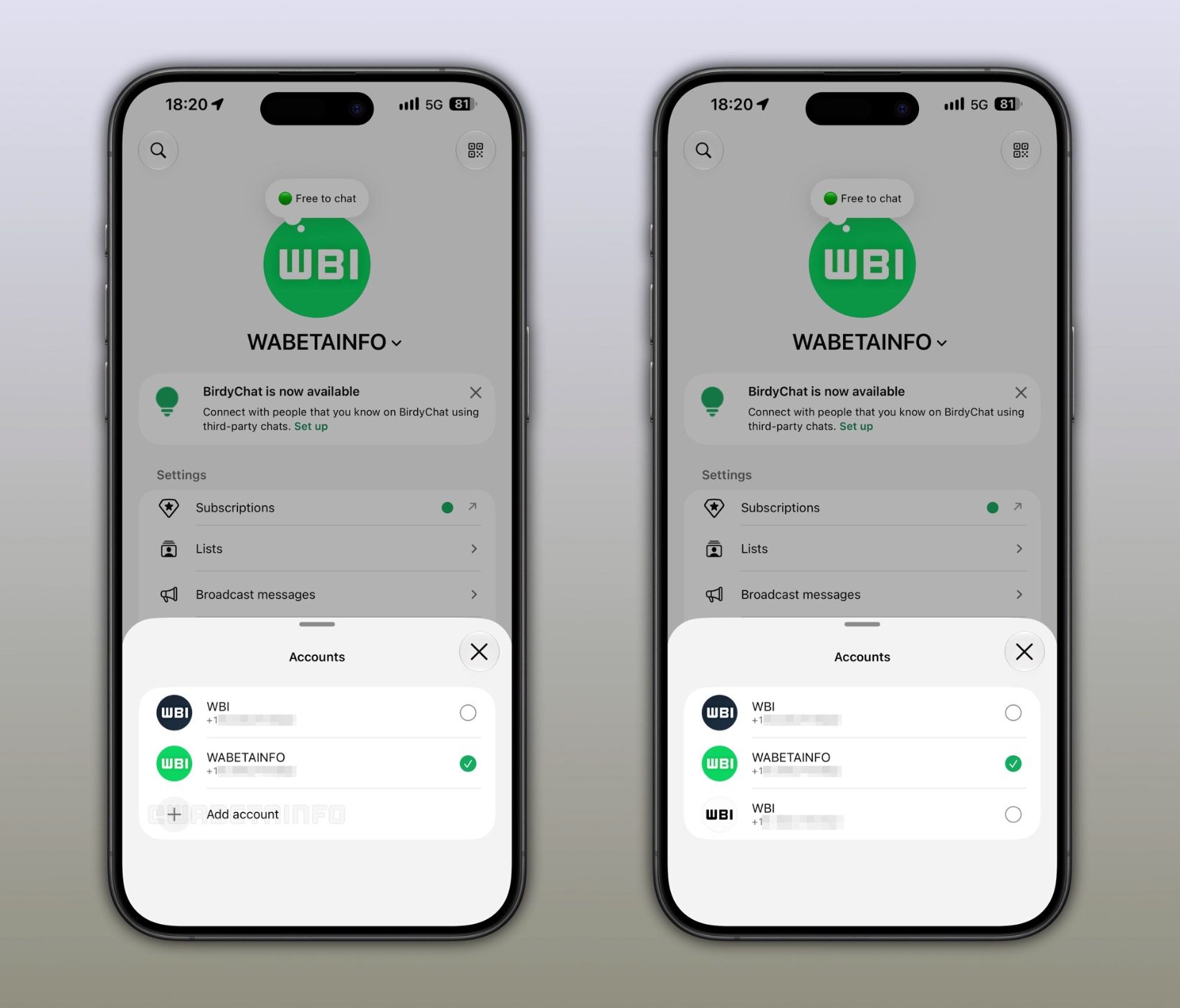
As captured in early developmental interface mocks, the platform is redesigning its account selector dropdown to accommodate a third profile slot cleanly. Rather than plateauing at two accounts, WhatsApp is recognizing that modern communication demands are increasingly granular. By moving to a three-account framework, Meta is bridging the gap between casual users and enterprise-level power users who require absolute separation between their social, professional, and public-facing digital identities.
Technical Mechanics: How the Three-Account System Operates
Building a multi-account feature within a secure, end-to-end encrypted messaging application is no trivial engineering feat. WhatsApp’s underlying architecture relies heavily on local SQLite databases, cryptographic key pairs, and push notification tokens tied to specific device-number pairs.
Interface and Account Switching
Based on structural insights provided by WABetaInfo, the visual layout for the three-account switcher remains remarkably intuitive, adhering to the clean design language established during the dual-account rollout.
- The Account Selector: When users access the profile management pane, they are presented with a clean vertical list of active profiles. Each entry clearly displays the user’s chosen display name, profile photo, and registered phone number.
- Active Status Indicators: The currently active profile is clearly demarcated by a prominent green checkmark, preventing accidental messages from being dispatched from the wrong identity.
- The "Add Account" Persistence: Even when two accounts are actively configured, the interface retains a persistent "Add account" option. Once a third account is successfully registered via SMS or voice-call verification, the interface adapts to display all three active profiles simultaneously, allowing instant, password-free switching.
Data Isolation and Privacy Boundaries
One of the primary concerns for users adopting multi-account frameworks is the potential for data cross-contamination—the terrifying prospect of sending a professional document to a family group chat, or vice versa. WhatsApp has engineered strict compartmentalization safeguards to prevent this:
- Isolated Chat Histories: Each of the three accounts maintains its own entirely separate message database. Chats, media, documents, and voice notes from Account A are strictly firewalled from Account B and Account C.
- Independent Notifications: Users can customize notification sounds, alert banners, and preview behaviors on a per-account basis. This ensures that high-priority work alerts can be audibly distinguished from casual personal chats.
- Granular Privacy Settings: Last seen timestamps, profile photo visibility, "About" info, and status privacy settings can be configured independently for each of the three numbers. A user can maintain a wide-open public profile for their business line while locking down their personal profile to strict contacts-only privacy.
- Standalone Cloud Backups: Each account links to its own designated iCloud container or Google Drive path (depending on cross-platform iterations), ensuring that message restores do not overwrite or merge separate identity archives.
Supporting Context & Market Dynamics
To understand why WhatsApp is prioritizing a three-account limit, one must examine the broader socio-technological shifts in how people manage their digital lives. The boundary between work and personal life has dissolved significantly over the past decade, yet the human desire for psychological and digital separation has never been stronger.
The Rise of the Gig Economy and Micro-Entrepreneurs
Millions of individuals worldwide operate as independent contractors, freelancers, content creators, or small business owners. For these digital-first workers, a single phone number is rarely sufficient. They typically maintain:

- A Personal Line: Reserved exclusively for close friends, family, and intimate social circles.
- A Professional/Client Line: Used for day-to-day business operations, customer service inquiries, and professional networking.
- A Niche/Project Line: Increasingly utilized for side hustles, e-commerce storefronts (such as Depop, Vinted, or local marketplace listings), or temporary community moderation roles.
Previously, managing this triad required juggling multiple devices or constantly logging in and out—a security nightmare that often resulted in missed messages and operational friction. By expanding native support to three accounts, WhatsApp directly targets this vast demographic of multi-identity professionals.
Competitive Pressures in the Messaging Ecosystem
While WhatsApp remains the undisputed global heavyweight in instant messaging—boasting over two billion active monthly users—it faces stiff competition in feature richness from alternative platforms.
- Telegram: Has long championed multi-account support, allowing users to seamlessly switch between multiple profiles on a single device with minimal performance degradation.
- Signal: Emphasizes privacy and security above all else, though its account architecture historically remained tethered to a strict single-device, single-number model, pushing privacy-conscious users to seek more flexible alternatives.
By continuously refining its feature set to match and exceed the flexibility of competitors, Meta ensures that WhatsApp remains the default communication hub for both casual conversations and professional workflows, particularly in key markets across Latin America, Europe, India, and Southeast Asia.
Official Statements & Industry Outlook
As of publication, Meta has not yet issued a formal press release or global product announcement regarding the three-account feature. This aligns with the company’s standard deployment playbook: features of this scale undergo prolonged, quiet iteration within internal development environments before graduating to closed beta rings via TestFlight for iOS and Google Play Beta for Android.
However, statements from previous multi-account rollouts emphasize Meta’s core product philosophy: reducing friction, enhancing user security, and consolidating utility within the primary application framework.

Industry analysts tracking Meta’s product roadmap suggest that the three-account rollout is a calculated stepping stone. While three accounts will satisfy the vast majority of consumer and prosumer use cases, infrastructural groundwork is reportedly being laid that could theoretically accommodate even more profiles in future software cycles, should enterprise or power-user demand warrant it.
Future Outlook: What Comes Next for WhatsApp Users?
The transition toward a robust, multi-identity messaging experience marks a mature evolution for WhatsApp. No longer just a simple SMS replacement for chatting with friends, the application has cemented its role as an indispensable utility tool powering global commerce, social networking, and professional correspondence.
Anticipated Timeline and Rollout Strategy
- Internal Testing Phase (Current): Engineers are actively squashing bugs, refining the account-switcher UI animations, and auditing database encryption boundaries to ensure zero data leakage between profiles.
- Beta Distribution (Upcoming): Within the coming weeks or months, the feature is expected to migrate to the official WhatsApp Beta program for iOS via TestFlight, allowing select external testers to stress-test the three-profile system in real-world scenarios.
- Stable Public Release (Projected): Subject to successful beta trials, a public rollout across the App Store is anticipated later in the product cycle. Android users can also reasonably expect the feature to hit their ecosystem concurrently or shortly after its iOS debut, maintaining feature parity across platforms.
Strategic Takeaways
For the everyday user, the impending arrival of three-account support represents the ultimate simplification of device management. Carrying a single iPhone while simultaneously maintaining three fully operational, secure, and isolated WhatsApp identities is a massive win for productivity and privacy. As Meta continues to push the boundaries of what a single messaging application can achieve, WhatsApp is proving that even the most deeply entrenched software architectures can adapt to meet the complex, multi-faceted demands of the modern digital citizen.